
We read your photo as:
A) Find the correlation coefficient between X and Y. X = [45, 50, 56, 62, 65, 70], Y = [65, 70, 75, 80, 90, 100]
ScanSolve AI Answer
Answers
2 partsStep-by-step solution
5 stepsHere is the solution for Question 16.
Part 16
Part a0.9664
Find the correlation coefficient between X and Y.
List the given data for X (supply) and Y (price).
The number of data points is .Calculate the sums needed for the correlation coefficient formula.
Apply the Pearson correlation coefficient formula.
The formula is:
Substitute the calculated values:
The correlation coefficient between X and Y is .
Part b107
Calculate the supply when the price of commodity is Rs. 150.
Determine the regression line equation of X on Y ().
First, calculate the slope :
Using values from part (a):
Next, calculate the means and :
Now, calculate the y-intercept :
The regression equation of X on Y is .
Calculate the supply (X) when the price (Y) is Rs.
Substitute into the regression equation:
The supply when the price of the commodity is Rs. 150 is .
Try one yourself
A new problem that tests the same skill.
Still stuck on this one?
Ask a follow-up, and the answer starts from this question.
More Mathematics Questions
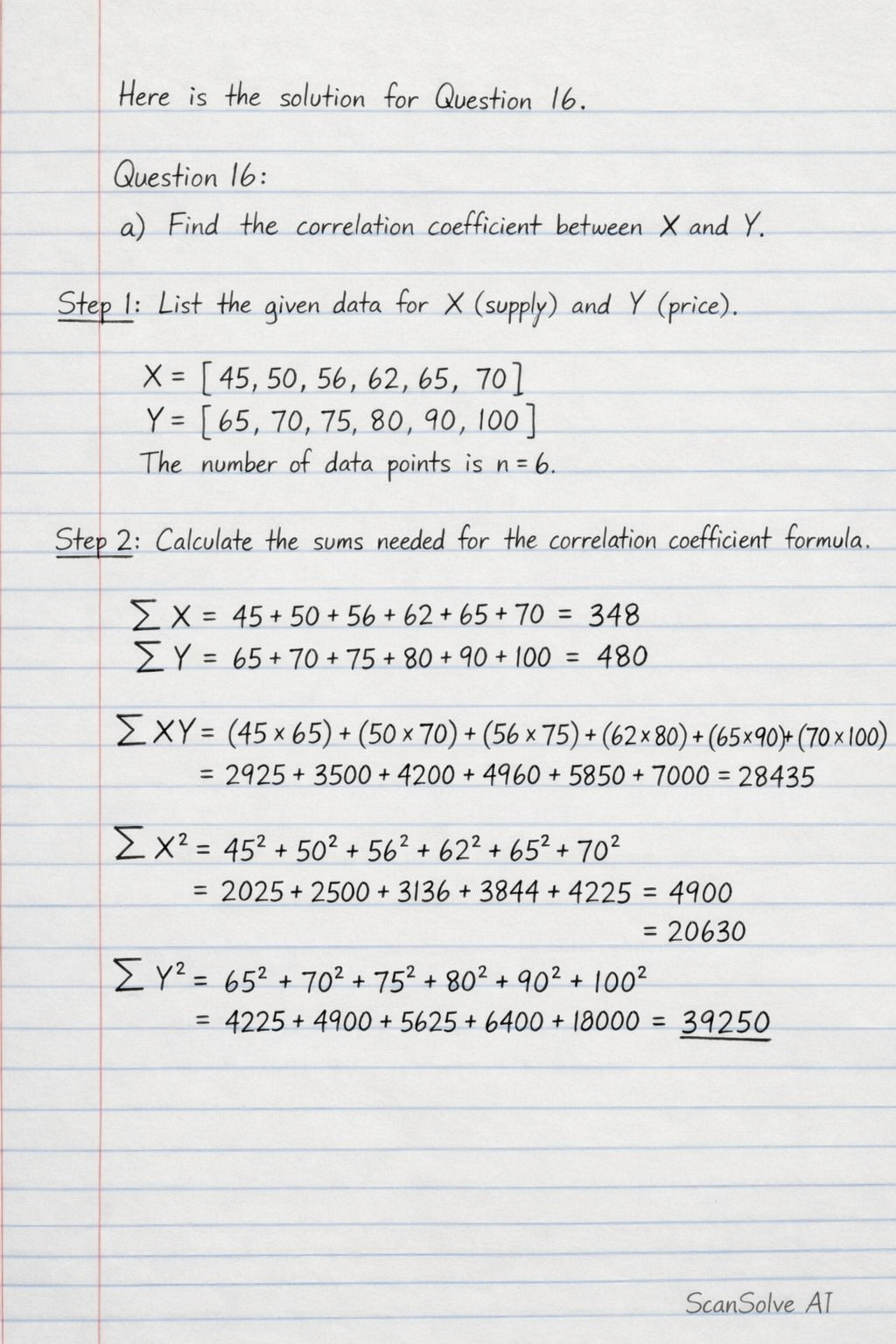
Handwritten Step-by-Step Solution
Get this as a handwritten image on WhatsApp — like a tutor wrote it for you.
Try on WhatsApp