We read your photo as:

A) Find the slant height of the cone correct to 2 decimal places. b) Find the total surface area of the solid Q correct to 4 significant figures.

Mathematics

ScanSolve AI Answer

Answers

3 parts
a

5.42 m\text{5.42 m}

b

248.3 m2\text{248.3 m}^2

c

237 m3\text{237 m}^3

Step-by-step solution

9 steps

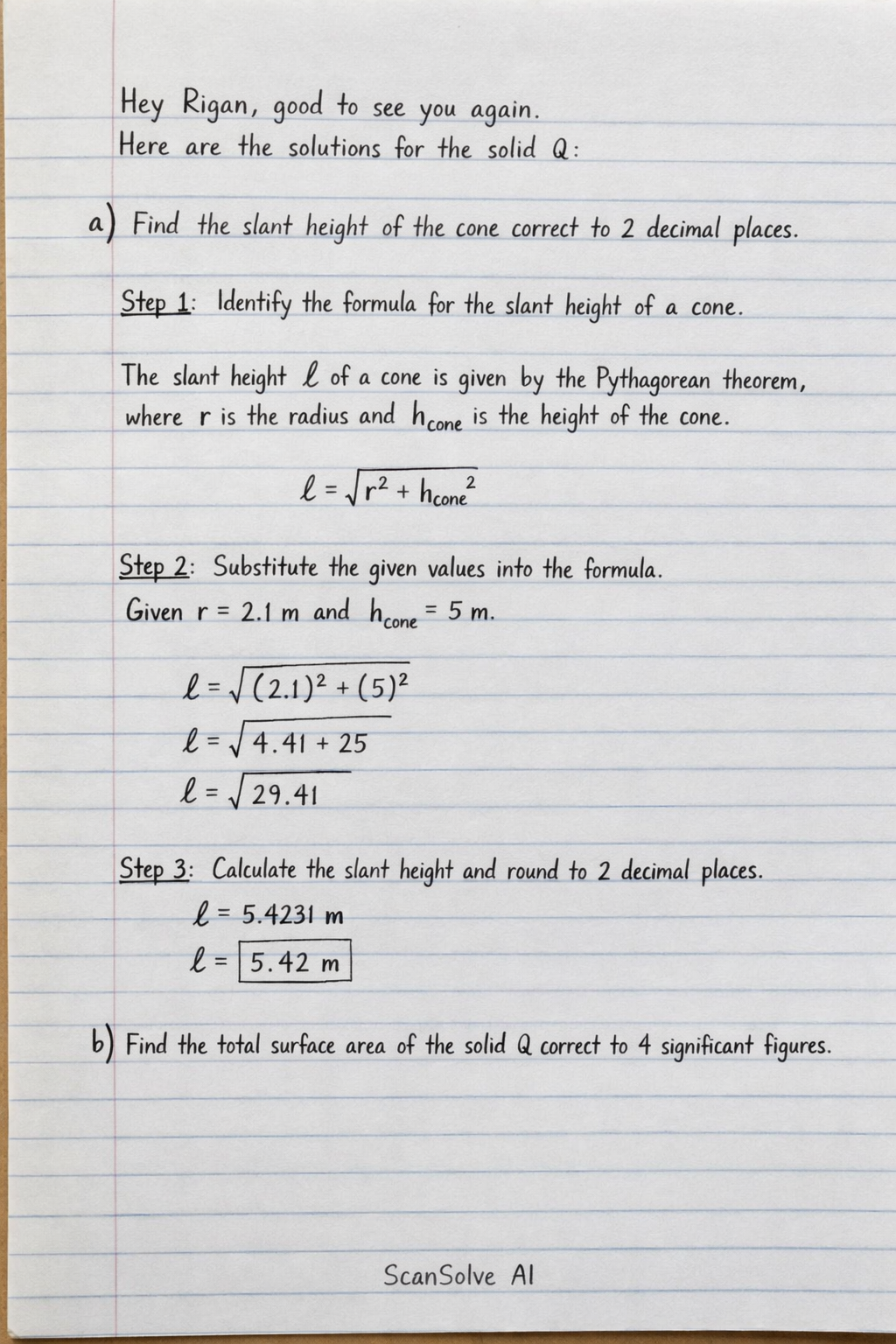
Here are the solutions for the solid Q:

Part a· 3 steps

Find the slant height of the cone correct to 2 decimal places.

  1. Identify the formula for the slant height of a cone.

    The slant height ll of a cone is given by the Pythagorean theorem, where rr is the radius and hconeh_{cone} is the height of the cone.

    l=r2+hcone2l = \sqrt{r^2 + h_{cone}^2}
  2. Substitute the given values into the formula.

    Given r=2.1r = 2.1 m and hcone=5h_{cone} = 5 m.

    l=(2.1)2+(5)2l = \sqrt{(2.1)^2 + (5)^2} l=4.41+25l = \sqrt{4.41 + 25} l=29.41l = \sqrt{29.41}
  3. Calculate the slant height and round to 2 decimal places.

    l≈5.4231 ml \approx 5.4231 \text{ m} l≈5.42 ml \approx \boxed{\text{5.42 m}}

Part b

248.3 m2\text{248.3 m}^2

Find the total surface area of the solid Q correct to 4 significant figures.

  1. Identify the components of the total surface area.

    The total surface area (TSA) of the solid Q is the sum of the surface area of the hemisphere, the lateral surface area of the cylinder, and the lateral surface area of the cone.

    TSA=(Area of hemisphere)+(Lateral area of cylinder)+(Lateral area of cone)TSA = (\text{Area of hemisphere}) + (\text{Lateral area of cylinder}) + (\text{Lateral area of cone}) TSA=2πr2+2πrhc+πrlTSA = 2\pi r^2 + 2\pi r h_c + \pi r l

    We can factor out πr\pi r:

    TSA=πr(2r+2hc+l)TSA = \pi r (2r + 2h_c + l)
  2. Substitute the given values and the calculated slant height into the formula.

    Given r=2.1r = 2.1 m, hc=14h_c = 14 m, π=227\pi = \frac{22}{7}, and l≈5.4231l \approx 5.4231 m (using the unrounded value for accuracy).

    TSA=227×2.1×(2×2.1+2×14+5.4231)TSA = \frac{22}{7} \times 2.1 \times (2 \times 2.1 + 2 \times 14 + 5.4231) TSA=6.6×(4.2+28+5.4231)TSA = 6.6 \times (4.2 + 28 + 5.4231) TSA=6.6×(37.6231)TSA = 6.6 \times (37.6231)
  3. Calculate the total surface area and round to 4 significant figures.

    TSA≈248.31246 m2TSA \approx 248.31246 \text{ m}^2 TSA≈248.3 m2TSA \approx \boxed{\text{248.3 m}^2}

Part c

237 m3\text{237 m}^3

Find the volume of solid Q to the nearest metres.

  1. Identify the components of the total volume.

    The total volume (V) of the solid Q is the sum of the volume of the hemisphere, the volume of the cylinder, and the volume of the cone.

    V=(Volume of hemisphere)+(Volume of cylinder)+(Volume of cone)V = (\text{Volume of hemisphere}) + (\text{Volume of cylinder}) + (\text{Volume of cone}) V=23πr3+πr2hc+13πr2hconeV = \frac{2}{3}\pi r^3 + \pi r^2 h_c + \frac{1}{3}\pi r^2 h_{cone}

    We can factor out πr2\pi r^2:

    V=πr2(23r+hc+13hcone)V = \pi r^2 \left(\frac{2}{3}r + h_c + \frac{1}{3}h_{cone}\right)
  2. Substitute the given values into the formula.

    Given r=2.1r = 2.1 m, hc=14h_c = 14 m, hcone=5h_{cone} = 5 m, and π=227\pi = \frac{22}{7}.

    V=227×(2.1)2×(23×2.1+14+13×5)V = \frac{22}{7} \times (2.1)^2 \times \left(\frac{2}{3} \times 2.1 + 14 + \frac{1}{3} \times 5\right) V=227×4.41×(1.4+14+53)V = \frac{22}{7} \times 4.41 \times \left(1.4 + 14 + \frac{5}{3}\right) V=13.86×(15.4+1.6666...)V = 13.86 \times \left(15.4 + 1.6666...\right) V=13.86×(17.0666...)V = 13.86 \times \left(17.0666...\right)
  3. Calculate the total volume and round to the nearest metre.

    V≈236.5824 m3V \approx 236.5824 \text{ m}^3 V≈237 m3V \approx \boxed{\text{237 m}^3}
Was this helpful?

Try one yourself

A new problem that tests the same skill.

Still stuck on this one?

Ask a follow-up, and the answer starts from this question.

Got a different question?Ask your own question
Handwritten step-by-step solution preview

Handwritten Step-by-Step Solution

Get this as a handwritten image on WhatsApp — like a tutor wrote it for you.

Try on WhatsApp