
We read your photo as:
A flower pot in the form of a frustum of a cone. The diameters of the top and bottom ends are 64cm and 48cm respectively. If the slanting height is 15m, calculate (a) volume (b) TSA
ScanSolve AI Answer
Answers
2 partsStep-by-step solution
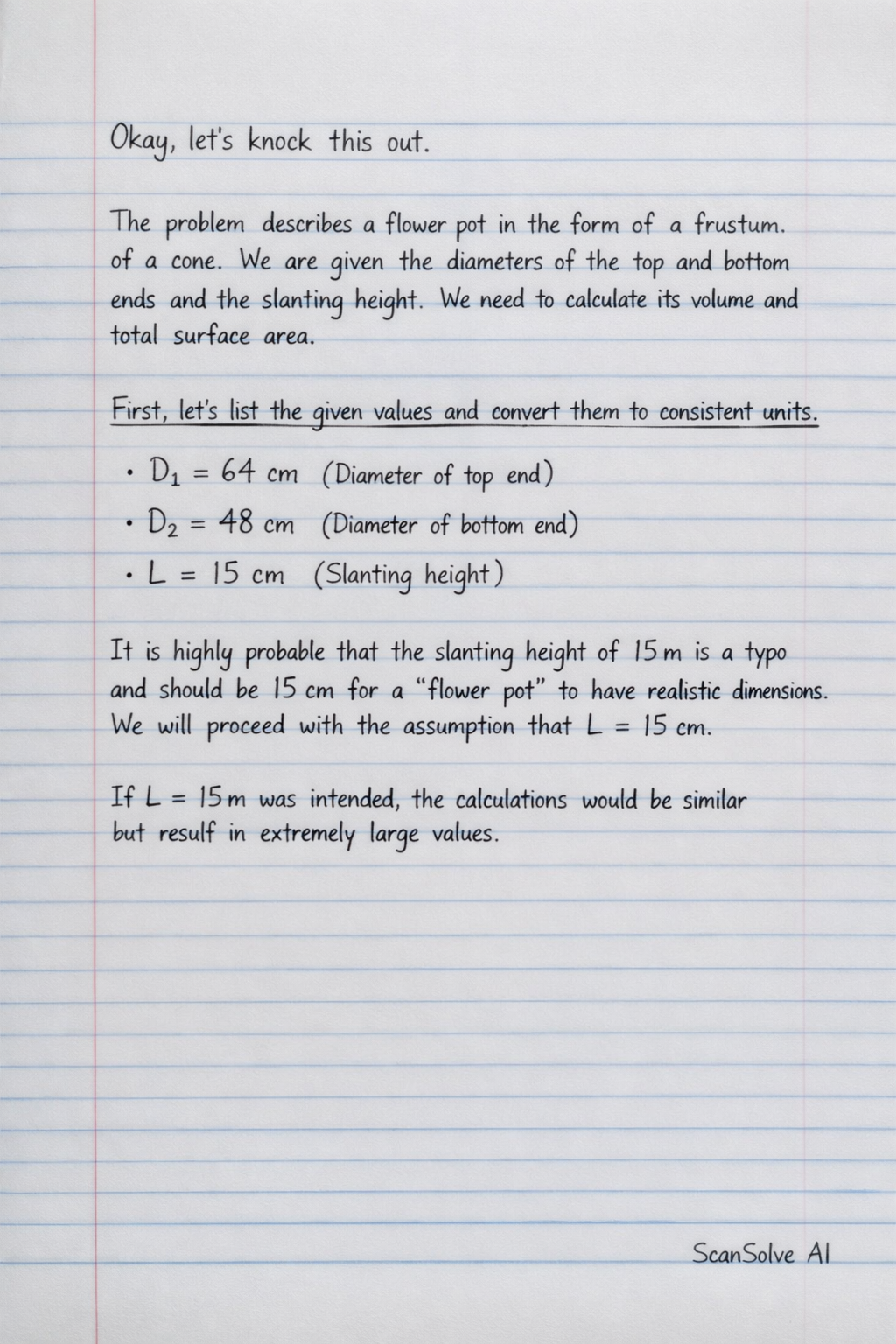
2 stepsThe problem describes a flower pot in the form of a frustum of a cone. We are given the diameters of the top and bottom ends and the slanting height. We need to calculate its volume and total surface area.
First, let's list the given values and convert them to consistent units.
Diameter of the top end () =
Diameter of the bottom end () =
Slanting height () =
It is highly probable that the slanting height of is a typo and should be for a "flower pot" to have realistic dimensions. We will proceed with the assumption that . If was intended, the calculations would be similar but result in extremely large values.
Step 1: Convert given diameters to radii and ensure consistent units.
Radius of the top end () =
Radius of the bottom end () =
Slanting height () = (Assumption: was a typo and should be )
Step 2: Calculate the perpendicular height () of the frustum.
The relationship between the slant height, perpendicular height, and radii is given by the Pythagorean theorem:
Part a· 1 step
Calculate the Volume
Use the formula for the volume of a frustum.
The volume () of a frustum is given by:
Substitute the values:
Using and :
Rounding to two decimal places:
Part b
Calculate the Total Surface Area (TSA)
Use the formula for the total surface area of a frustum.
The total surface area (TSA) of a frustum is the sum of the curved surface area (CSA) and the areas of the top and bottom circular bases.
Substitute the values:
Using :
Rounding to two decimal places:
Try one yourself
A new problem that tests the same skill.
Still stuck on this one?
Ask a follow-up, and the answer starts from this question.
More Mathematics Questions
Handwritten Step-by-Step Solution
Get this as a handwritten image on WhatsApp — like a tutor wrote it for you.
Try on WhatsApp