
We read your photo as:
A man walks 5 km due north and then 4 km due west. What is his bearing from his starting point?
ScanSolve AI Answer
Answer
Step-by-step solution
4 stepsSketch the path and identify the points.
Let point A be the origin.
The man walks due north from A to an intermediate point, let's call it B. So, the coordinates of B relative to A are .
From B, he walks due west to point C. So, the coordinates of C relative to B are .
Therefore, the coordinates of C relative to A are .
This movement forms a right-angled triangle , with the right angle at B.
The length of side AB is (north).
The length of side BC is (west).Calculate the angle at A.
We need to find the angle , which is the angle between the North line (AB) and the line segment AC.
In the right-angled triangle :Calculate the value of the angle.
Determine the bearing of C from A.
Point C is located North-West of point A. The angle is the angle measured from the North line (AB) towards the West.
Bearings are measured clockwise from the North line ().
For a point in the North-West quadrant, the bearing is minus the angle measured from the North line towards the West.Rounding to one decimal place, the bearing is .
Try one yourself
A new problem that tests the same skill.
Still stuck on this one?
Ask a follow-up, and the answer starts from this question.
More Mathematics Questions
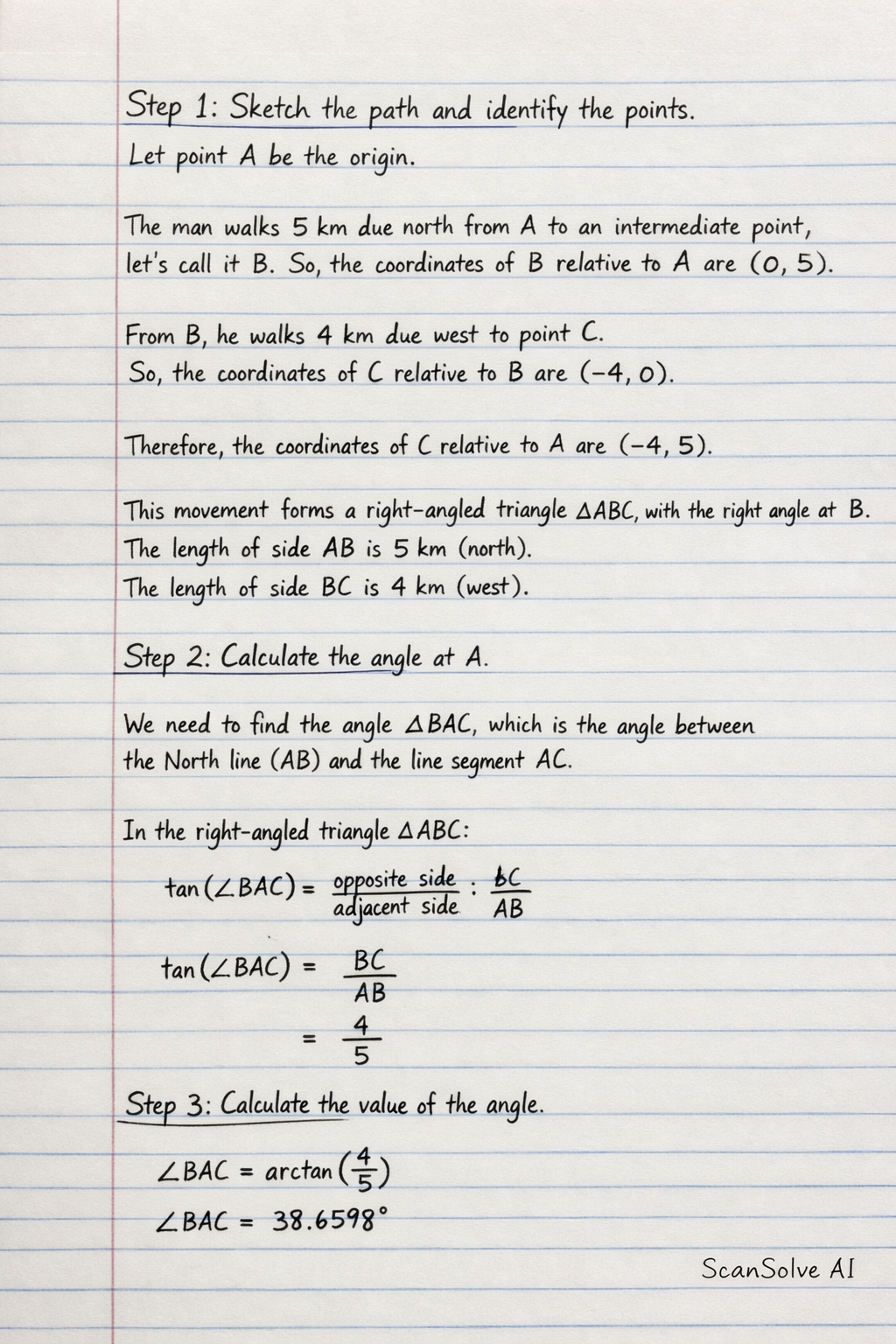
Handwritten Step-by-Step Solution
Get this as a handwritten image on WhatsApp — like a tutor wrote it for you.
Try on WhatsApp