
We read your photo as:
A mobile phone company offers two plans: Option A and Option B. The cost for Option A includes a fixed monthly fee plus a per-minute charge. The cost for Option B is purely a per-minute charge. The ta
ScanSolve AI Answer
Step-by-step solution
10 stepsPart a
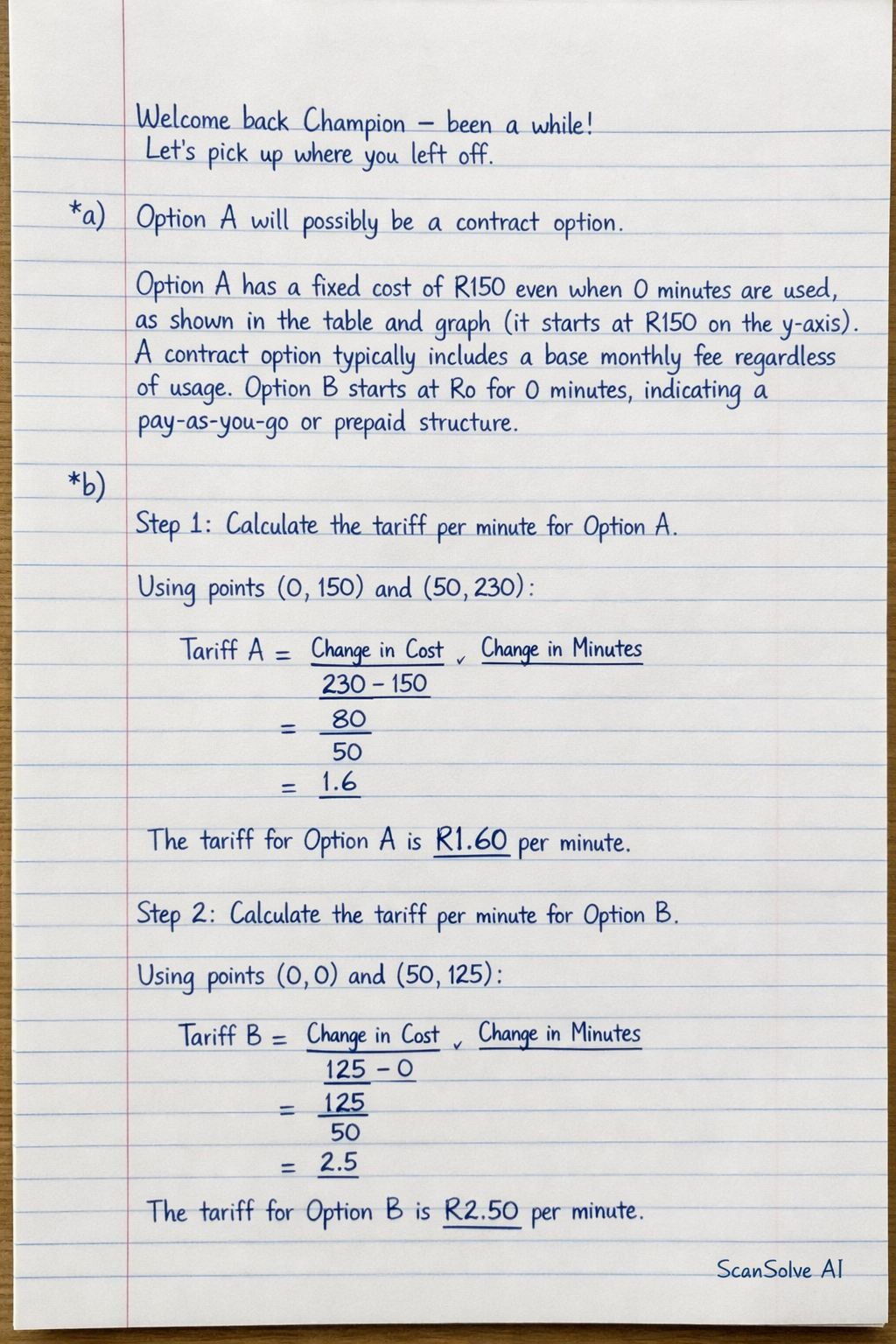
Option A will possibly be a contract option.
Option A has a fixed cost of R150 even when 0 minutes are used, as shown in the table and graph (it starts at R150 on the y-axis). A contract option typically includes a base monthly fee regardless of usage. Option B starts at R0 for 0 minutes, indicating a pay-as-you-go or prepaid structure.
Part b· 2 steps
Calculate the tariff per minute for Option A.
Using points and from the table:
The tariff for Option A is R1.60 per minute.
Calculate the tariff per minute for Option B.
Using points and from the table:
The tariff for Option B is R2.50 per minute.
Part c· 2 steps
Write the equation for Option A.
The general form is , where is total cost, is minutes, is the tariff per minute, and is the fixed cost.
For Option A, and .Write the equation for Option B.
For Option B, and .
Part d· 3 steps
Calculate the cost for Option A for 100 minutes.
Substitute into the equation for Option A:
The cost for Option A is R310.
Calculate the cost for Option B for 100 minutes.
Substitute into the equation for Option B:
The cost for Option B is R250.
Compare the costs.
Since R250 < R310, Option B will be the cheapest option for 100 minutes of calls.
Part e· 3 steps
Set the costs equal to find the intersection point.
Option A becomes cheaper than Option B when . The point where they are equal is the intersection:
Solve for .
So, approximately 167 minutes.
Calculate the cost at this number of minutes.
Using in either equation:
At approximately , Option A becomes cheaper than Option B.
Still stuck on this one?
Ask a follow-up, and the answer starts from this question.
More Mathematics Questions
Handwritten Step-by-Step Solution
Get this as a handwritten image on WhatsApp — like a tutor wrote it for you.
Try on WhatsApp