
We read your photo as:
Find the derivation of the following with respect to x using first principle and find the value of the following limits.
Mathematics
ScanSolve AI Answer
Answer
Step-by-step solution
4 stepsHere's how to find the derivative of using the first principle.
State the definition of the derivative using the first principle.
The derivative is defined as:
Substitute and into the definition and simplify the numerator.
Given , we find .
Expand :
Distribute the negative sign and combine like terms in the numerator:
Factor out from the numerator and cancel it with the denominator.
Since but , we can cancel :
Evaluate the limit by substituting .
Was this helpful?
Still stuck on this one?
Ask a follow-up, and the answer starts from this question.
Got a different question?Ask your own question
More Mathematics Questions
QFind the derivative of the following with respect to x using first principles. Find the values of…QAssignment on Differentiation, find the derivation of the following with x using first principle: 1…QFind the derivatives of the following functions using first principles: f(x) = x3 and f(x)…QFind the derivation of each of the following expressions. a. 3x 2+2x+3 / 2x2 b. (3x+2)(x−2) c…QFind the derivative of y with respect to x for the given functions and evaluate the limit.
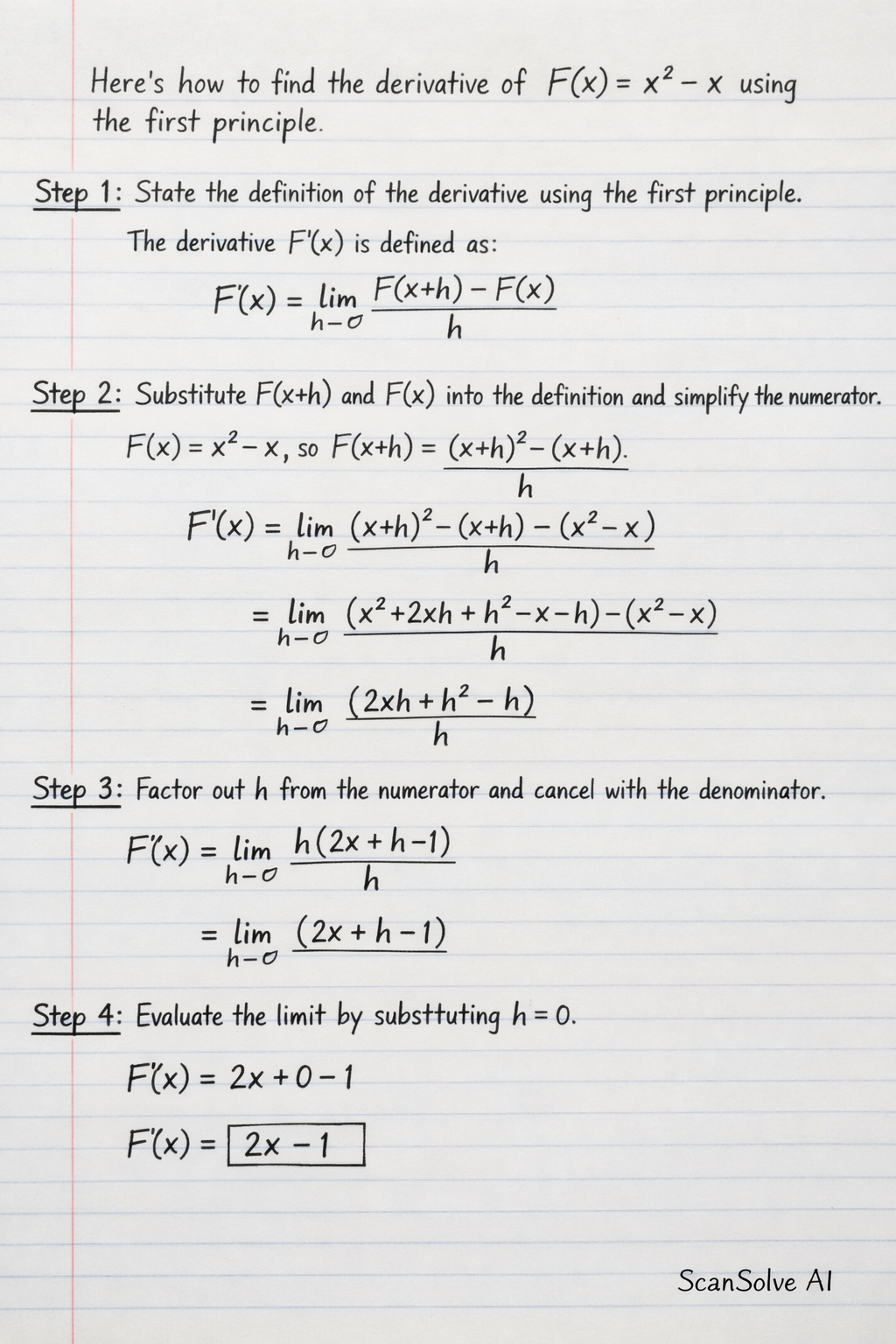
Handwritten Step-by-Step Solution
Get this as a handwritten image on WhatsApp — like a tutor wrote it for you.
Try on WhatsApp