
We read your photo as:
A parabola is defined by the equation f(x) = (x−4)2 − 9. Find the turning point E, the x-intercept A (with the smaller x-value), the y-intercept C, and the reflection M of C in the axis of symmetry. T
ScanSolve AI Answer
Answers
6 parts4.1
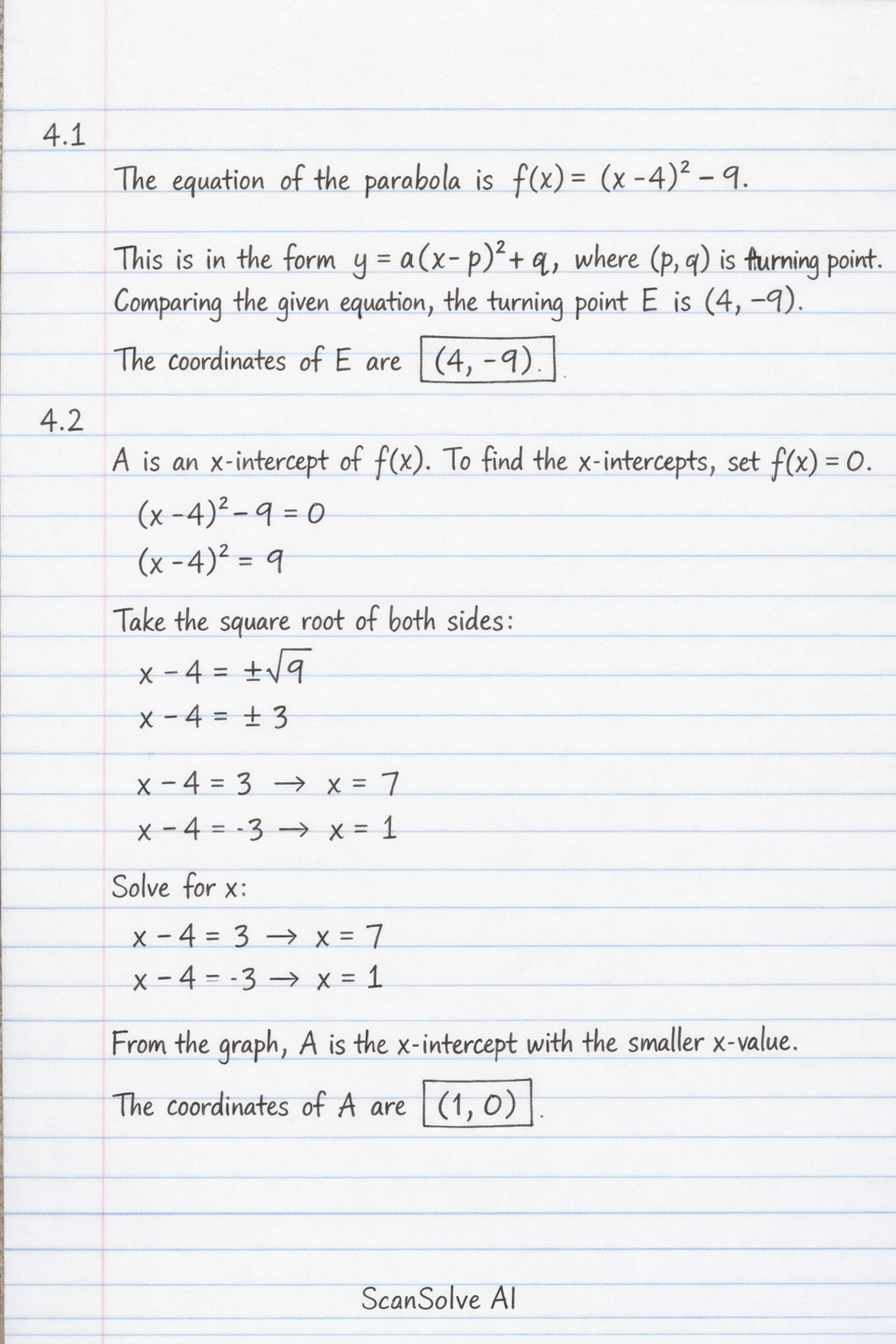
The equation of the parabola is .
This is in the form , where is the turning point.
Comparing the given equation, the turning point E is .
The coordinates of E are .
4.2
A is an x-intercept of . To find the x-intercepts, set .
Take the square root of both sides:
Solve for :
From the graph, A is the x-intercept with the smaller x-value.
The coordinates of A are .
4.3
First, find the coordinates of C. C is the y-intercept of . Set .
So, C is .
The axis of symmetry of is the vertical line (the x-coordinate of the turning point).
M is the reflection of C in the line .
The x-coordinate of C is 0. The distance from C to the axis of symmetry () is units.
The x-coordinate of M will be .
The y-coordinate remains the same during reflection across a vertical line.
The coordinates of M are .
4.4
The equation of line is in the form .
C is the y-intercept of and . From 4.3, C is . So, .
The equation of is .
D is the x-intercept of .
DE is parallel to the y-axis, which means D and E have the same x-coordinate.
From 4.1, E is . So, the x-coordinate of D is 4.
Since D is an x-intercept, its y-coordinate is 0.
So, D is .
Now, calculate the gradient using points C and D:
The equation of is .
4.5
To find the inverse function , swap and in the equation for and solve for .
The equation of is .
Swap and :
Subtract 7 from both sides:
Multiply by :
The equation of is .
4.6
We need to find the values of for which .
This inequality holds true if:
- AND
- AND
From 4.2, the x-intercepts of are (point A) and (point B).
Since is an upward-opening parabola, when is between or equal to the x-intercepts.
So, for .
And for or .
Now, let's apply these to the two cases:
Case 1: AND
This means AND .
The intersection of these two conditions is .
Case 2: AND
This means AND ( or ).
The intersection of these two conditions is .
Combining the results from Case 1 and Case 2, the values of for which are:
.
Try one yourself
A new problem that tests the same skill.
Still stuck on this one?
Ask a follow-up, and the answer starts from this question.
More Mathematics Questions
Handwritten Step-by-Step Solution
Get this as a handwritten image on WhatsApp — like a tutor wrote it for you.
Try on WhatsApp