
We read your photo as:
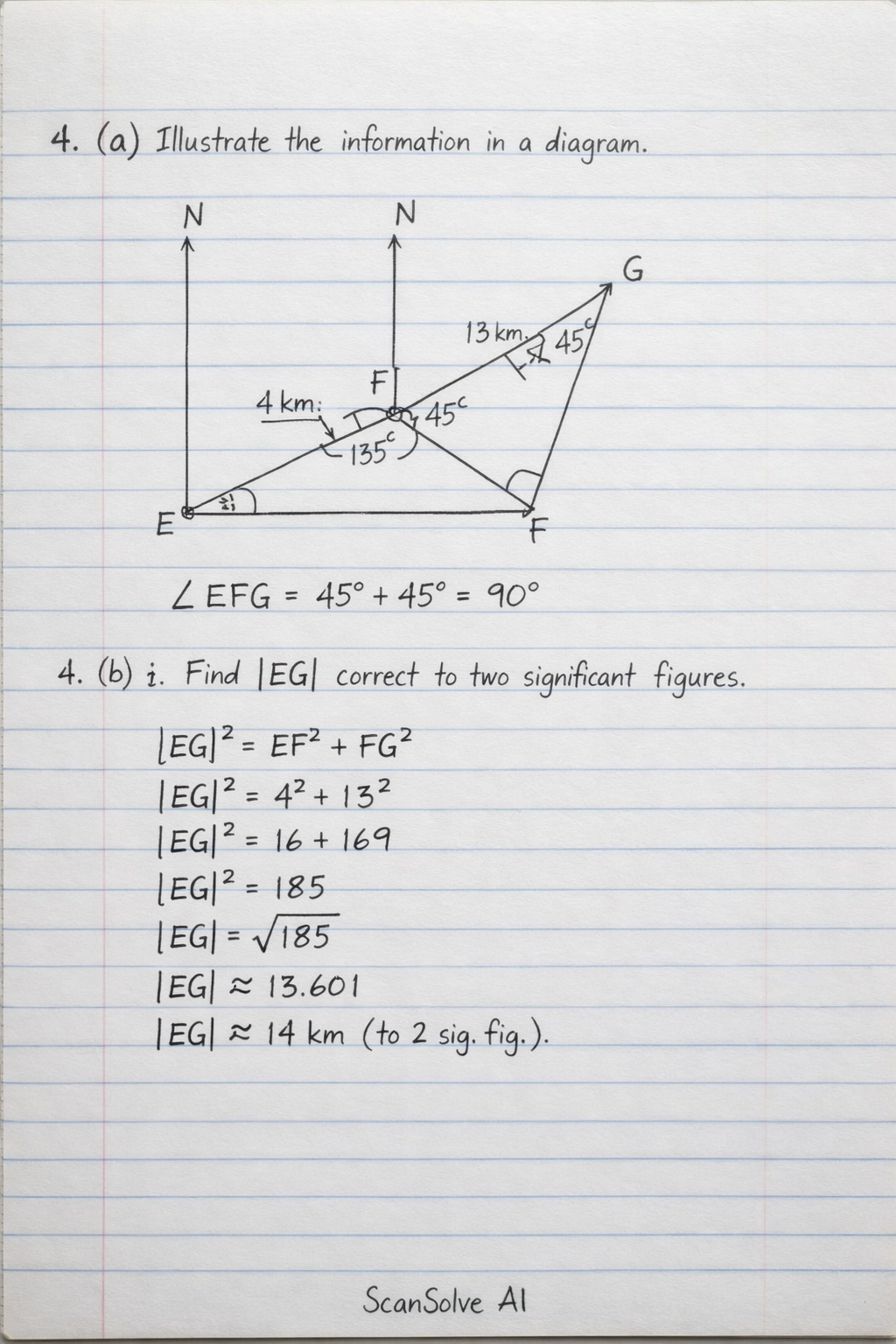
A person travels from point E to point F, a distance of 4 km on a bearing of 135°. Then, the person travels from point F to point G, a distance of 13 km on a bearing of 45°. Draw a diagram of the jour
ScanSolve AI Answer
Step-by-step solution
8 steps4. (a) Illustrate the information in a diagram.
A diagram showing the journey:
- Start at point E. Draw a North line vertically upwards from E.
- From E, draw a line segment EF, 4 km long, at an angle of clockwise from the North line. Point F is the end of this segment.
- From point F, draw another North line vertically upwards, parallel to the first North line.
- From F, draw a line segment FG, 13 km long, at an angle of clockwise from the North line at F. Point G is the end of this segment.
- Connect points E and G to form triangle EFG.
The angle can be determined from the bearings. The bearing of F from E is . The angle between the North line at F and the line FE (pointing towards E) is (alternate interior angles with the bearing from E, considering the line from F to E). The bearing of G from F is . Therefore, the interior angle .
4. (b) i. Find correct to two significant figures.
Identify the sides and angle of triangle EFG.
We have km, km, and .
Use the cosine rule to find $|EG|$.
Since , we can use the Pythagorean theorem.
Calculate $|EG|$ and round to two significant figures.
Correct to two significant figures, is .
4. (b) ii. The bearing of G from F.
Read the information directly from the problem statement.
The problem states: "He continues 13km on a bearing of 045° to G." This means the bearing of G from F is .
The bearing of G from F is .5. (a) The midpoint of the line joining and is . Find the values of and .
Use the midpoint formula for the x-coordinate.
The x-coordinate of the midpoint is .
Use the midpoint formula for the y-coordinate.
The y-coordinate of the midpoint is .
Substitute the value of found in Step 1 into the equation from Step 2 and solve for .
The values are .
5. (b) Find .
Determine the coordinates of points Y and Z using the values of and .
$Z
Still stuck on this one?
Ask a follow-up, and the answer starts from this question.
More Mathematics Questions
Handwritten Step-by-Step Solution
Get this as a handwritten image on WhatsApp — like a tutor wrote it for you.
Try on WhatsApp