
We read your photo as:
A pie chart shows the total livestock population in millions. If buffalo comprise 20.45% and beef cattle comprise 24.9% of the total 34.736 million livestock, with cattle making up 35.94% of the total
ScanSolve AI Answer
Answers
3 partsStep-by-step solution
9 stepshere are the answers to Question 3:
Part 3.1· 3 steps
Identify the total livestock population from the pie chart.
Total livestock population = 34.736 million.
Identify the percentage of buffalo from the pie chart.
Percentage of buffalo = .
Calculate the actual number of the buffalo population.
Rounding to three decimal places:
The actual number of the buffalo population is .
Part 3.2
An example of livestock that can be classified as OTHER is chickens (or poultry).
Part 3.30.693
Identify the percentage of beef cattle from the pie chart.
Percentage of beef cattle = .
Identify the total percentage of cattle from the pie chart.
Total percentage of cattle = .
Determine the probability of randomly selecting beef cattle from the percentage cattle livestock population.
Rounding to three decimal places:
The probability is .
Part 3.4
This is a statement providing information for the next question.
Part 3.5
Identify the total livestock population in November 2019.
Total livestock population in November 2019 = 34.736 million.
Identify the percentage increase between November 2019 and November 2020.
Percentage increase = .
Calculate the total livestock population in November 2020.
Rounding to three decimal places:
The total livestock population in November 2020 is .
Try one yourself
A new problem that tests the same skill.
Still stuck on this one?
Ask a follow-up, and the answer starts from this question.
More Mathematics Questions
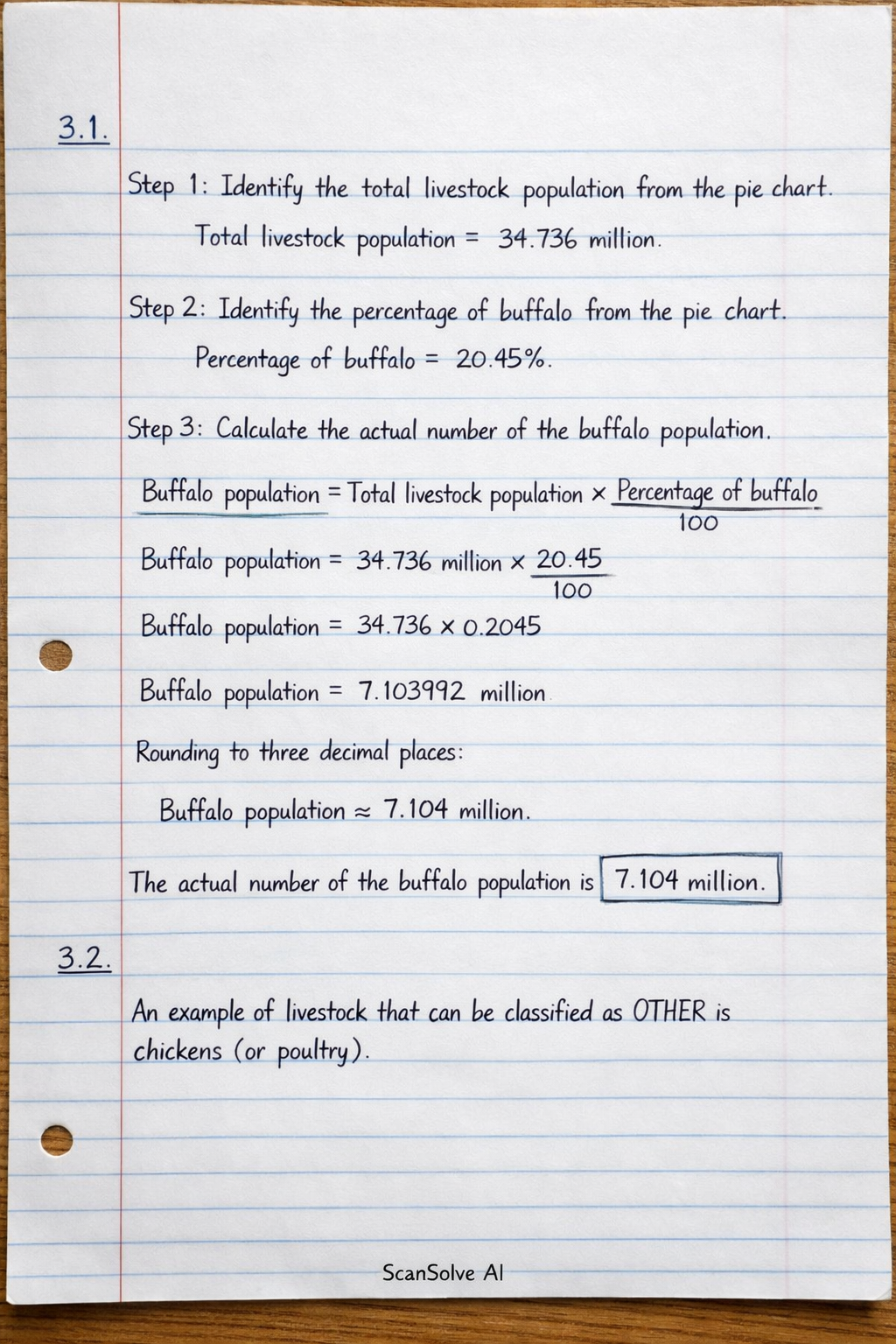
Handwritten Step-by-Step Solution
Get this as a handwritten image on WhatsApp — like a tutor wrote it for you.
Try on WhatsApp