
We read your photo as:
A point P(2, 3) is mapped onto P(-7, 0) under an enlargement with scale factor of -2. Without drawing, find the centre of enlargement.
ScanSolve AI Answer
Step-by-step solution
7 stepshere are the solutions to the next problems:
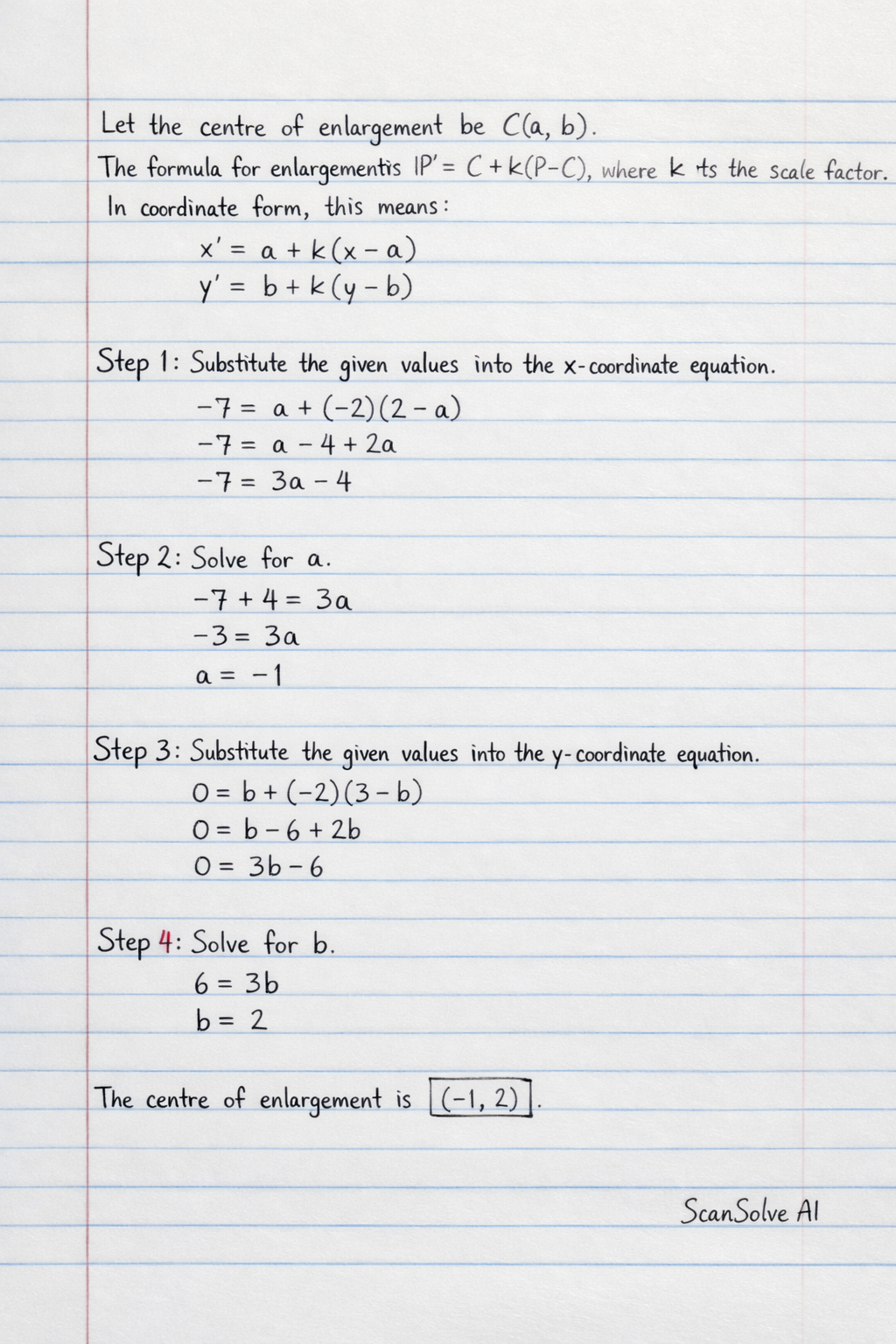
9. A point P(2, 3) is mapped onto P'(-7, 0) under an enlargement with scale factor of -2. Without drawing, find the centre of enlargement.
Let the centre of enlargement be .
The formula for enlargement is , where is the scale factor.
In coordinate form, this means:
Substitute the given values into the x-coordinate equation.
Given , , and .
Solve for .
Substitute the given values into the y-coordinate equation.
Solve for .
The centre of enlargement is .
10. The present age of a father is 10 years more than twice the present age of his son. In how many years time will the age of the father be twice the age of the son.
Let be the father's current age and be the son's current age.Formulate the first equation based on the present ages.
"The present age of a father is 10 years more than twice the present age of his son."
Formulate the second equation based on future ages.
Let be the number of years from now when the father's age will be twice the son's age.
In years, the father's age will be .
In years, the son's age will be .
"In how many years time will the age of the father be twice the age of the son."Substitute equation (1) into equation (2) and solve for .
Subtract from both sides:
Subtract from both sides:
The age of the father will be twice the age of the son in .
11. A triangular prism ABCDEF with the cross section ABF is such that AB = 3cm, BF = 5.5cm and AF = 4cm. The length of the prism is 6cm. Draw the net of the solid.
As an AI, I cannot physically draw the net. However, I can describe the components and their dimensions, which would allow you to draw it.A triangular prism consists of two identical triangular bases and three rectangular lateral faces.
The cross-section is triangle ABF, so the two triangular bases are and .
The dimensions of the triangular bases are:- Side
- Side
- Side
The length of the prism is , which is the height of the rectangular faces.
The three rectangular lateral faces are:- Rectangle : with dimensions .
- Rectangle : with dimensions .
- Rectangle : with dimensions .
To draw the net, you would typically lay out the three rectangular faces side-by-side, sharing edges. For example, you could place the rectangle, then attach the rectangle to its side, and then attach the rectangle to the side of the second rectangle. Finally, attach the two triangular bases (with sides , , ) to the side of the first rectangle and the side of the third rectangle, respectively.
Still stuck on this one?
Ask a follow-up, and the answer starts from this question.
More Mathematics Questions
Handwritten Step-by-Step Solution
Get this as a handwritten image on WhatsApp — like a tutor wrote it for you.
Try on WhatsApp