We read your photo as:

Enlarge the quadrilateral PQRS with center of enlargement C(2, 1) and scale factor -1/2. The coordinates of P, Q, R, and S are (-3, 1), (-1, 3), (2, -2), and (-2, -2) respectively.

Mathematics

ScanSolve AI Answer

Answer

P'(4.5, 1), Q'(3.5, 0), R'(2, 2.5), S'(4, 2.5)

Step-by-step solution

4 steps

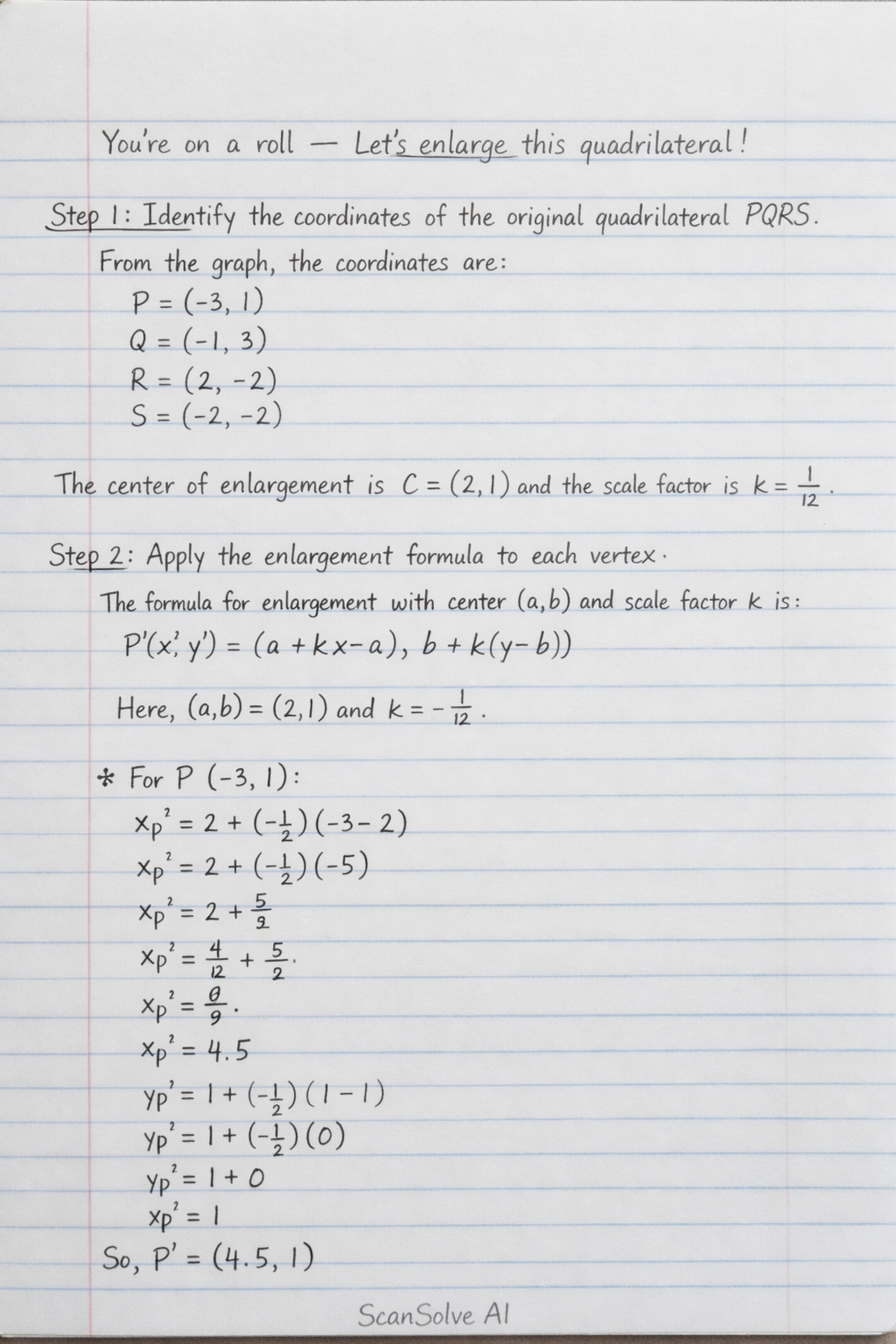
Let's enlarge this quadrilateral!

  1. Identify the coordinates of the original quadrilateral PQRS.

    From the graph, the coordinates are:

    • P=(−3,1)P = (-3, 1)
    • Q=(−1,3)Q = (-1, 3)
    • R=(2,−2)R = (2, -2)
    • S=(−2,−2)S = (-2, -2)

    The center of enlargement is C=(2,1)C = (2, 1) and the scale factor is k=−12k = -\frac{1}{2}.

  2. Apply the enlargement formula to each vertex.

    The formula for enlargement with center (a,b)(a,b) and scale factor kk is P′(x′,y′)=(a+k(x−a),b+k(y−b))P'(x', y') = (a + k(x-a), b + k(y-b)).
    Here, (a,b)=(2,1)(a,b) = (2,1) and k=−12k = -\frac{1}{2}.

    • For P (−3,1)(-3, 1): xP′=2+(−12)(−3−2)=2+(−12)(−5)=2+52=42+52=92=4.5x_P' = 2 + \left(-\frac{1}{2}\right)(-3 - 2) = 2 + \left(-\frac{1}{2}\right)(-5) = 2 + \frac{5}{2} = \frac{4}{2} + \frac{5}{2} = \frac{9}{2} = 4.5 yP′=1+(−12)(1−1)=1+(−12)(0)=1+0=1y_P' = 1 + \left(-\frac{1}{2}\right)(1 - 1) = 1 + \left(-\frac{1}{2}\right)(0) = 1 + 0 = 1 So, P′=(4.5,1)P' = (4.5, 1)

    • For Q (−1,3)(-1, 3): xQ′=2+(−12)(−1−2)=2+(−12)(−3)=2+32=42+32=72=3.5x_Q' = 2 + \left(-\frac{1}{2}\right)(-1 - 2) = 2 + \left(-\frac{1}{2}\right)(-3) = 2 + \frac{3}{2} = \frac{4}{2} + \frac{3}{2} = \frac{7}{2} = 3.5 yQ′=1+(−12)(3−1)=1+(−12)(2)=1−1=0y_Q' = 1 + \left(-\frac{1}{2}\right)(3 - 1) = 1 + \left(-\frac{1}{2}\right)(2) = 1 - 1 = 0 So, Q′=(3.5,0)Q' = (3.5, 0)

    • For R (2,−2)(2, -2): xR′=2+(−12)(2−2)=2+(−12)(0)=2+0=2x_R' = 2 + \left(-\frac{1}{2}\right)(2 - 2) = 2 + \left(-\frac{1}{2}\right)(0) = 2 + 0 = 2 yR′=1+(−12)(−2−1)=1+(−12)(−3)=1+32=22+32=52=2.5y_R' = 1 + \left(-\frac{1}{2}\right)(-2 - 1) = 1 + \left(-\frac{1}{2}\right)(-3) = 1 + \frac{3}{2} = \frac{2}{2} + \frac{3}{2} = \frac{5}{2} = 2.5 So, R′=(2,2.5)R' = (2, 2.5)

    • For S (−2,−2)(-2, -2): xS′=2+(−12)(−2−2)=2+(−12)(−4)=2+2=4x_S' = 2 + \left(-\frac{1}{2}\right)(-2 - 2) = 2 + \left(-\frac{1}{2}\right)(-4) = 2 + 2 = 4 yS′=1+(−12)(−2−1)=1+(−12)(−3)=1+32=22+32=52=2.5y_S' = 1 + \left(-\frac{1}{2}\right)(-2 - 1) = 1 + \left(-\frac{1}{2}\right)(-3) = 1 + \frac{3}{2} = \frac{2}{2} + \frac{3}{2} = \frac{5}{2} = 2.5 So, S′=(4,2.5)S' = (4, 2.5)

  3. List the coordinates of the enlarged quadrilateral P'Q'R'S'.

    The new coordinates are:

    • P′=(4.5,1)P' = (4.5, 1)
    • Q′=(3.5,0)Q' = (3.5, 0)
    • R′=(2,2.5)R' = (2, 2.5)
    • S′=(4,2.5)S' = (4, 2.5)
  4. Draw the quadrilateral P'Q'R'S'.

    To draw the quadrilateral, plot the points P′(4.5,1)P'(4.5, 1), Q′(3.5,0)Q'(3.5, 0), R′(2,2.5)R'(2, 2.5), and S′(4,2.5)S'(4, 2.5) on the same graph paper. Then, connect the points in order: P′P' to Q′Q', Q′Q' to R′R', R′R' to S′S', and S′S' to P′P'.

    The coordinates of the enlarged quadrilateral are P′(4.5,1),Q′(3.5,0),R′(2,2.5),S′(4,2.5)P'(4.5, 1), Q'(3.5, 0), R'(2, 2.5), S'(4, 2.5).

Was this helpful?

Try one yourself

A new problem that tests the same skill.

Still stuck on this one?

Ask a follow-up, and the answer starts from this question.

Got a different question?Ask your own question
Handwritten step-by-step solution preview

Handwritten Step-by-Step Solution

Get this as a handwritten image on WhatsApp — like a tutor wrote it for you.

Try on WhatsApp