
We read your photo as:
A quadratic equation is given by x2 + (2k+2)x + 2k+5 = 0. Part (a) asks for values of k where the roots are equal. Part (b) asks for a new quadratic equation with integral coefficients for k > 0, whos
ScanSolve AI Answer
Answers
3 partsStep-by-step solution
6 stepsHere's the solution to question 2:
Part i
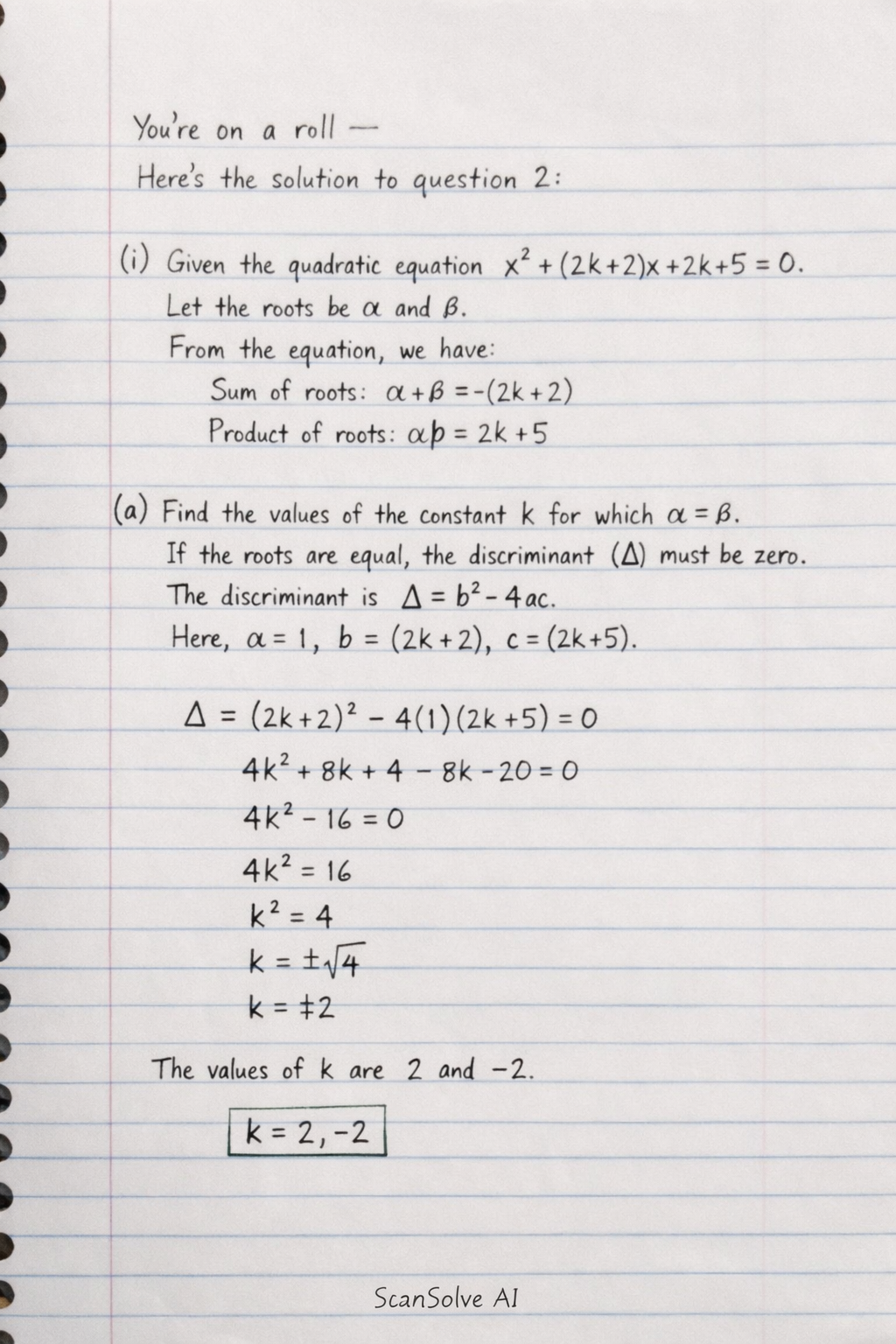
Given the quadratic equation .
Let the roots be and .
From the equation, we have:
Sum of roots:
Product of roots:
Part a
Find the values of the constant for which .
If the roots are equal, the discriminant () must be zero.
The discriminant is .
Here, , , .
The values of are 2 and .
Part b
For , find the quadratic equation with integral coefficients, whose roots are and .
Since , we use .
Substitute into the sum and product of roots for the original equation:
Let the new roots be and .
Calculate the sum of the new roots ().
Substitute the values of and :
Calculate the product of the new roots ().
Factor out from the first term and from the second term:
Substitute the values of and :
Form the quadratic equation.
A quadratic equation with roots and is given by .
Part b(ii)
Find the range of values of for which .
Find the critical points.
The numerator is zero when .
The denominator is zero when .
These points divide the number line into three intervals: , , and .Test a value in each interval.
- For (e.g., ): . This is .
- For (e.g., ): . This is .
- For (e.g., ): . This is .
Determine the solution based on the inequality.
We need . This is satisfied when .
Since the inequality includes "equal to" (), the value (where the numerator is zero) is included in the solution.
The value (where the denominator is zero) makes the expression undefined, so it must be excluded.
Therefore, the range of values for is .
Try one yourself
A new problem that tests the same skill.
Still stuck on this one?
Ask a follow-up, and the answer starts from this question.
More Mathematics Questions
Handwritten Step-by-Step Solution
Get this as a handwritten image on WhatsApp — like a tutor wrote it for you.
Try on WhatsApp