
We read your photo as:
A rectangular floor measures 12 m by 20 m. Calculate the size of the largest square tile that can be used to tile the floor, and the number of tiles needed.
ScanSolve AI Answer
Answers
2 partsStep-by-step solution
5 stepsThe image contains a mathematics question with two parts.
The dimensions of the rectangular floor are by .
Part a· 2 steps
The required size of each tile.
To cover the floor with square tiles of maximum size, the side length of the tile must be the greatest common divisor (GCD) of the floor's dimensions.
Find the prime factorization of each dimension.
Determine the greatest common divisor (GCD).
The common prime factors are .
The side length of the maximum size square tile is .
The required size of each tile is .
Part b15
The number of tiles required to cover the room if no fraction of tile is used.
Calculate the area of the rectangular floor.
Calculate the area of one square tile.
The side length of each tile is .
Calculate the number of tiles required.
The number of tiles required is .
Try one yourself
A new problem that tests the same skill.
Still stuck on this one?
Ask a follow-up, and the answer starts from this question.
More Mathematics Questions
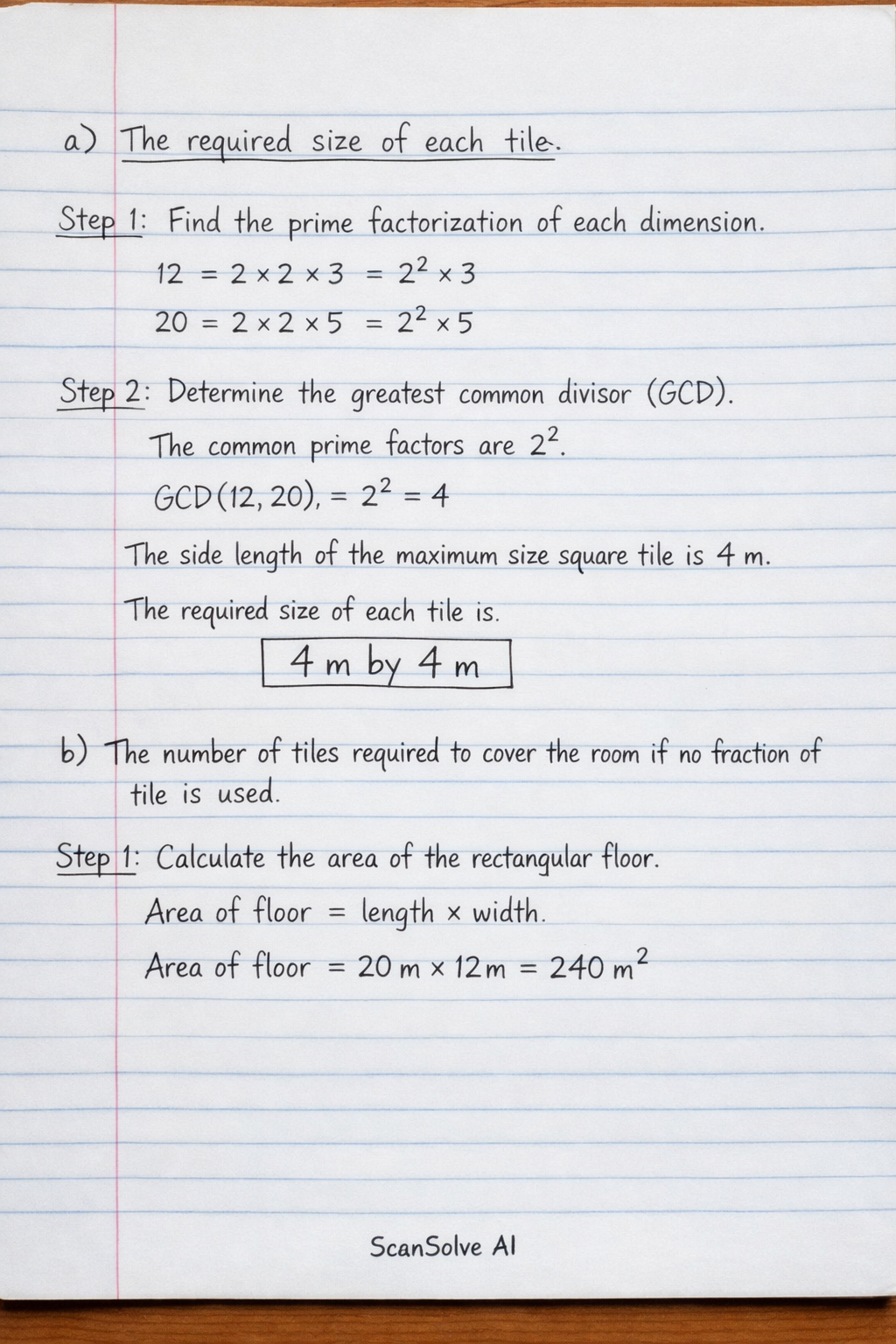
Handwritten Step-by-Step Solution
Get this as a handwritten image on WhatsApp — like a tutor wrote it for you.
Try on WhatsApp