
We read your photo as:
A rhombus has diagonals of length 12 cm and 7 cm respectively. Find the larger angle of the rhombus.
ScanSolve AI Answer
This answer stops before the end.
It was cut off when it was first written. Ask ScanSolve this question again for the full working.
Here are the solutions to your trigonometry problems:
6. A rhombus has diagonals of length 12 cm and 7 cm respectively. Find the larger angle of the rhombus.
Step 1: Understand the properties of a rhombus.
The diagonals of a rhombus bisect each other at right angles. This forms four congruent right-angled triangles.
The half-diagonals are the legs of these right-angled triangles.
Half of diagonal 1: cm.
Half of diagonal 2: cm.
Step 2: Find the angles within one of the right-angled triangles.
Let be the larger angle of the rhombus and be the smaller angle. The diagonals bisect these angles.
Consider one of the right-angled triangles formed by the half-diagonals. The angle is opposite the longer half-diagonal () and adjacent to the shorter half-diagonal ().
Step 3: Solve for and the larger angle.
The larger angle of the rhombus is .
The larger angle of the rhombus is approximately \boxed{\text{119.48^\circ}}.
10. From a point A which is 60 metres from the base of a building B and on the same level, the angle of elevation to the top of the building C is and to the top of the flagpole D on top of the building the angle of elevation is . Find the height of the flagpole.
Step 1: Define variables and set up trigonometric relationships.
Let AB be the distance from point A to the base of the building B, so m.
Let be the height of the building (BC).
Let be the total height from the base of the building to the top of the flagpole (BD).
Let be the height of the flagpole (CD).
The angle of elevation to the top of the building is .
The angle of elevation to the top of the flagpole is .
Step 2: Calculate the height of the building ().
Using the right-angled triangle ABC:
Step 3: Calculate the total height to the top of the flagpole ().
Using the right-angled triangle ABD:
Still stuck on this one?
Ask a follow-up, and the answer starts from this question.
More Mathematics Questions
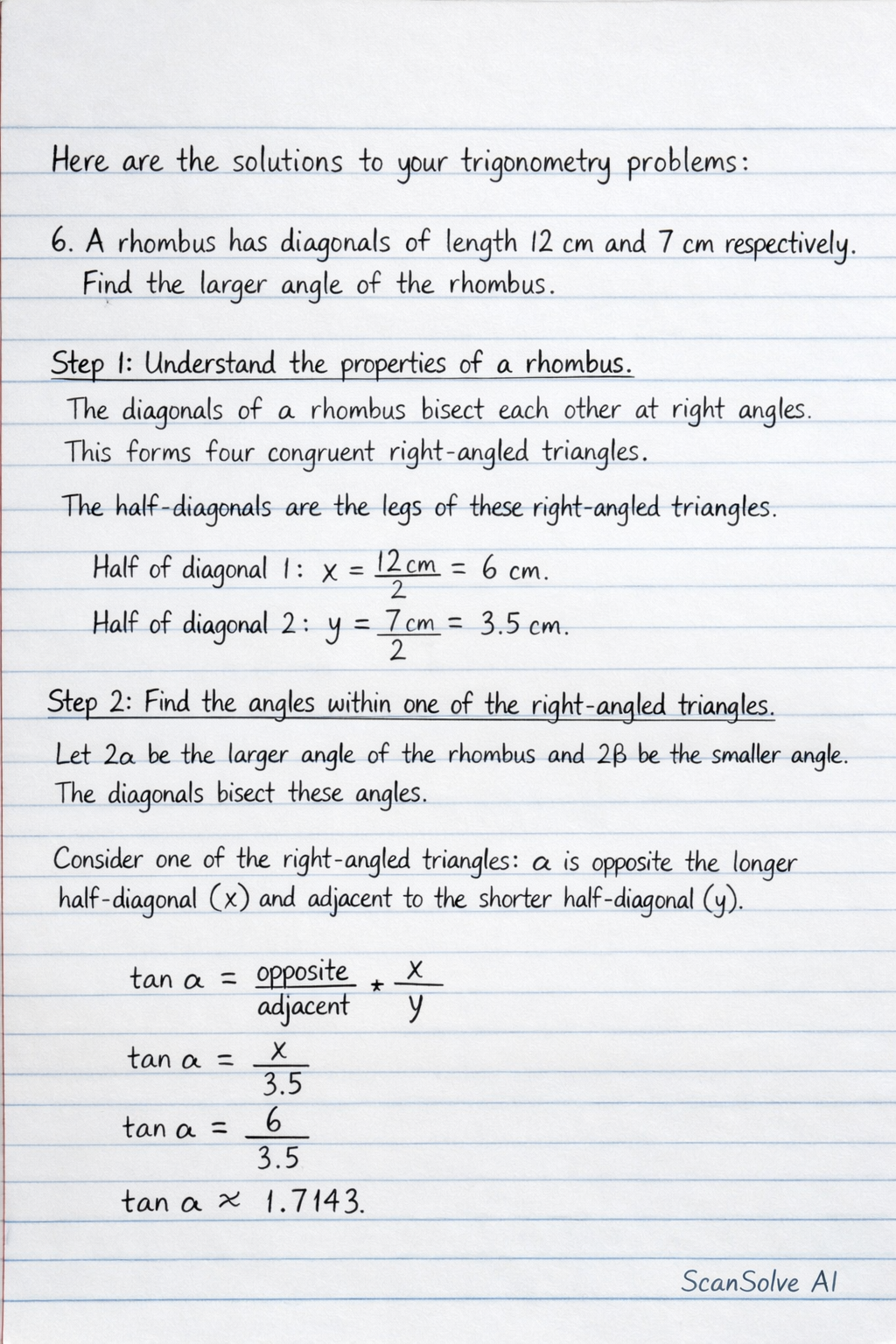
Handwritten Step-by-Step Solution
Get this as a handwritten image on WhatsApp — like a tutor wrote it for you.
Try on WhatsApp