We read your photo as:

A school has 700 learners. 72% use cricket nets, 48% use tennis courts, and 8% use neither. Find the number of learners using at least one facility and the probability a learner uses exactly one facil

Mathematics

ScanSolve AI Answer

Step-by-step solution

8 steps
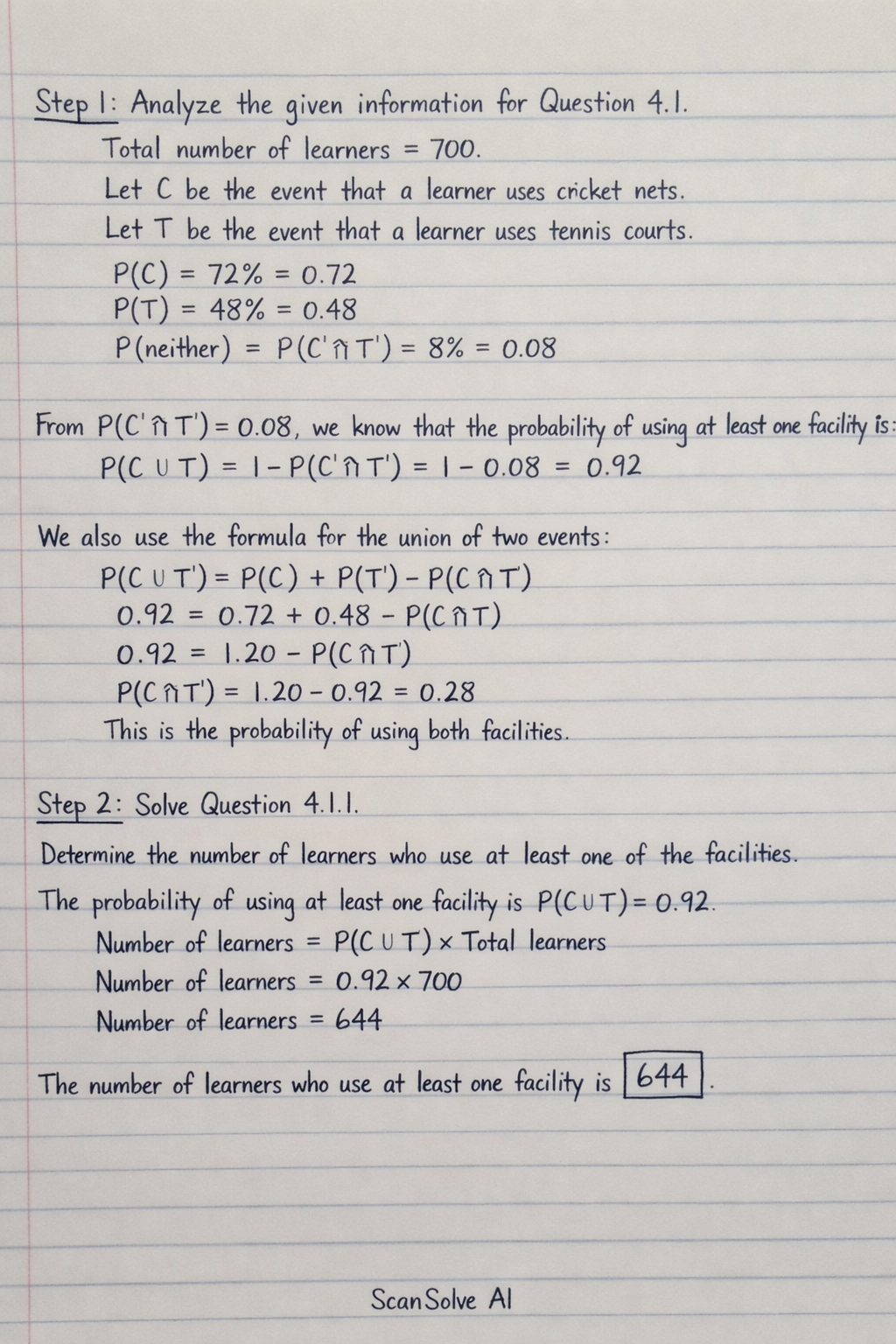
  1. Analyze the given information for Question 4.1.

    Total number of learners = 700.
    Let C be the event that a learner uses cricket nets.
    Let T be the event that a learner uses tennis courts.
    P(C)=72%=0.72P(C) = 72\% = 0.72
    P(T)=48%=0.48P(T) = 48\% = 0.48
    P(neither)=P(C′∩T′)=8%=0.08P(\text{neither}) = P(C' \cap T') = 8\% = 0.08

    From P(C′∩T′)=0.08P(C' \cap T') = 0.08, we know that the probability of using at least one facility is:

    P(C∪T)=1−P(C′∩T′)=1−0.08=0.92P(C \cup T) = 1 - P(C' \cap T') = 1 - 0.08 = 0.92

    We also use the formula for the union of two events:

    P(C∪T)=P(C)+P(T)−P(C∩T)P(C \cup T) = P(C) + P(T) - P(C \cap T) 0.92=0.72+0.48−P(C∩T)0.92 = 0.72 + 0.48 - P(C \cap T) 0.92=1.20−P(C∩T)0.92 = 1.20 - P(C \cap T) P(C∩T)=1.20−0.92=0.28P(C \cap T) = 1.20 - 0.92 = 0.28

    This is the probability of using both facilities.

  2. Solve Question 4.1.1.

    Determine the number of learners who use at least one of the facilities.
    The probability of using at least one facility is P(C∪T)=0.92P(C \cup T) = 0.92.
    Number of learners = P(C∪T)×Total learnersP(C \cup T) \times \text{Total learners}
    Number of learners = 0.92×7000.92 \times 700
    Number of learners = 644
    The number of learners who use at least one facility is 644\boxed{\text{644}}.

  3. Solve Question 4.1.2.

    Determine the probability that a learner uses exactly one facility.
    The probability of using exactly one facility is P(C only)+P(T only)P(C \text{ only}) + P(T \text{ only}).
    P(C only)=P(C)−P(C∩T)=0.72−0.28=0.44P(C \text{ only}) = P(C) - P(C \cap T) = 0.72 - 0.28 = 0.44
    P(T only)=P(T)−P(C∩T)=0.48−0.28=0.20P(T \text{ only}) = P(T) - P(C \cap T) = 0.48 - 0.28 = 0.20
    P(exactly one facility)=0.44+0.20=0.64P(\text{exactly one facility}) = 0.44 + 0.20 = 0.64
    Alternatively, P(exactly one facility)=P(C∪T)−P(C∩T)=0.92−0.28=0.64P(\text{exactly one facility}) = P(C \cup T) - P(C \cap T) = 0.92 - 0.28 = 0.64.
    The probability that a learner uses exactly one facility is 0.64\boxed{\text{0.64}}.

  4. Solve Question 4.1.3.

    Determine whether the events 'using the cricket nets' and 'using the tennis courts' are independent or not.
    Two events A and B are independent if P(A∩B)=P(A)×P(B)P(A \cap B) = P(A) \times P(B).
    Here, we check if P(C∩T)=P(C)×P(T)P(C \cap T) = P(C) \times P(T).
    We found P(C∩T)=0.28P(C \cap T) = 0.28.
    Now, calculate P(C)×P(T)P(C) \times P(T):

    P(C)×P(T)=0.72×0.48=0.3456P(C) \times P(T) = 0.72 \times 0.48 = 0.3456

    Since 0.28≠0.34560.28 \neq 0.3456, the events are not independent.
    The events are not independent\boxed{\text{not independent}}.

  5. Analyze the given data for Question 4.2.

    The table shows data from the NSFAS financial aid office.
    Total students = 10 730.

    Receiving financial aid (A)Not receiving financial aid (A')Total
    First time recipients (F)4 2223 8988 120
    Repeating recipients (R)1 8797312 610
    Total6 1014 62910 730
  6. Solve Question 4.2.1.

    Determine the probability that a student selected at random is a student receiving financial aid.
    This is P(A)P(A).

    P(A)=Number of students receiving financial aidTotal number of studentsP(A) = \frac{\text{Number of students receiving financial aid}}{\text{Total number of students}} P(A)=610110730P(A) = \frac{6101}{10730} P(A)≈0.5686P(A) \approx 0.5686

    The probability that a student is receiving financial aid is 610110730 or approximately 0.5686\boxed{\frac{6101}{10730} \text{ or approximately } 0.5686}.

  7. Solve Question 4.2.2.

    Determine the probability that a student selected at random is a repeating learner and is not receiving financial aid.
    This is P(R∩A′)P(R \cap A').
    From the table, the number of repeating recipients not receiving financial aid is 731.

    P(R∩A′)=Number of repeating recipients not receiving financial aidTotal number of studentsP(R \cap A') = \frac{\text{Number of repeating recipients not receiving financial aid}}{\text{Total number of students}} P(R∩A′)=73110730P(R \cap A') = \frac{731}{10730} P(R∩A′)≈0.0681P(R \cap A') \approx 0.0681

    The probability that a student is a repeating learner and is not receiving financial aid is 73110730 or approximately 0.0681\boxed{\frac{731}{10730} \text{ or approximately } 0.0681}.

  8. Solve Question 4.2.3.

    Determine the probability that a student selected at random is a first-time learner and is receiving financial aid.
    This is P(F∩A)P(F \cap A).
    From the table, the number of first-time recipients receiving financial aid is 4222.

    P(F∩A)=Number of first-time recipients receiving financial aidTotal number of studentsP(F \cap A) = \frac{\text{Number of first-time recipients receiving financial aid}}{\text{Total number of students}} P(F∩A)=422210730P(F \cap A) = \frac{4222}{10730} P(F∩A)≈0.3935P(F \cap A) \approx 0.3935

    The probability that a student is a first-time learner and is receiving financial aid is 422210730 or approximately 0.3935\boxed{\frac{4222}{10730} \text{ or approximately } 0.3935}.

Was this helpful?

Still stuck on this one?

Ask a follow-up, and the answer starts from this question.

Got a different question?Ask your own question
Handwritten step-by-step solution preview

Handwritten Step-by-Step Solution

Get this as a handwritten image on WhatsApp — like a tutor wrote it for you.

Try on WhatsApp