
We read your photo as:
A semicircle has center M and diameter AB. MN is perpendicular to AB, with N on the semicircle. If |MN| = 2 cm, find (a) |AB|, (b) the angle subtended by arc ANB at the center, and (c) the difference
ScanSolve AI Answer
Step-by-step solution
4 stepsHere are the calculations for the given problem:
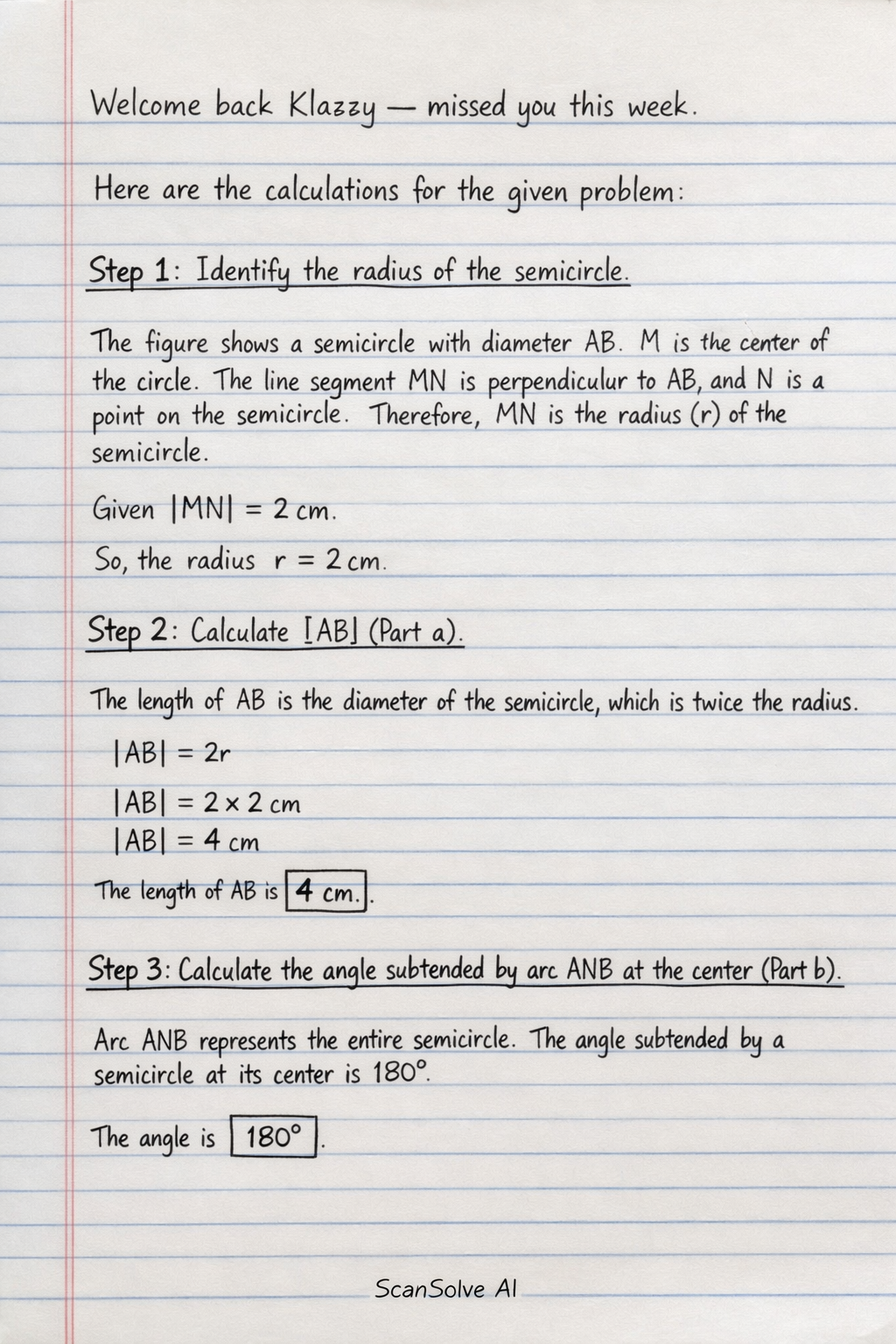
Identify the radius of the semicircle.
The figure shows a semicircle with diameter AB. M is the center of the circle. The line segment MN is perpendicular to AB, and N is a point on the semicircle. Therefore, MN is the radius () of the semicircle.
Given cm.
So, the radius cm.Calculate $|AB|$ (Part a).
The length of AB is the diameter of the semicircle, which is twice the radius.
The length of AB is .
Calculate the angle subtended by arc ANB at the center (Part b).
Arc ANB represents the entire semicircle. The angle subtended by a semicircle at its center is .
The angle is .Calculate the difference in length between and arc ANB (Part c).
The length of the line segment is the diameter, which is 4 cm.
The length of arc ANB is the circumference of a semicircle, given by the formula .
Length of arc ANB .
The difference in length is the absolute difference between the arc length and the diameter:Using :
To convert this to millimeters, multiply by 10 (since ):
Rounding to the nearest millimeter:
The difference in length is .
Still stuck on this one?
Ask a follow-up, and the answer starts from this question.
More Mathematics Questions
Handwritten Step-by-Step Solution
Get this as a handwritten image on WhatsApp — like a tutor wrote it for you.
Try on WhatsApp