
We read your photo as:
A spherical balloon's volume increases by 18p%. What is the percentage change in its radius?
ScanSolve AI Answer
Step-by-step solution
5 stepsHere's the solution for question 4.
Define the initial and final volumes and radii.
Let the initial volume of the spherical balloon be and its initial radius be .
Let the final volume be and its final radius be .
The formula for the volume of a sphere is .
So, we have:Express the new volume () in terms of the initial volume () using the given percentage increase.
The volume increases by . This means the new volume is the original volume plus of the original volume.
Substitute the volume formulas from Step 1 into the equation from Step 2.
Solve for in terms of .
Divide both sides of the equation by :
Take the cube root of both sides:
Calculate the percentage change in radius.
The percentage change in radius is given by the formula:
Substitute the expression for from Step 4:
Factor out from the numerator:
The percentage change in its radius is .
Still stuck on this one?
Ask a follow-up, and the answer starts from this question.
More Mathematics Questions
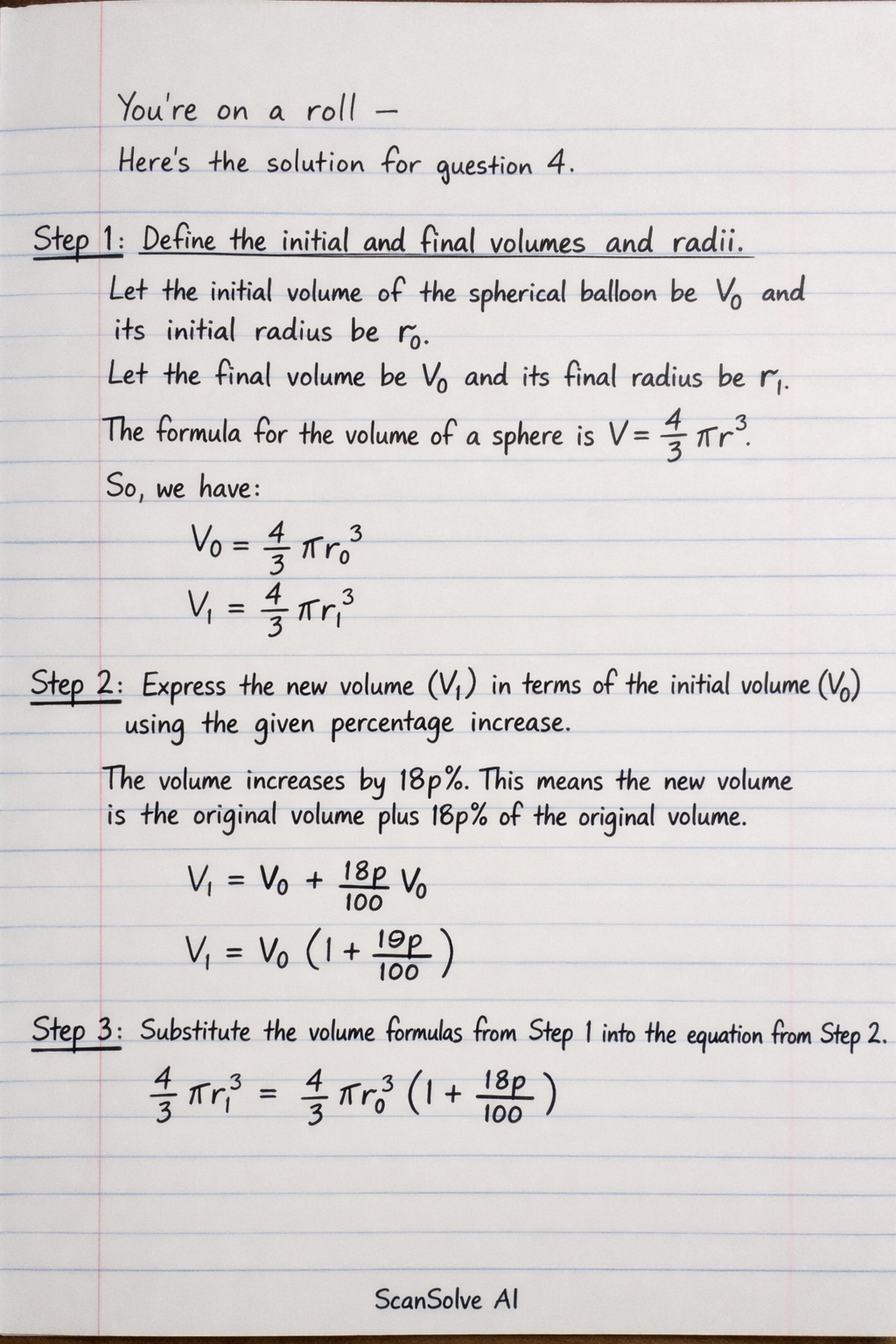
Handwritten Step-by-Step Solution
Get this as a handwritten image on WhatsApp — like a tutor wrote it for you.
Try on WhatsApp