
We read your photo as:
A teacher's initial pay is K850 per fortnight, increasing by K120 per fortnight each year. Calculate his pay for the first 5 years, in Year 10, and when it first exceeds K1500.
ScanSolve AI Answer
Answers
3 partsStep-by-step solution
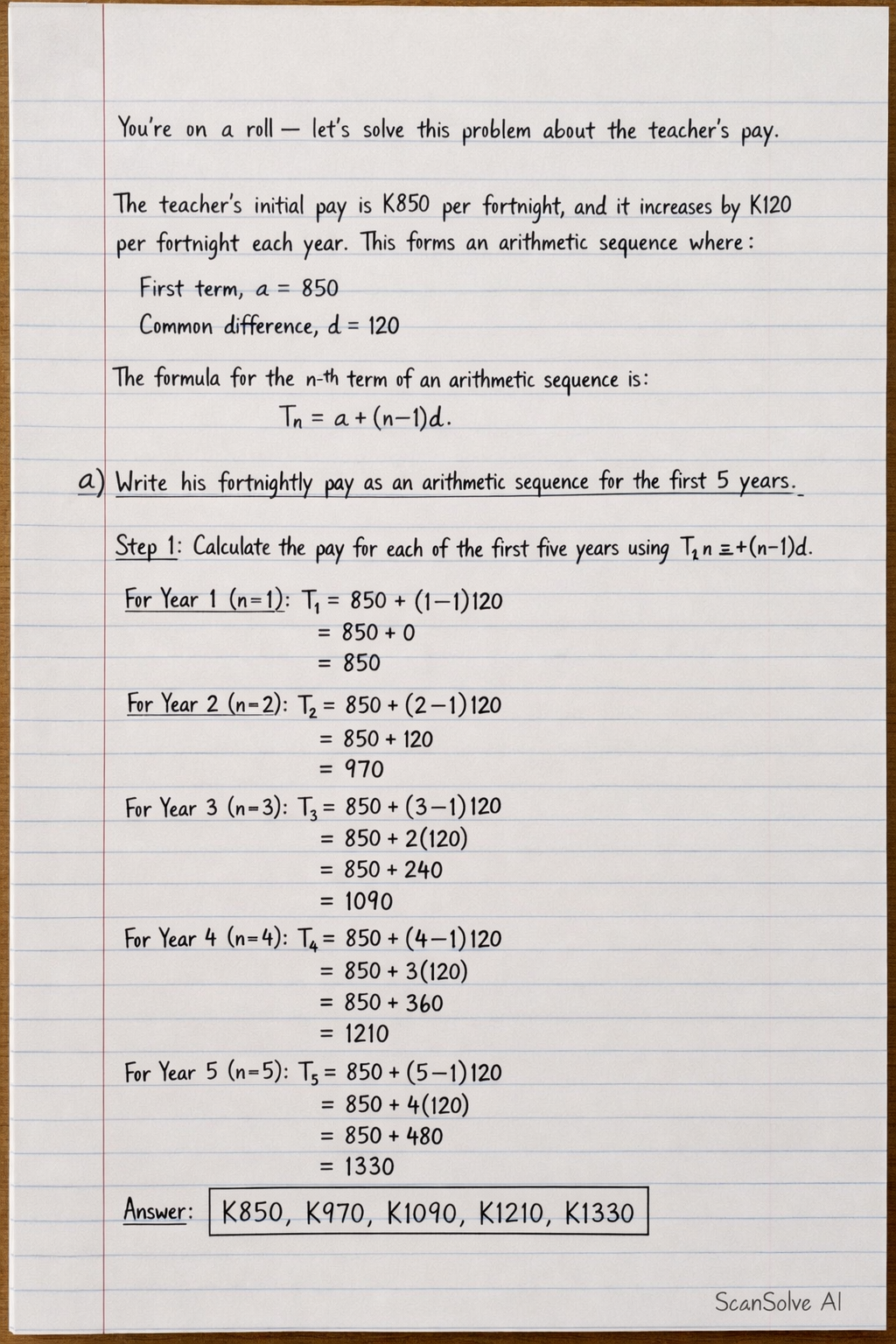
8 stepslet's solve this problem about the teacher's pay.
The teacher's initial pay is K850 per fortnight, and it increases by K120 per fortnight each year. This forms an arithmetic sequence where:
First term,
Common difference,
The formula for the -th term of an arithmetic sequence is .
Part a· 1 step
Write his fortnightly pay as an arithmetic sequence for the first 5 years.
Calculate the pay for each of the first five years using .
For Year 1 ():
For Year 2 ():
For Year 3 ():
For Year 4 ():
For Year 5 ():
Answer:
Part bK1930
What will his fortnightly pay be in Year 10?
Use the formula with .
Calculate the value.
Answer:
Part c
In which year will his fortnightly pay first exceed K1 500?
Set up an inequality using the formula and solve for .
Isolate the term with .
Divide by 120.
Solve for .
Since must be an integer (representing a year), the smallest integer greater than 6.416...
is 7.
Answer:
Try one yourself
A new problem that tests the same skill.
Still stuck on this one?
Ask a follow-up, and the answer starts from this question.
More Mathematics Questions
Handwritten Step-by-Step Solution
Get this as a handwritten image on WhatsApp — like a tutor wrote it for you.
Try on WhatsApp