
We read your photo as:
A trader bought a camera at a price that allowed for a 20% profit. He then sold it at a discount of 10% on the marked price of Ksh 2400. Find the cost price of the camera.
ScanSolve AI Answer
Answer
Step-by-step solution
6 stepsCalculate the selling price (SP) of the camera.
The marked price (MP) is Ksh 2400.
The discount is 10% of the marked price.The selling price is the marked price minus the discount amount.
Relate the selling price to the cost price (CP) and profit.
The trader makes a profit of 20% on the cost price.
This means the selling price is the cost price plus 20% of the cost price.Determine the cost price (CP).
We have the selling price from Step 1 and the relationship from Step 2.
To find the cost price, divide the selling price by 1.20.
The cost price of the camera is .
Factor the denominator.
The denominator is a difference of squares, .
Attempt to factor the numerator.
The numerator is .
To factor this quadratic expression, we look for two numbers that multiply to and add up to . The integer pairs that multiply to -2 are (1, -2) and (-1, 2). Their sums are and . Neither sum is -3.
Therefore, the numerator does not factor into simple linear terms with integer coefficients that would allow cancellation with the denominator's factors or .Write the simplified expression.
Since there are no common factors between the numerator and the denominator, the expression cannot be simplified further by cancellation. The most simplified form involves factoring the denominator.
Still stuck on this one?
Ask a follow-up, and the answer starts from this question.
More Mathematics Questions
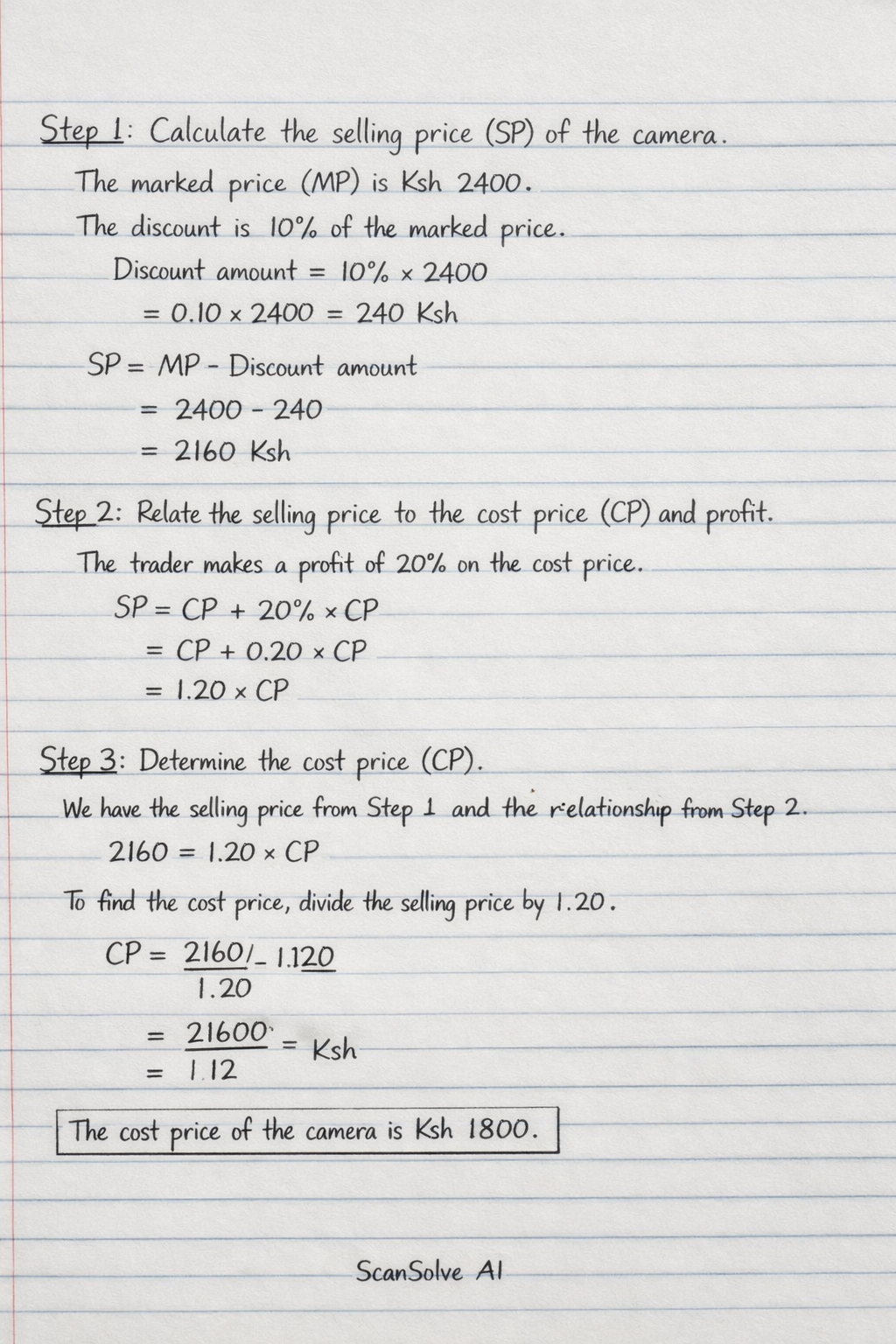
Handwritten Step-by-Step Solution
Get this as a handwritten image on WhatsApp — like a tutor wrote it for you.
Try on WhatsApp