
We read your photo as:
A triangle ABC with vertices A(1, -1), B(3, -1), C(1, 3) is mapped to A'B'C' by transformation T1 = [[-1, 0], [0, 1]]. Triangle A'B'C' is then mapped to A''B''C'' by transformation T2 = [[2, 2], [0, 1
ScanSolve AI Answer
Answers
4 partsA'(-1, -1), B'(-3, -1), C'(-1, 3)
Step 1: Understand the transformations.
Triangle ABC with vertices , , is mapped to by transformation .
Triangle is then mapped to by transformation .
a) Find the coordinates of A'B'C'.
To find the coordinates of , we multiply the coordinates of by the matrix .
For :
So, .
For :
So, .
For :
So, .
The coordinates of are .
b) Find the matrix which maps A'B'C' onto A''B''C''.
The problem statement explicitly gives this matrix as the second transformation.
The matrix is .
c) Determine the area scale factor between A'B'C' and A''B''C''.
The transformation from to is given by the matrix .
The area scale factor is the absolute value of the determinant of the transformation matrix.
The area scale factor is .
d) Find the transformation matrix which maps A''B''C'' onto ABC.
This requires finding the inverse of the combined transformation from to .
First, find the combined transformation matrix that maps to . This is .
Now, find the inverse of . For a matrix , its inverse is .
Here, .
Still stuck on this one?
Ask a follow-up, and the answer starts from this question.
More Mathematics Questions
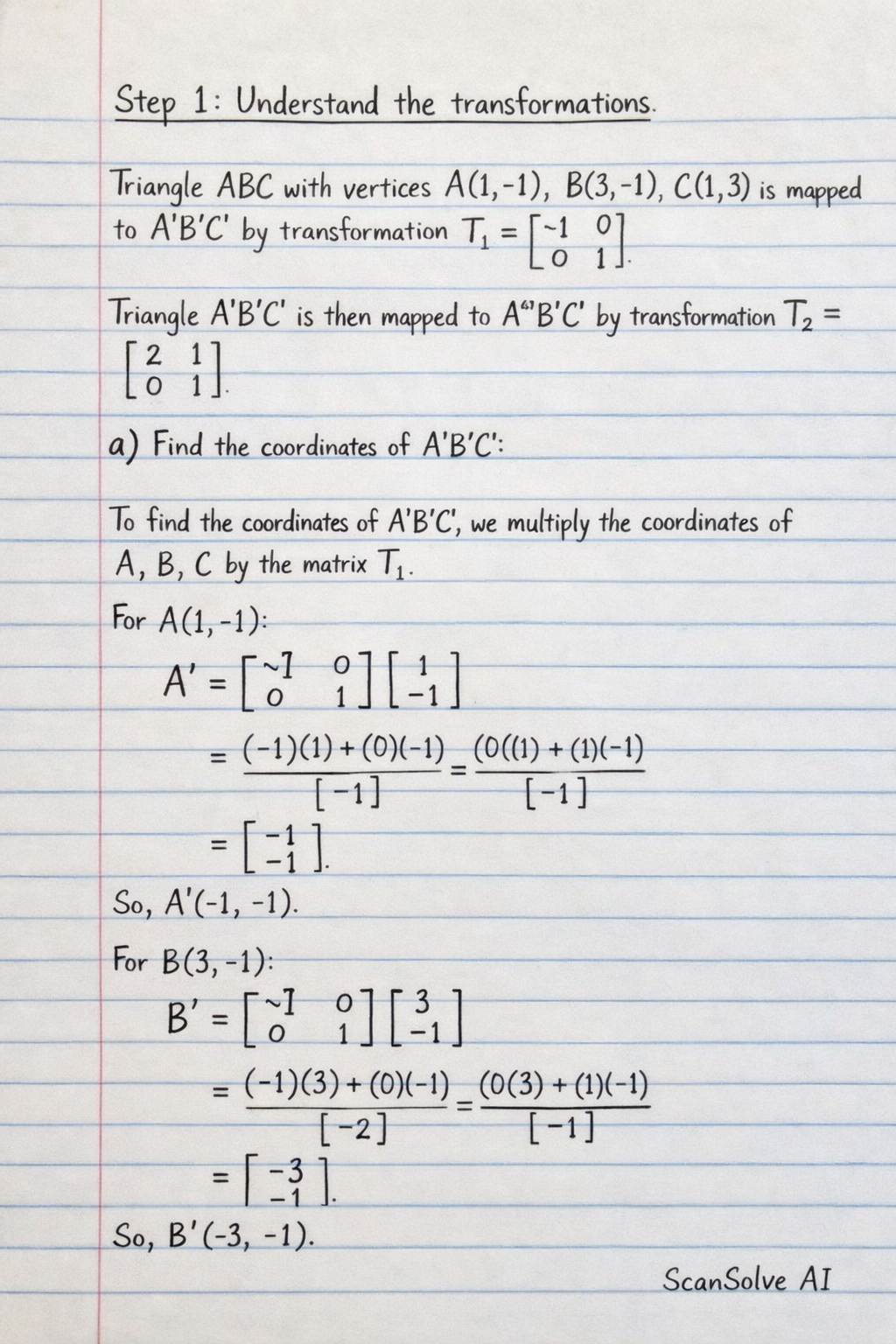
Handwritten Step-by-Step Solution
Get this as a handwritten image on WhatsApp — like a tutor wrote it for you.
Try on WhatsApp