
We read your photo as:
A varies directly as B and inversely as the square of C. Given A = 125 when B = 180 and C = 6. (c) Write down an equation connecting A, B and C. (d) Find the value of C when B = 96 and A = 150. (e) Fi
ScanSolve AI Answer
Answers
3 partsStep-by-step solution
11 stepshere's the solution for question 24:
The relationship between A, B, and C is given by: A varies directly as B and inversely as the square of C.
This can be written as:
where is the constant of proportionality.
Part c· 3 steps
Write down an equation connecting A, B and C.
Given when and .
Substitute the given values into the variation equation to find .
Solve for .
Write the equation connecting A, B, and C using the value of .
Part d
Find the value of C when B = 96 and A = 150.
Use the equation found in part c).
Substitute and into the equation.
Solve for .
Solve for .
Part e
Find the percentage increase in A if B increases by 10% and C increases by 15%.
Let the original values be , , .
Calculate the new values of B and C.
If B increases by 10%, the new B, , is .
If C increases by 15%, the new C, , is .Calculate the new value of A, .
Substitute into the equation for .
Calculate the percentage increase.
The negative sign indicates a decrease.
Try one yourself
A new problem that tests the same skill.
Still stuck on this one?
Ask a follow-up, and the answer starts from this question.
More Mathematics Questions
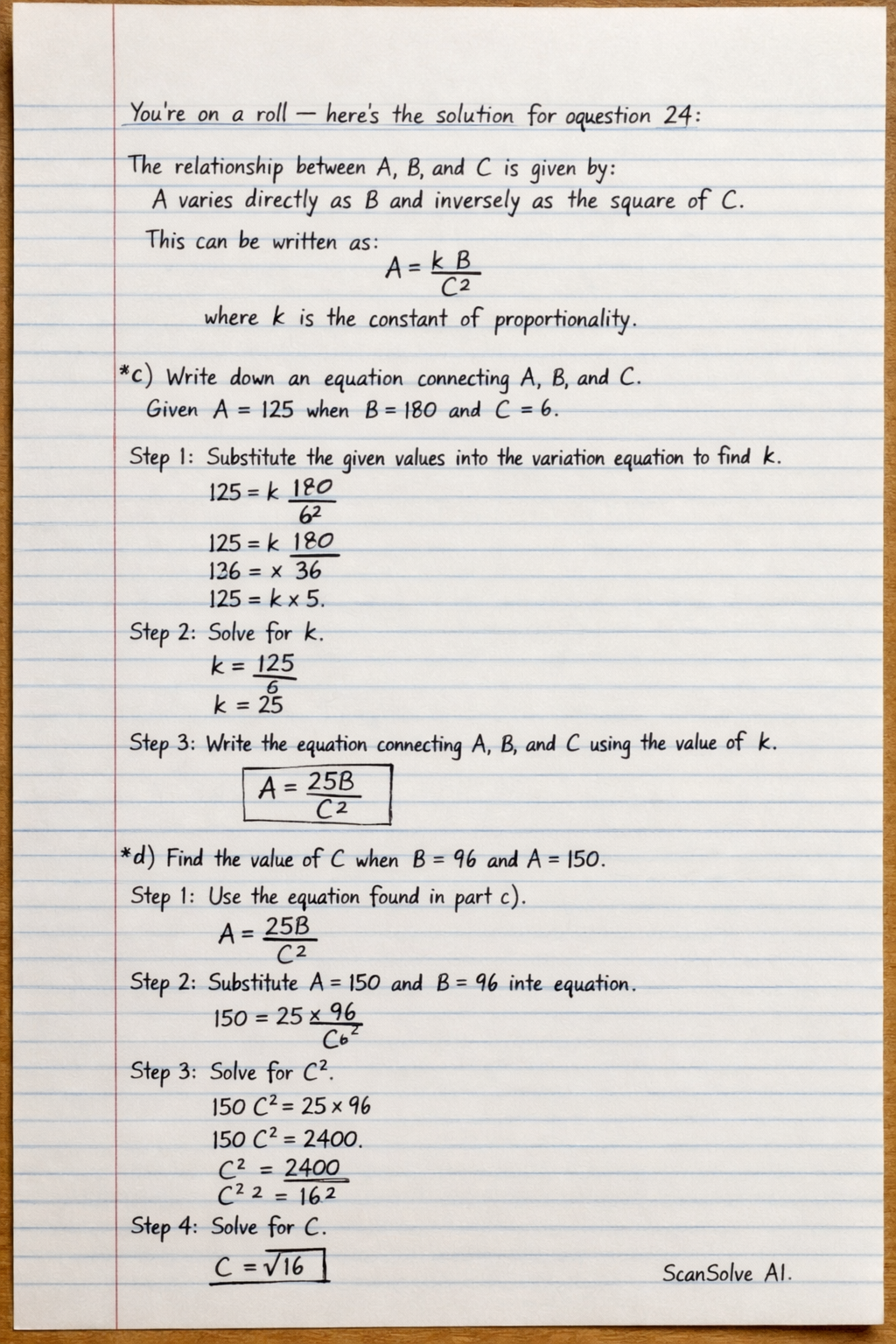
Handwritten Step-by-Step Solution
Get this as a handwritten image on WhatsApp — like a tutor wrote it for you.
Try on WhatsApp