
We read your photo as:
ABC is an isosceles triangle. (i) Measure the size of angles B and C. What do you notice? (ii) Without measuring it, look at the size of A. Do you think it is the same size as B or C?
ScanSolve AI Answer
Step-by-step solution
4 stepsHere's the solution for :
Part a(i)· 2 steps
Measure the size of angles B and C. What do you notice?
Identify the type of triangle.
The tick marks on sides AB and AC indicate that is an isosceles triangle, meaning sides AB and AC are equal in length.
Apply the property of an isosceles triangle.
In an isosceles triangle, the angles opposite the equal sides are equal. Angle B is opposite side AC, and Angle C is opposite side AB. Therefore, if you were to measure them, you would notice that .
Part a(ii)· 2 steps
Without measuring it, look at the size of A. Do you think it is the same size as B or C?
Visually inspect the angles.
By looking at the diagram, appears to be larger than or .
Recall properties of isosceles triangles.
In an isosceles triangle, the base angles (angles B and C, which are opposite the equal sides) are equal. The vertex angle (angle A) is typically different from the base angles, unless it's an equilateral triangle.
No, I do not think is the same size as or . It appears to be .
Still stuck on this one?
Ask a follow-up, and the answer starts from this question.
More Mathematics Questions
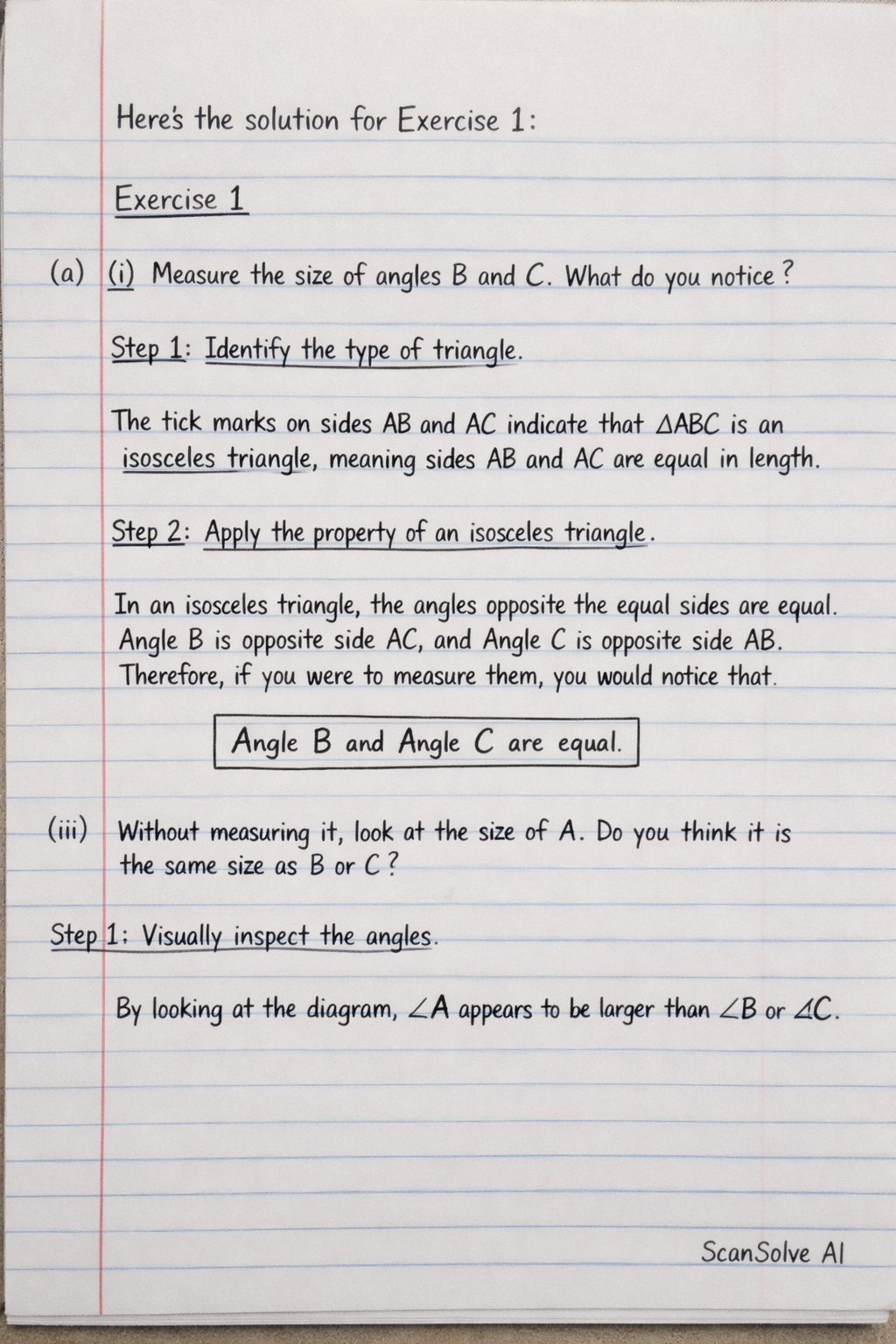
Handwritten Step-by-Step Solution
Get this as a handwritten image on WhatsApp — like a tutor wrote it for you.
Try on WhatsApp