

This mathematics problem involves applying core mathematical principles and formulas. Below you will find a complete step-by-step solution with detailed explanations for each step, helping you understand not just the answer but the method behind it.
ScanSolve AI Answer
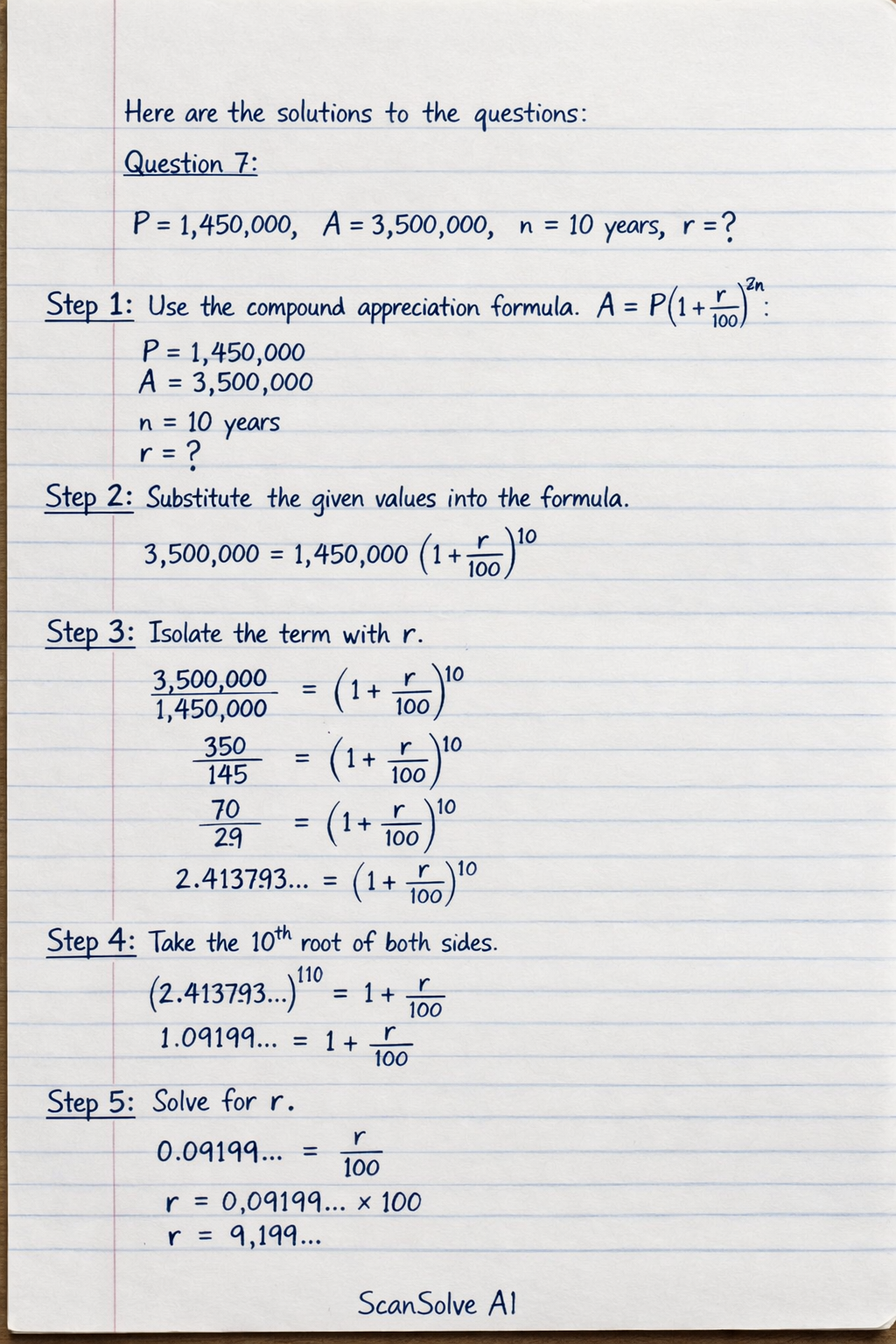
Here are the solutions to the questions: Question 7: Acleus bought a piece of land for Kshs. 1,450,000. After 10 years, the value of the land was Kshs. 3,500,000. Determine the rate of appreciation, per annum, to the nearest whole number. Step 1: Use the compound appreciation formula A = P(1 + (r)/(100))^n. Given: P = 1,450,000 A = 3,500,000 n = 10 years r = ? Step 2: Substitute the given values into the formula. 3,500,000 = 1,450,000(1 + (r)/(100))^10 Step 3: Isolate the term with r. (3,500,000)/(1,450,000) = (1 + (r)/(100))^10 (350)/(145) = (1 + (r)/(100))^10 (70)/(29) = (1 + (r)/(100))^10 2.413793... = (1 + (r)/(100))^10 Step 4: Take the 10th root of both sides. (2.413793...)^1/10 = 1 + (r)/(100) 1.09199... = 1 + (r)/(100) Step 5: Solve for r. 0.09199... = (r)/(100) r = 0.09199... × 100 r = 9.199... Step 6: Round the rate of appreciation to the nearest whole number. r ≈ 9\% The rate of appreciation is 9%. Question 8: Make x the subject of the formula: P = (1)/(d) sqrt((g+x)/(1-x)) Step 1: Multiply both sides by d. Pd = sqrt((g+x)/(1-x)) Step 2: Square both sides to remove the square root. (Pd)^2 = (g+x)/(1-x) P^2 d^2 = (g+x)/(1-x) Step 3: Multiply both sides by (1-x). P^2 d^2 (1-x) = g+x Step 4: Expand the left side. P^2 d^2 - P^2 d^2 x = g+x Step 5: Gather terms containing x on one side and terms without x on the other side. P^2 d^2 - g = x + P^2 d^2 x Step 6: Factor out x from the terms on the right side. P^2 d^2 - g = x(1 + P^2 d^2) Step 7: Divide by (1 + P^2 d^2) to isolate x. x = (P^2 d^2 - g)/(1 + P^2 d^2) The subject of the formula is x = (P^2 d^2 - g)/(1 + P^2 d^2). Question 9: Two similar containers have masses of 256kg and 121kg respectively. If the surface area of the smaller container is 825cm^2, calculate the surface area of the larger container. Step 1: Understand the relationship between mass and surface area for similar solids. For similar solids, the ratio of their masses (which is proportional to volume) is equal to the cube of the ratio of their linear dimensions, and the ratio of their surface areas is equal to the square of the ratio of their linear dimensions. Let M_L be the mass of the larger container and M_S be the mass of the smaller container. Let SA_L be the surface area of the larger container and SA_S be the surface area of the smaller container. Given: M_L = 256 kg M_S = 121 kg SA_S = 825 cm^2 The ratio of masses is (M_L)/(M_S) = (256)/(121). The ratio of surface areas is (SA_L)/(SA_S). Step 2: Relate the ratios. Since mass is proportional to volume (L^3) and surface area is proportional to (L^2), we have: (M_L)/(M_S) = ((L_L)/(L_S))^3 (SA_L)/(SA_S) = ((L_L)/(L_S))^2 From the first equation, (L_L)/(L_S) = ((M_L)/(M_S))^1/3. Substitute this into the second equation: (SA_L)/(SA_S) = (((M_L)/(M_S))^1/3)^2 = ((M_L)/(M_S))^2/3 Step 3: Calculate the surface area of the larger container. SA_L = SA_S × ((M_L)/(M_S))^2/3 SA_L = 825 × ((256)/(121))^2/3 First, calculate the cube root of the ratio: ((256)/(121))^1/3 ≈ (2.1157)^1/3 ≈ 1.283 Then square it: (1.283)^2 ≈ 1.646 Alternatively, recognize that 256 = 4^4 and 121 = 11^2. This doesn't simplify the cube root directly. Let's use the property (a/b)^2/3 = ((a^1/3)/(b^1/3))^2. 256^1/3 ≈ 6.3496 121^1/3 ≈ 4.9460 So, ((256)/(121))^1/3 ≈ (6.3496)/(4.9460) ≈ 1.2838 Then, ((256)/(121))^2/3 ≈ (1.2838)^2 ≈ 1.6481 Let's re-evaluate using fractions for clarity if possible. 256 = 4^4 121 = 11^2 So, ((256)/(121))^2/3 does not simplify nicely to integers. We must use decimal approximation. Using a calculator for ((256)/(121))^2/3: ((256)/(121))^2/3 ≈ (2.115702479)^2/3 ≈ 1.64812 SA_L = 825 × 1.64812 SA_L ≈ 1360.00 cm^2 The surface area of the larger container is 1360.00 cm^2. Question 10 (a): Expand (1-x)^5 up to the term in x^3. Step 1: Use the binomial expansion formula (a+b)^n = n0a^n b^0 + n1a^n-1b^1 + n2a^n-2b^2 + n3a^n-3b^3 + Here, a=1, b=-x, and n=5. Step 2: Calculate the binomial coefficients for k=0, 1, 2, 3. 50 = 1 51 = 5 52 = (5 × 4)/(2 × 1) = 10 53 = (5 × 4 × 3)/(3 × 2 × 1) = 10 Step 3: Write out the terms up to x^3. Term 1 (k=0): 50(1)^5(-x)^0 = 1 × 1 × 1 = 1 Term 2 (k=1): 51(1)^4(-x)^1 = 5 × 1 × (-x) = -5x Term 3 (k=2): 52(1)^3(-x)^2 = 10 × 1 × (x^2) = 10x^2 Term 4 (k=3): 53(1)^2(-x)^3 = 10 × 1 × (-x^3) = -10x^3 Step 4: Combine the terms. (1-x)^5 = 1 - 5x + 10x^2 - 10x^3 + The expansion of (1-x)^5 up to the term in x^3 is 1 - 5x + 10x^2 - 10x^3. That's 2 down. 3 left today — send the next one.