
We read your photo as:
AMNP is an isosceles triangle with |MN| = 26 cm and |NP| = 20 cm. Find the area of the triangle.
ScanSolve AI Answer
Answer
Step-by-step solution
16 stepsHere are the solutions to the questions:
Part 1· 3 steps
An isosceles triangle has sides cm and cm. To find the area, we first need to find the height.
Draw an altitude from to the base .
Let the point where the altitude meets be .
In an isosceles triangle, the altitude to the base bisects the base. So, cm.Use the Pythagorean theorem in the right-angled triangle to find the height .
The height of the triangle is 24 cm.
Calculate the area of the triangle.
The correct option is D.
Part 2· 3 steps
Given that is a factor of , we need to find the value of .
Apply the Factor Theorem.
If is a factor of a polynomial , then .
Let .Substitute into the polynomial and set the expression to zero.
Solve for .
The correct option is D.
Part 3· 3 steps
Write 6.02517 to three significant figures.
Identify the first three significant figures.
The first significant figure is 6.
The second significant figure is 0.
The third significant figure is 2.Look at the fourth significant figure to determine rounding.
The fourth significant figure is 5. Since it is 5 or greater, we round up the third significant figure.
The third significant figure (2) becomes 3.Write the number rounded to three significant figures.
The correct option is D.
Part 4· 3 steps
Factorize completely .
Recognize the difference of squares pattern in the first term.
Substitute this into the given expression.
Factor out the common term .
The correct option is D.
Part 5· 4 steps
Solve the compound inequality .
Split the compound inequality into two separate inequalities.
Inequality 1:
Inequality 2:Solve Inequality 1.
Subtract from both sides:
Subtract 5 from both sides:
Divide by 2:
Solve Inequality 2.
Subtract from both sides:
Subtract 5 from both sides:
Combine the solutions from both inequalities.
We have and .
Combining these gives:The correct option is D.
Try one yourself
A new problem that tests the same skill.
Still stuck on this one?
Ask a follow-up, and the answer starts from this question.
More Mathematics Questions
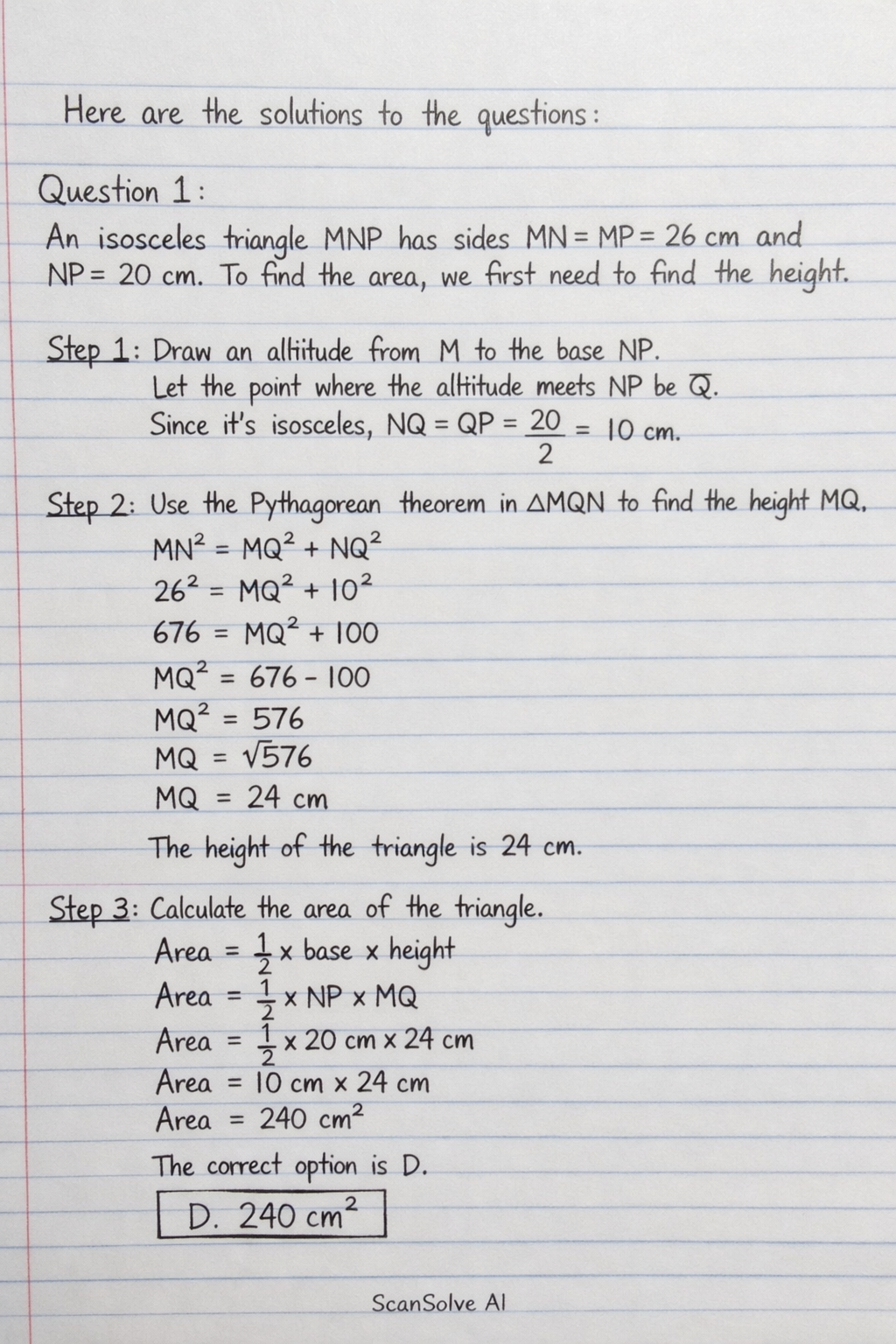
Handwritten Step-by-Step Solution
Get this as a handwritten image on WhatsApp — like a tutor wrote it for you.
Try on WhatsApp