
We read your photo as:
In triangle LMN, LM = 23.7 m, MN = 16.6 m, and angle LMN = 106°. Calculate the distance LN, the area of triangle LMN, and the shortest distance from M to LN.
ScanSolve AI Answer
Answers
3 partsHere's the solution to the problem:
a)
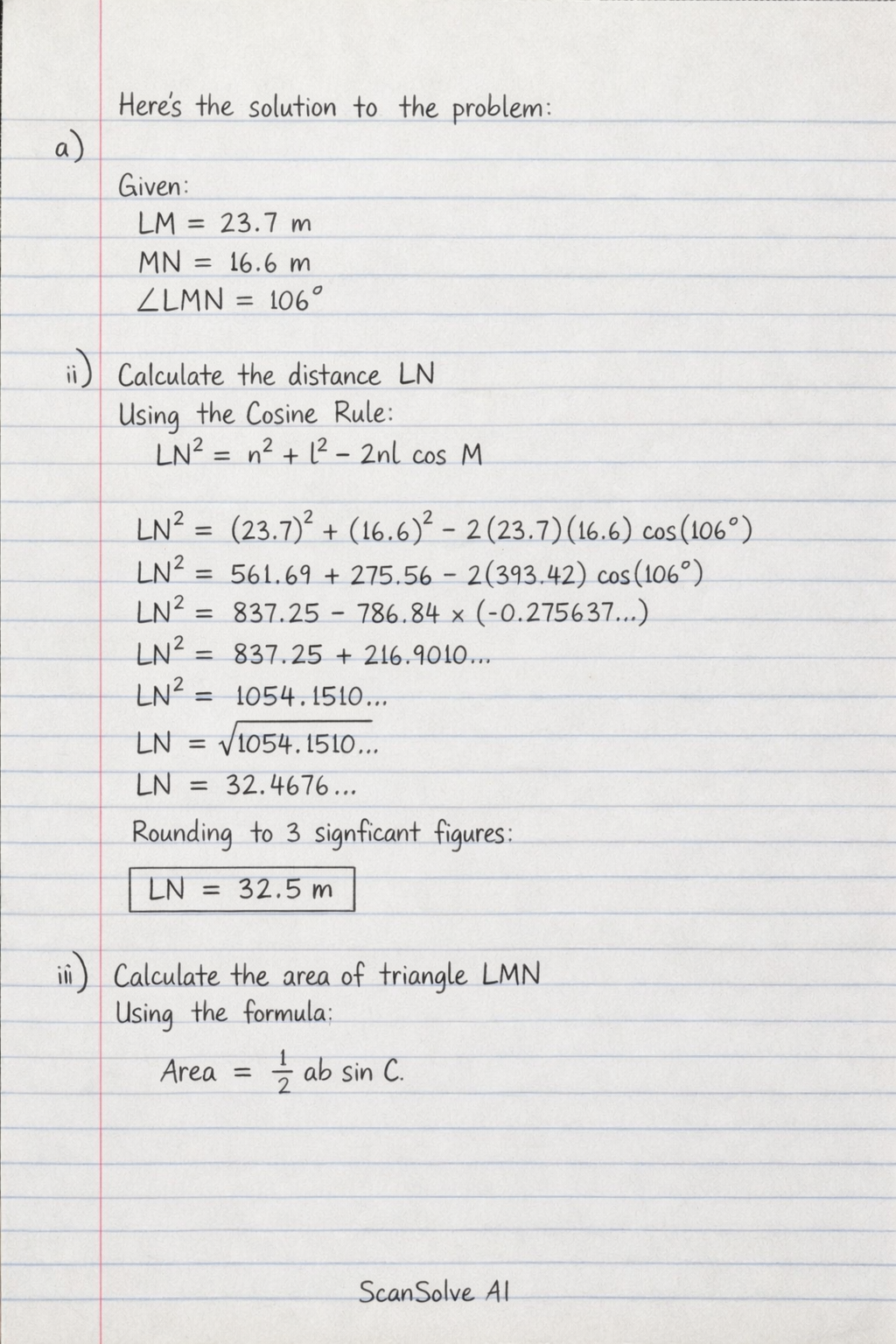
Given:
Angle
i) Calculate the distance LN
We can use the Cosine Rule to find the length of side LN. The Cosine Rule states . In our triangle LMN, we want to find (let's call it ), and we have sides (let's call it ) and (let's call it ) and the included angle (angle ).
Rounding to 3 significant figures:
ii) Calculate the area of triangle LMN
We can use the formula for the area of a triangle given two sides and the included angle: Area .
Rounding to 3 significant figures:
iii) Calculate the shortest distance from M to LN.
The shortest distance from point M to line LN is the perpendicular height () from M to LN. We can use the formula for the area of a triangle: Area . Here, LN is the base and is the height.
We know the Area from part (ii) and LN from part (i).
Rounding to 3 significant figures:
Try one yourself
A new problem that tests the same skill.
Still stuck on this one?
Ask a follow-up, and the answer starts from this question.
More Mathematics Questions
Handwritten Step-by-Step Solution
Get this as a handwritten image on WhatsApp — like a tutor wrote it for you.
Try on WhatsApp