
We read your photo as:
An independent samples t-test is most appropriate for comparing The relationship between two categorical variables Three or more group means at once The same group measured before and after an intervention The means of two separate, unrelated groups
ScanSolve AI Answer
-
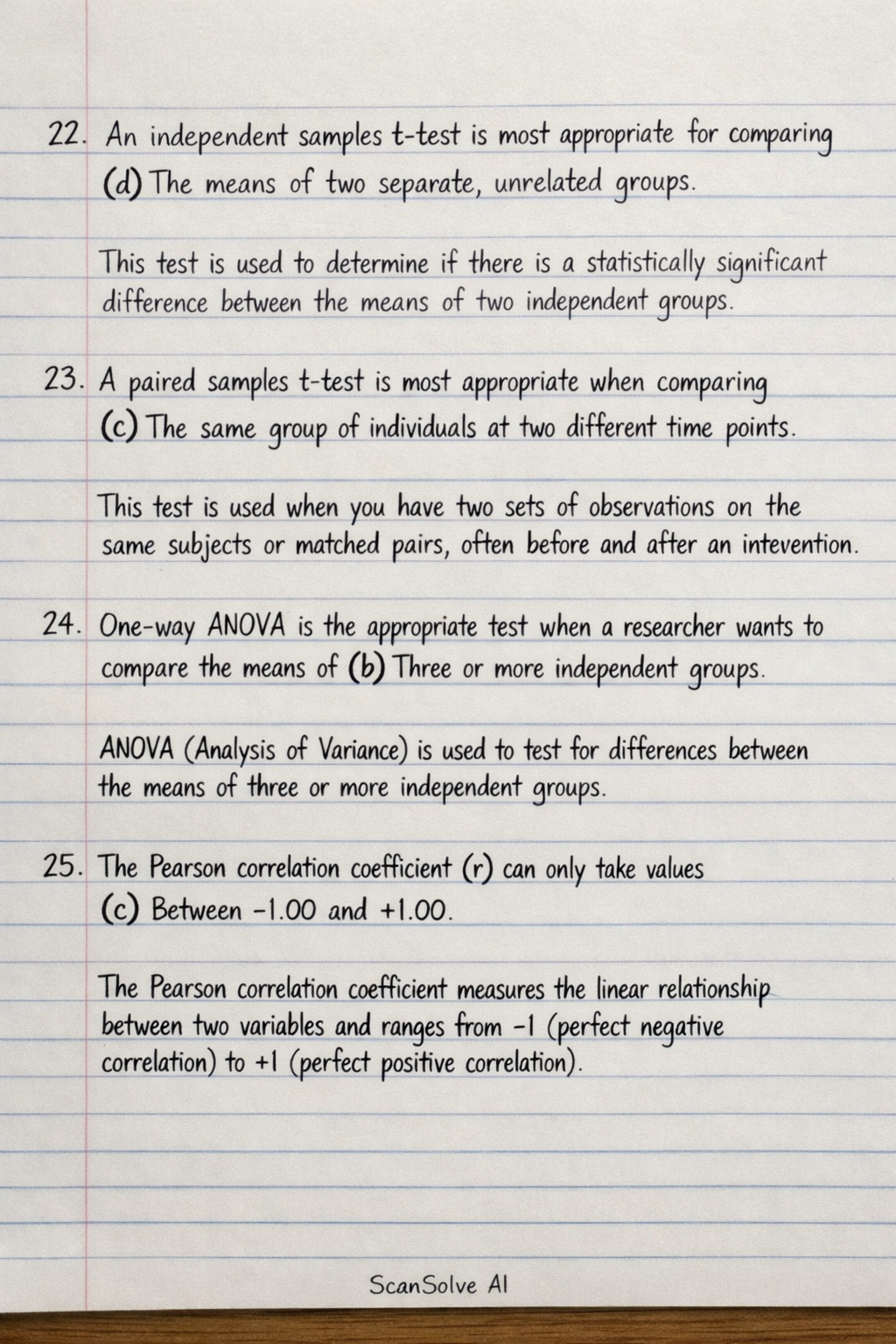
An independent samples t-test is most appropriate for comparing (d) The means of two separate, unrelated groups.
- This test is used to determine if there is a statistically significant difference between the means of two independent groups.
-
A paired samples t-test is most appropriate when comparing (c) The same group of individuals at two different time points.
- This test is used when you have two sets of observations on the same subjects or matched pairs, often before and after an intervention.
-
One-way ANOVA is the appropriate test when a researcher wants to compare the means of (b) Three or more independent groups.
- ANOVA (Analysis of Variance) is used to test for differences between the means of three or more independent groups.
-
The Pearson correlation coefficient () can only take values (c) Between -1.00 and +1.00.
- The Pearson correlation coefficient measures the linear relationship between two variables and ranges from -1 (perfect negative correlation) to +1 (perfect positive correlation).
-
In simple linear regression, R-squared () is best interpreted as (b) The proportion of variation in Y explained by X.
- indicates how well the independent variable(s) explain the variability of the dependent variable.
-
Under the standard hypothesis testing decision rule at the 5% significance level, the null hypothesis is rejected when (a) The p-value is less than 0.05.
- If the p-value is less than the significance level (, commonly 0.05), there is sufficient evidence to reject the null hypothesis.
-
When the evidence is not strong enough to reject the null hypothesis, the correct statistical conclusion is to state that we (a) Fail to reject H0.
- We never "accept" or "prove" the null hypothesis; we simply state that there isn't enough evidence to reject it.
-
The '6x6 rule' in PowerPoint slide design recommends a maximum of (d) 6 bullet points per slide and 6 words per bullet.
- This rule is a guideline for keeping slides concise and easy to read, preventing information overload.
Still stuck on this one?
Ask a follow-up, and the answer starts from this question.
More Mathematics Questions
Handwritten Step-by-Step Solution
Get this as a handwritten image on WhatsApp — like a tutor wrote it for you.
Try on WhatsApp