
We read your photo as:
An investment of GHS 10,000 is being considered for two options. Option A offers an 8% annual interest rate compounded quarterly. Option B offers a 7.5% annual interest rate compounded monthly. Both i
ScanSolve AI Answer
Step-by-step solution
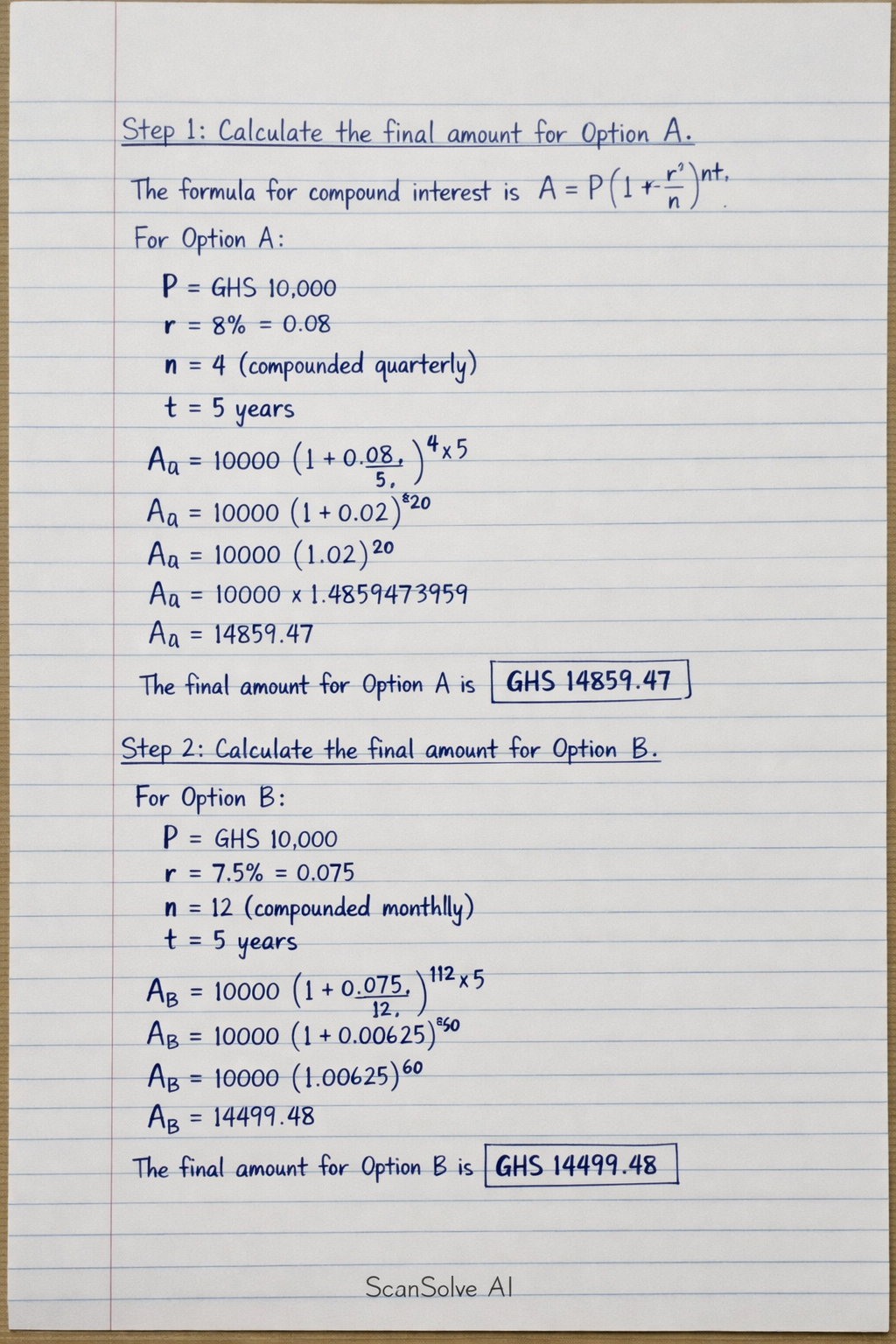
5 stepsCalculate the final amount for Option A.
The formula for compound interest is .
For Option A:
(compounded quarterly)
yearsThe final amount for Option A is .
Calculate the final amount for Option B.
For Option B:
(compounded monthly)
yearsThe final amount for Option B is .
Determine which option yields more profit and by how much.
Profit for Option A = Final Amount - Principal
Profit for Option B = Final Amount - Principal
Option A yields more profit.
Difference in profit =
Option A yields more profit by .Calculate the time for the investment to double under Option A.
The formula given is .
For Option A:
It would take approximately for the investment to double.
Discuss the relationship between compounding frequency and final amount.
Generally, for a given principal, annual interest rate, and time period, a higher compounding frequency (more times per year) leads to a higher final amount. This is because interest is calculated and added to the principal more often, allowing subsequent interest calculations to be based on a larger principal, leading to greater overall growth.
Still stuck on this one?
Ask a follow-up, and the answer starts from this question.
More Mathematics Questions
Handwritten Step-by-Step Solution
Get this as a handwritten image on WhatsApp — like a tutor wrote it for you.
Try on WhatsApp