

This chemistry question involves key chemical concepts and calculations. The detailed solution below walks through each step, from identifying the reaction type to computing the final answer.
ScanSolve AI Answer
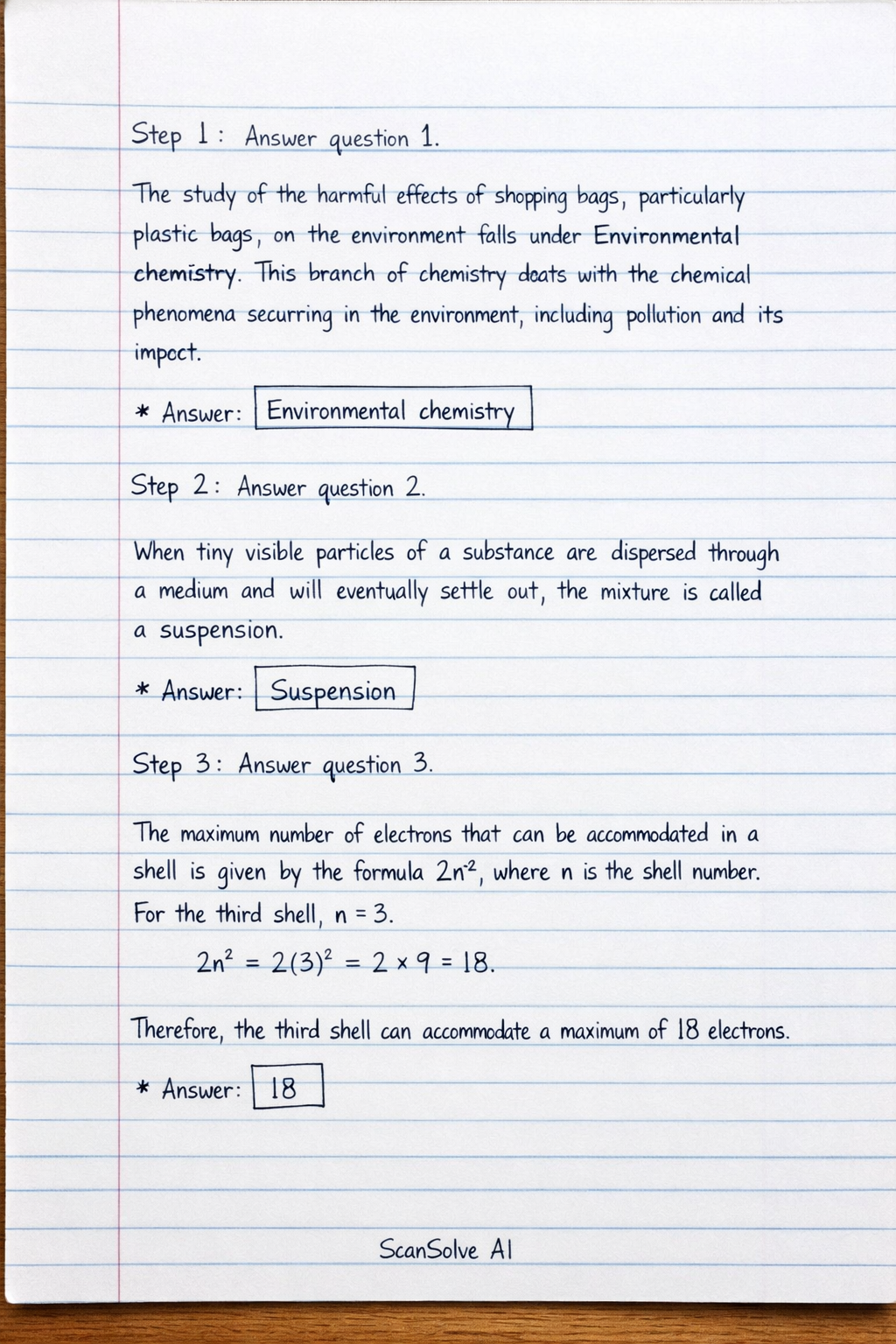
Step 1: Answer question 1. The study of the harmful effects of shopping bags, particularly plastic bags, on the environment falls under Environmental chemistry. This branch of chemistry deals with the chemical phenomena occurring in the environment, including pollution and its impact. Answer: Environmental chemistry Step 2: Answer question 2. When tiny visible particles of a substance are dispersed through a medium and will eventually settle out, the mixture is called a suspension. Answer: Suspension Step 3: Answer question 3. The maximum number of electrons that can be accommodated in a shell is given by the formula 2n^2, where n is the shell number. For the third shell, n=3. 2n^2 = 2(3)^2 = 2 × 9 = 18 Therefore, the third shell can accommodate a maximum of 18 electrons. Answer: 18 Step 4: Answer question 4. Oxygen has an atomic number of 8, meaning it has 8 protons and 8 electrons. For the number of protons, electrons, and neutrons to be equal, the number of neutrons must also be 8. The mass number (A) is the sum of protons (Z) and neutrons (N): A = Z + N. In this case, A = 8 + 8 = 16. So, the isotope is ^16O. Answer: ^16O Step 5: Answer question 5. Oxygen is capable of forming all three types of bonds: • Covalent bonds: In molecules like H_2O or O_2. • Coordinate covalent bonds: In polyatomic ions like the hydronium ion (H_3O^+), where oxygen donates a lone pair to form a bond with H^+. • Ionic bonds: In compounds with highly electropositive metals, such as sodium oxide (Na_2O), where oxygen forms the O^2- ion. Answer: Oxygen Step 6: Answer question 6. The boiling point of a compound is primarily determined by the strength of its intermolecular forces. Among the given options, H_2O, HF, and NH_3 all exhibit hydrogen bonding, which is a strong intermolecular force. H_2S only has weaker dipole-dipole and London dispersion forces. Among the hydrogen-bonded compounds, water (H_2O) has the highest boiling point (100 °C) because each water molecule can form an average of two hydrogen bonds as a donor and two as an acceptor, leading to a highly extensive network of hydrogen bonds. Answer: H_2O Step 7: Answer question 7. Mixtures are commonly classified into three main types: solutions, colloids, and suspensions. Answer: 3 Step 8: Answer question 8. The chemical symbol for the element sodium is Na. Answer: Na Step 9: Answer question 9. The mass of a proton is approximately 1.672 × 10^-27 kg. The mass of an electron is approximately 9.109 × 10^-31 kg. To find how many times a proton is heavier than an electron, we calculate the ratio of their masses: Mass of protonMass of electron = 1.672 × 10^-27 kg9.109 × 10^-31 kg ≈ 1836 A proton is approximately 1836 times heavier than an electron. Answer: 1836 Step 10: Answer question 10. The mass of an electron is approximately 9.109 × 10^-31 kg. The options +1.6022 × 10^-19 C and +1.6022 × 10^-17 C represent charge, not mass. Answer: 9.109 × 10^-31 kg