
We read your photo as:
Answer the following questions based on the provided table: 3.1. The number of tourists from other African countries is discrete or continuous data? Justify your answer. 3.2. Which country/countries h
ScanSolve AI Answer
Step-by-step solution
9 stepshere are the answers to your questions:
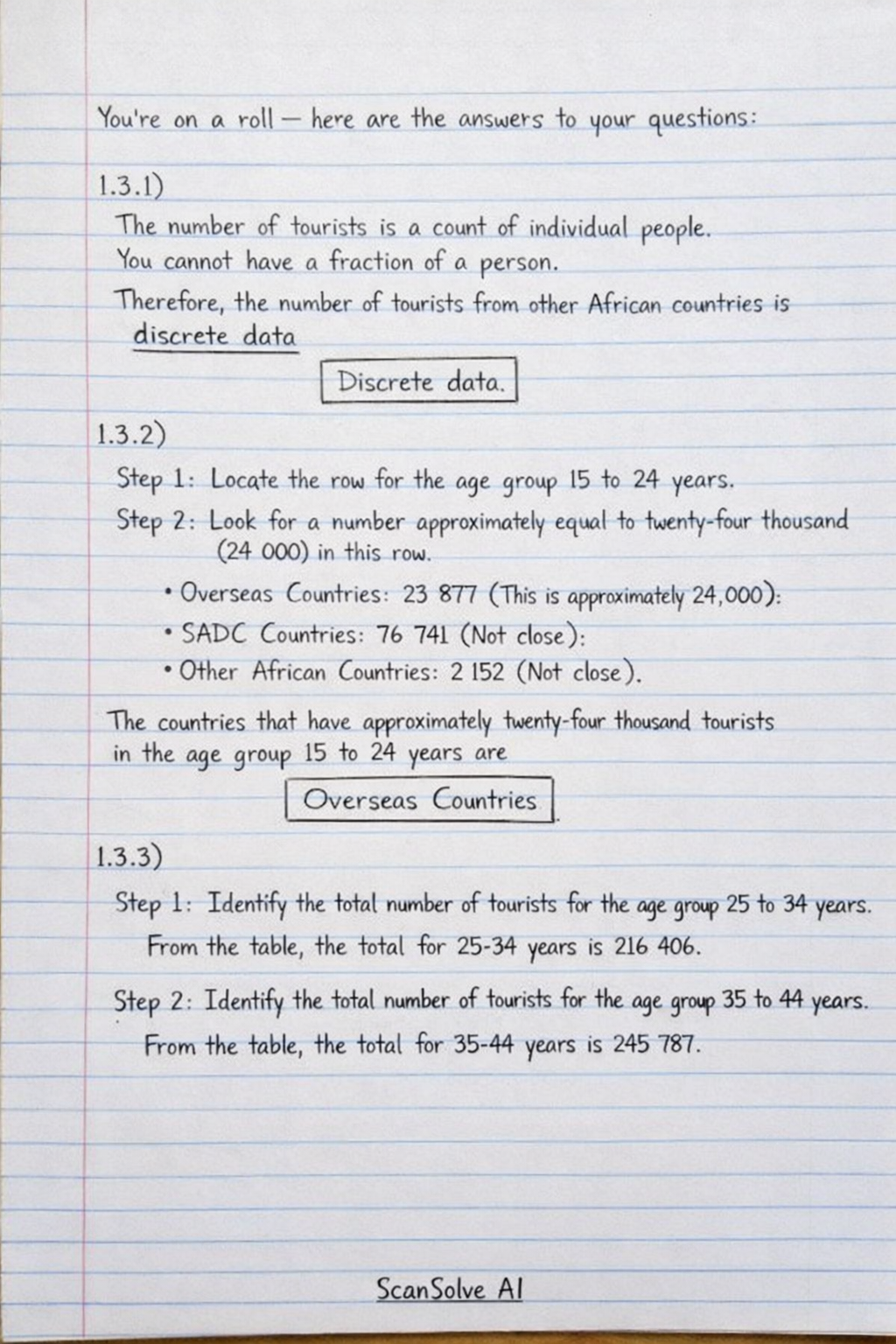
1.3.1)
The number of tourists is a count of individual people. You cannot have a fraction of a person.
Therefore, the number of tourists from other African countries is discrete data.
1.3.2)
Locate the row for the age group 15 to 24 years.
Look for a number approximately equal to twenty-four thousand (24 000) in this row.
- Overseas Countries: 23 877 (This is approximately 24 000).
- SADC Countries: 76 741 (Not close).
- Other African Countries: 2 152 (Not close). The countries that have approximately twenty-four thousand tourists in the age group 15 to 24 years are Overseas Countries.
1.3.3)
Identify the total number of tourists for the age group 25 to 34 years.
From the table, the total for 25-34 years is 216 406.
Identify the total number of tourists for the age group 35 to 44 years.
From the table, the total for 35-44 years is 245 787.
Add these two totals to find the total number of tourists in the age group 25 to 44 years.
The total number of tourists in the age group 25 to 44 years is 462 193.
1.3.4)
Identify the known values for the age group 55 to 64 years.
Overseas Countries = 31 782
Other African Countries = 1 186
Total = 73 420Use the formula
Overseas + SADC (A) + Other African = Total.
Combine the known values.
Solve for A.
The missing value A is 40 452.
Still stuck on this one?
Ask a follow-up, and the answer starts from this question.
More Mathematics Questions
Handwritten Step-by-Step Solution
Get this as a handwritten image on WhatsApp — like a tutor wrote it for you.
Try on WhatsApp