
We read your photo as:
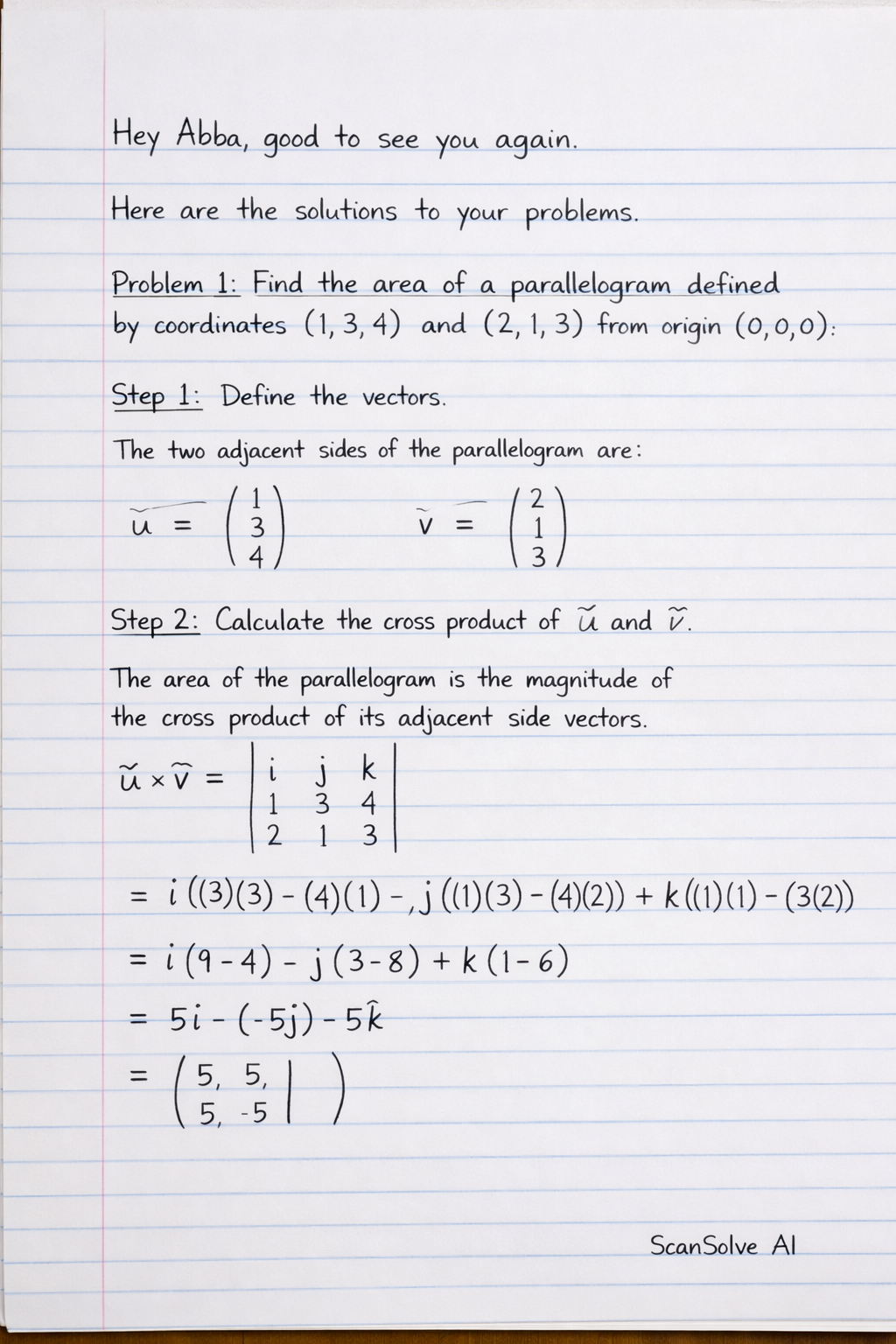
Find the area of a parallelogram defined by coordinates (1,3,4) and (2,1,3) from the origin (0,0,0).
ScanSolve AI Answer
Step-by-step solution
8 stepsHere are the solutions to your problems.
: Find the area of a parallelogram defined by coordinates $(1,3,4)$ and $(2,1,3)$ from the origin $(0,0,0)$.
Define the vectors.
The two adjacent sides of the parallelogram are given by the vectors originating from the origin:
Calculate the cross product of and .
The area of the parallelogram is the magnitude of the cross product of its adjacent side vectors.
Calculate the magnitude of the cross product vector.
The magnitude of the vector is:
The area of the parallelogram is .
: Show that if for some scalar , then .
Start with the given equation.
We are given the relationship:
Take the cross product of both sides with .
Apply the distributive property of the cross product.
The cross product is distributive over vector addition:
Use the property that the cross product of a vector with itself (or a scalar multiple of itself) is zero.
Since is a scalar multiple of , the cross product is zero because the vectors are parallel.
Substitute this back into the equation.
This proves the statement.
Still stuck on this one?
Ask a follow-up, and the answer starts from this question.
More Mathematics Questions
Handwritten Step-by-Step Solution
Get this as a handwritten image on WhatsApp — like a tutor wrote it for you.
Try on WhatsApp