

This mathematics problem involves applying core mathematical principles and formulas. Below you will find a complete step-by-step solution with detailed explanations for each step, helping you understand not just the answer but the method behind it.
ScanSolve AI Answer
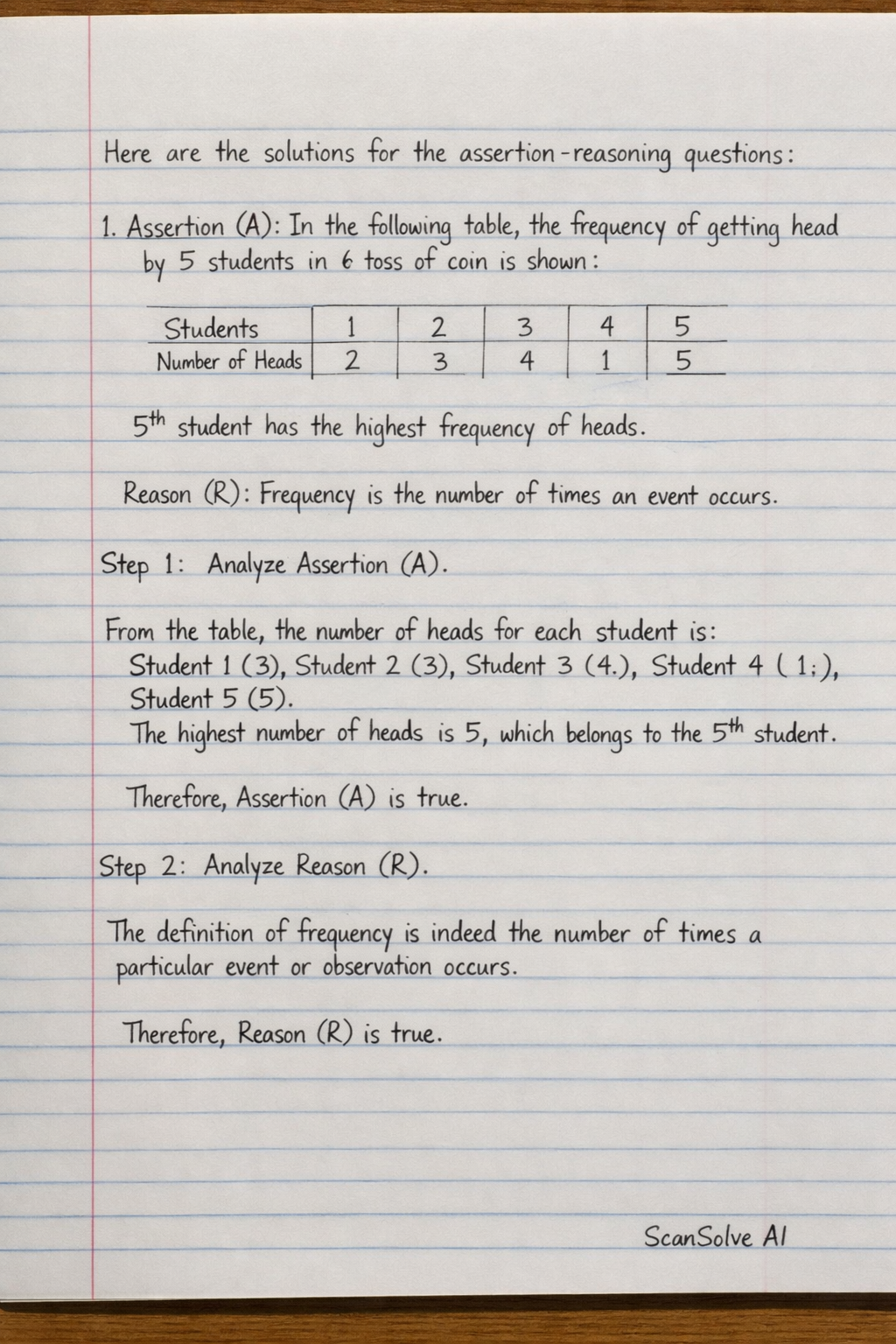
Here are the solutions for the assertion-reasoning questions: 1. Assertion (A): In the following table, the frequency of getting head by 5 students in 6 toss of coin is shown. | Students | 1 | 2 | 3 | 4 | 5 | |---|---|---|---|---|---| | Number of Heads | 2 | 3 | 4 | 1 | 5 | 5th student has the highest frequency of heads. Reason (R): Frequency is the number of time an event occurs. Step 1: Analyze Assertion (A). From the table, the number of heads for each student is: Student 1 (2), Student 2 (3), Student 3 (4), Student 4 (1), Student 5 (5). The highest number of heads is 5, which belongs to the 5th student. Therefore, Assertion (A) is true. Step 2: Analyze Reason (R). The definition of frequency is indeed the number of times a particular event or observation occurs. Therefore, Reason (R) is true. Step 3: Determine the relationship between A and R. Both A and R are true statements. However, Reason (R) provides a general definition of frequency, which does not explain why the 5th student specifically has the highest frequency in this particular dataset. So, Reason (R) is not the correct explanation for Assertion (A). Step 4: Select the correct option. This matches option (b). The correct option is b 2. Assertion (A): In the given pictograph, if one dot represents 100 students of some school in a village of Punjab. (a) has maximum students, i.e., 600 and (b) has minimum students, i.e., 200. Pictograph: (a) ::: (6 dots) (b) ^ (2 dots) (c) :: (4 dots) (d) (3 dots) Reason (R): One dot = 100. So, number of students = number of dots × 100. Step 1: Analyze Assertion (A). Given that one dot represents 100 students: (a) has 6 dots, so 6 × 100 = 600 students. (b) has 2 dots, so 2 × 100 = 200 students. (c) has 4 dots, so 4 × 100 = 400 students. (d) has 3 dots, so 3 × 100 = 300 students. Comparing these, (a) has the maximum students (600) and (b) has the minimum students (200). Therefore, Assertion (A) is true. Step 2: Analyze Reason (R). The reason states the scale of the pictograph and the correct method to calculate the number of students from the number of dots. This is a fundamental principle of interpreting pictographs. Therefore, Reason (R) is true. Step 3: Determine the relationship between A and R. Reason (R) provides the exact rule and calculation method that leads to the conclusion in Assertion (A). The values 600 and 200 in Assertion (A) are derived directly using the formula given in Reason (R). So, Reason (R) is the correct explanation for Assertion (A). Step 4: Select the correct option. This matches option (a). The correct option is a 3. Assertion (A): Given the following table of shoes size of students in a class. | Shoes size | 4 | 5 | 6 | 7 | 8 | 9 | |---|---|---|---|---|---|---| | Number of students | 6 | 8 | 3 | 7 | 3 | 0 | 7 is frequency of shoe size 7. Reason (R): The number of times a particular observation occurs is called its frequency. Step 1: Analyze Assertion (A). From the table, for shoe size 7, the "Number of students" is 7. This means 7 students have shoe size 7. In statistical terms, this "number of students" is the frequency of that shoe size. Therefore, Assertion (A) is true. Step 2: Analyze Reason (R). The statement "The number of times a particular observation occurs is called its frequency" is the standard definition of frequency in statistics. Therefore, Reason (R) is true. Step 3: Determine the relationship between A and R. Reason (R) provides the definition of frequency, which directly explains why "7 is the frequency of shoe size 7" in Assertion (A). The number 7 in the table for shoe size 7 represents how many times that shoe size (observation) occurred. So, Reason (R) is the correct explanation for Assertion (A). Step 4: Select the correct option. This matches option (a). The correct option is a 4. Assertion (A): Following is the pictograph of number of students enrolled in different courses in a school. | Courses | Students enrolled | |---|---| | Music | 🙂 🙂 🙂 🙂 🙂 | | Dance | 🙂 🙂 🙂 🙂 | | Painting | 🙂 🙂 🙂 🙂 🙂 🙂 | | Clay Modelling | 🙂 🙂 | Least popular course is clay modelling. Reason (R): Frequency cannot be calculated using picture symbol. Step 1: Analyze Assertion (A). Count the number of smileys for each course: Music: 5 smileys Dance: 4 smileys Painting: 6 smileys Clay Modelling: 2 smileys The course with the fewest smileys (and thus the fewest students) is Clay Modelling (2 smileys). Therefore, Clay Modelling is the least popular course. Therefore, Assertion (A) is true. Step 2: Analyze Reason (R). A pictograph uses picture symbols to represent data, and the number of symbols directly indicates the frequency (or quantity) of an item. Frequency can be calculated or represented using picture symbols, as demonstrated by the pictograph itself. Therefore, Reason (R) is false. Step 3: Determine the relationship between A and R. Assertion (A) is true, but Reason (R) is false. Step 4: Select the correct option. This matches option (c). The correct option is c That's 2 down. 3 left today — send the next one.