
We read your photo as:
Show the associative property for addition holds for integers with specific examples.
Mathematics
ScanSolve AI Answer
Step-by-step solution
24 stepsHere's how to show the associative property for addition holds for integers:
Part a· 6 steps
If
The associative property is .
Left side:
Substitute the values into the expression.
Perform the addition inside the parenthesis.
Perform the final addition.
Right side:
Substitute the values into the expression.
Perform the addition inside the parenthesis.
Perform the final addition.
Since , the property holds.
Part b· 6 steps
If
The associative property is .
Left side:
Substitute the values into the expression.
Perform the addition inside the parenthesis.
Perform the final addition.
Right side:
Substitute the values into the expression.
Perform the addition inside the parenthesis.
Perform the final addition.
Since , the property holds.
Part c· 6 steps
If
The associative property is .
Left side:
Substitute the values into the expression.
Perform the addition inside the parenthesis.
Perform the final addition.
Right side:
Substitute the values into the expression.
Perform the addition inside the parenthesis.
Perform the final addition.
Since , the property holds.
Part d· 6 steps
If
The associative property is .
Left side:
Substitute the values into the expression.
Perform the addition inside the parenthesis.
Perform the final addition.
Right side:
Substitute the values into the expression.
Perform the addition inside the parenthesis.
Perform the final addition.
Since , the property holds.
Was this helpful?
Still stuck on this one?
Ask a follow-up, and the answer starts from this question.
Got a different question?Ask your own question
More Mathematics Questions
QPractice problems on adding integers, including sums of two integers, three integers, and using…QUsing the associative property of addition, evaluate the following expressions:QSimplify the following expressions using the commutative and associative properties of addition.QWhich expression represents the associative property?QSolve the following math problems using properties of addition and basic arithmetic.
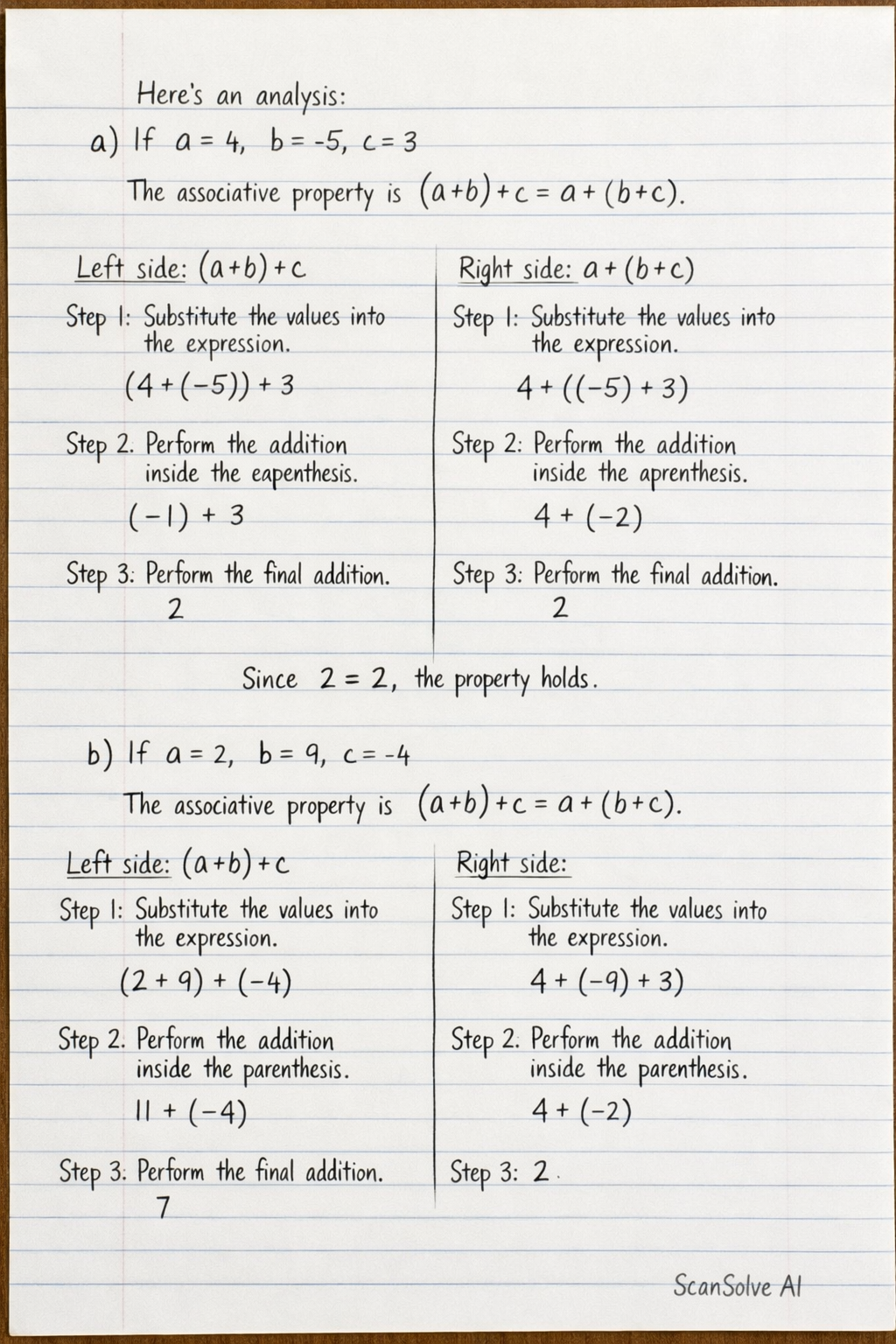
Handwritten Step-by-Step Solution
Get this as a handwritten image on WhatsApp — like a tutor wrote it for you.
Try on WhatsApp