

This mathematics problem involves applying core mathematical principles and formulas. Below you will find a complete step-by-step solution with detailed explanations for each step, helping you understand not just the answer but the method behind it.
ScanSolve AI Answer
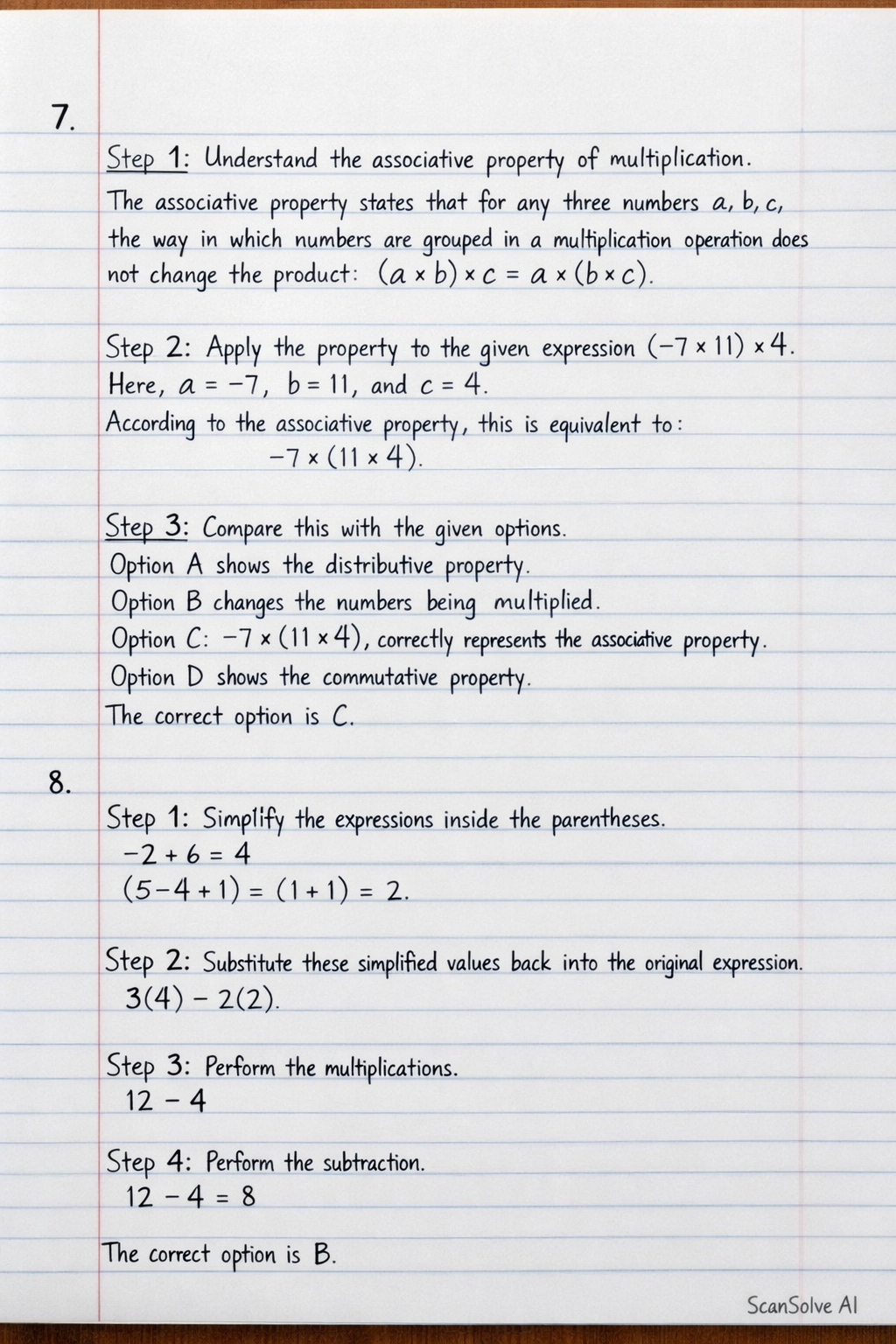
7. Step 1: Understand the associative property of multiplication. The associative property states that for any three numbers a, b, c, the way in which numbers are grouped in a multiplication operation does not change the product: (a × b) × c = a × (b × c). Step 2: Apply the property to the given expression (-7 × 11) × 4. Here, a = -7, b = 11, and c = 4. According to the associative property, this is equivalent to -7 × (11 × 4). Step 3: Compare this with the given options. Option A shows the distributive property. Option B changes the numbers being multiplied. Option C, -7 × (11 × 4), correctly represents the associative property. Option D shows the commutative property. The correct option is C. 8. Step 1: Simplify the expressions inside the parentheses. (-2+6) = 4 (5-4+1) = (1+1) = 2 Step 2: Substitute these simplified values back into the original expression. 3(4) - 2(2) Step 3: Perform the multiplications. 12 - 4 Step 4: Perform the subtraction. 12 - 4 = 8 The correct option is B. 9. Step 1: Find the additive inverse of -2. The additive inverse of a number x is -x, such that x + (-x) = 0. For -2, the additive inverse is -(-2) = 2. Step 2: Find the multiplicative inverse of -2. The multiplicative inverse (reciprocal) of a non-zero number x is (1)/(x), such that x × (1)/(x) = 1. For -2, the multiplicative inverse is (1)/(-2) = -(1)/(2). Step 3: Combine the results. The additive inverse is 2 and the multiplicative inverse is -(1)/(2). The correct option is D. 10. Step 1: Simplify the expression in the numerator. The expression is 2(-3) - (5) - 4(6+8). First, simplify inside the parentheses: (6+8) = 14. Substitute this back: 2(-3) - 5 - 4(14). Perform multiplications: 2(-3) = -6 and 4(14) = 56. The numerator becomes: -6 - 5 - 56. Combine the terms: -11 - 56 = -67. Step 2: Simplify the expression in the denominator. The expression is 5-6. 5-6 = -1 Step 3: Divide the numerator by the denominator. (-67)/(-1) = 67 Note: The calculated answer is 67, which is not among the given options. Assuming there might be a typo in the question and that (6+8) was intended to be (6-8), let's re-evaluate the numerator: If the numerator was 2(-3) - (5) - 4(6-8): 2(-3) - 5 - 4(-2) -6 - 5 + 8 -11 + 8 = -3 In this case, the fraction would be (-3)/(-1) = 3. This matches option D. Given the multiple-choice format, we will proceed with this assumption to select an option. The correct option is D. What's next?