
We read your photo as:
Find the basis and dimension of the span of the given vectors: (1,0), (0,1), (1,1) and (1,2,0), (0,1,3).
ScanSolve AI Answer
Answer
Step-by-step solution
2 stepsFind the dimension of Span of .
Let the given vectors be , , and . These vectors are in .
We check for linear independence. The vectors and are the standard basis vectors for , so they are linearly independent.
We can express as a linear combination of and :Since is a linear combination of and , it is linearly dependent on them.
Therefore, the set is linearly dependent.
A basis for the span is a maximal set of linearly independent vectors. In this case, forms a basis.
The dimension of the span is the number of vectors in its basis.
The dimension of Span is 2.The dimension of Span is .
Find the basis and dimension of Span of .
Let the given vectors be and . These vectors are in .
To find the basis and dimension, we first check if the vectors are linearly independent.
Two vectors are linearly dependent if one is a scalar multiple of the other.
Assume for some scalar .From the first component, .
If , then , which is false.
Therefore, and are not scalar multiples of each other, meaning they are linearly independent.
Since the vectors are linearly independent and they span the given space, they form a basis for that space.
The basis for Span is .
The dimension of the span is the number of vectors in its basis.
The dimension of Span is 2.The basis is and the dimension is .
Try one yourself
A new problem that tests the same skill.
Still stuck on this one?
Ask a follow-up, and the answer starts from this question.
More Mathematics Questions
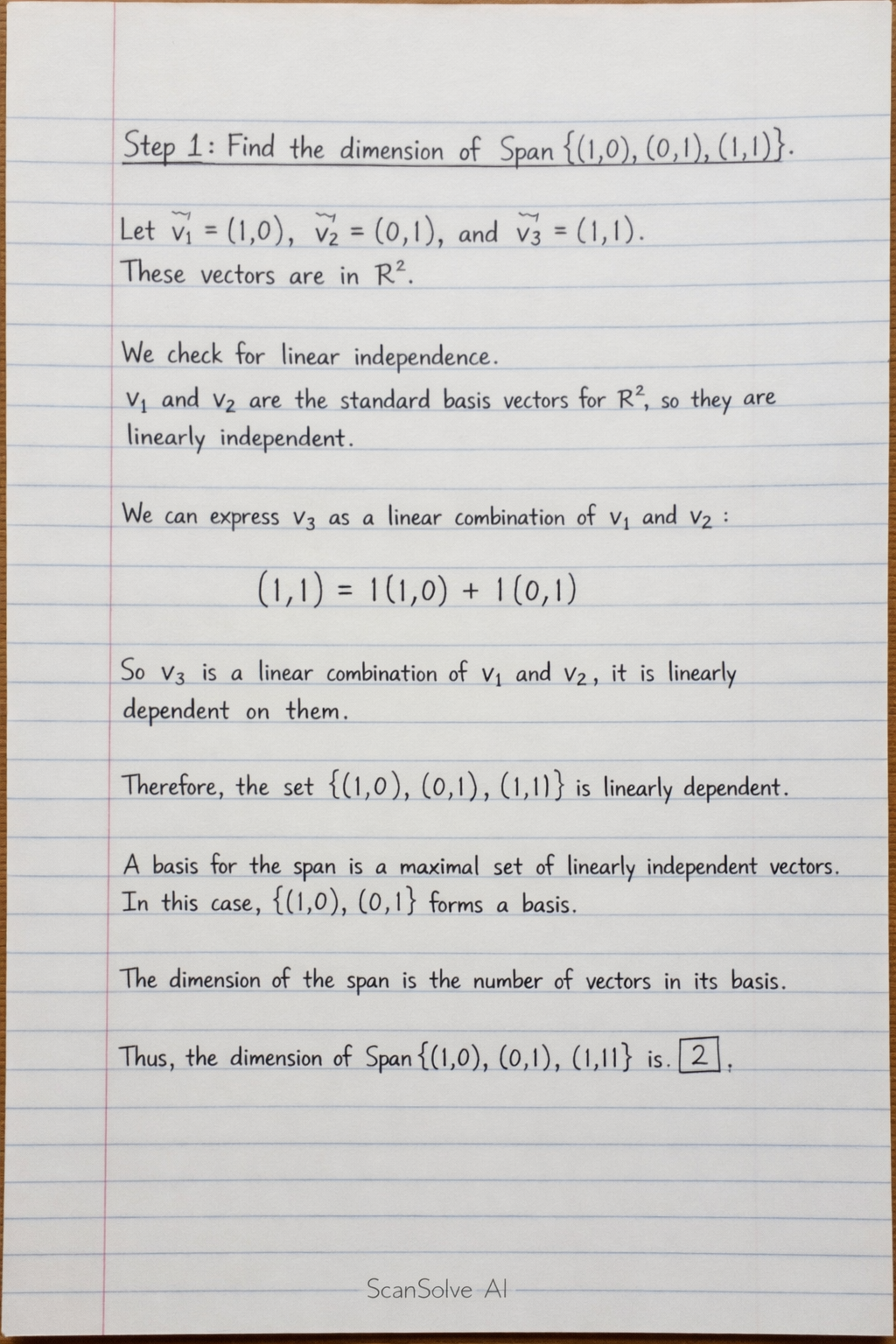
Handwritten Step-by-Step Solution
Get this as a handwritten image on WhatsApp — like a tutor wrote it for you.
Try on WhatsApp