

This mathematics problem involves applying core mathematical principles and formulas. Below you will find a complete step-by-step solution with detailed explanations for each step, helping you understand not just the answer but the method behind it.
ScanSolve AI Answer
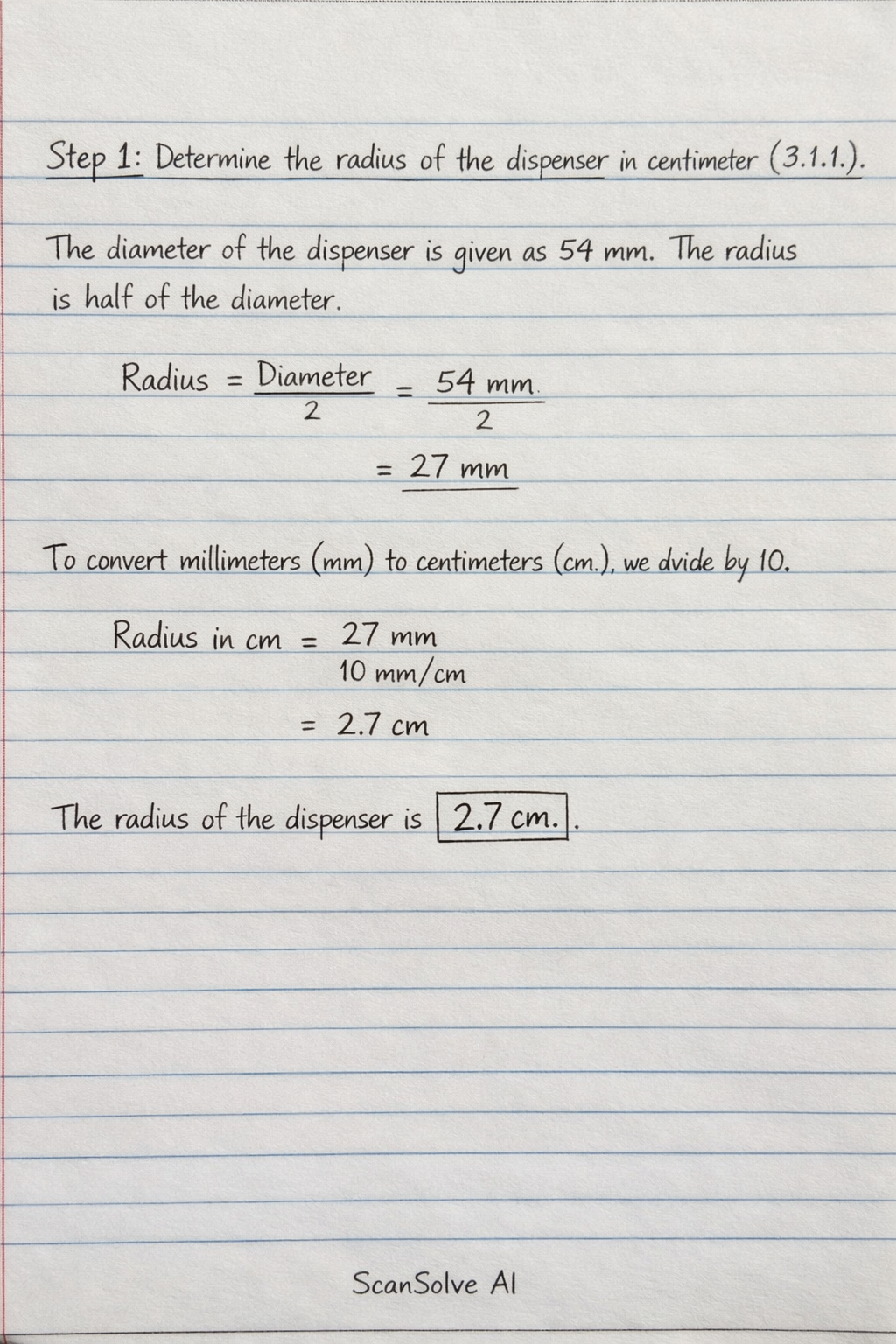
Step 1: Determine the radius of the dispenser in centimeter (3.1.1). The diameter of the dispenser is given as 54 mm. The radius is half of the diameter. Radius = Diameter2 = 54 mm2 = 27 mm To convert millimeters (mm) to centimeters (cm), we divide by 10. Radius in cm = 27 mm10 mm/cm = 2.7 cm The radius of the dispenser is 2.7 cm. Step 2: Calculate the capacity of the dispenser to the nearest millilitres (3.1.2). The formula for the volume of a cylinder is V = r^2 h. From the diagram, the height of the main dispenser body is 150 mm. From Step 1, the radius r = 27 mm. We are given = 3.142. V = 3.142 × (27 mm)^2 × 150 mm V = 3.142 × 729 mm^2 × 150 mm V = 343606.5 mm^3 To convert cubic millimeters (mm^3) to millilitres (ml), we use the conversion 1 ml = 1000 mm^3. V_ml = 343606.5 mm^31000 mm^3/ml = 343.6065 ml Rounding to the nearest millilitre: V_ml ≈ 344 ml The capacity of the dispenser is 344 ml. Step 3: Determine the number of dispensers that can be filled from a 20 litre liquid soap bottle (3.1.3). The capacity of one dispenser is 344 ml (from Step 2). The total volume of liquid soap is 20 litres. First, convert litres to millilitres (1 L = 1000 ml). Total volume = 20 L × 1000 ml/L = 20000 ml Now, divide the total volume by the capacity of one dispenser: Number of dispensers = 20000 ml344 ml/dispenser ≈ 58.1395 Since you can only fill whole dispensers, we round down to the nearest whole number. The number of dispensers that can be filled is 58. Step 4: Calculate the surface area in mm^2 of the dispenser head (3.1.4). The problem states the dispenser head is open at the bottom and provides the formula for the surface area of a cylinder as r^2 + 2 r h. This formula includes one circular base ( r^2) and the ✂️ _That answer was long and got cut off. Reply continue and I'll finish it._