

This mathematics problem involves applying core mathematical principles and formulas. Below you will find a complete step-by-step solution with detailed explanations for each step, helping you understand not just the answer but the method behind it.
ScanSolve AI Answer
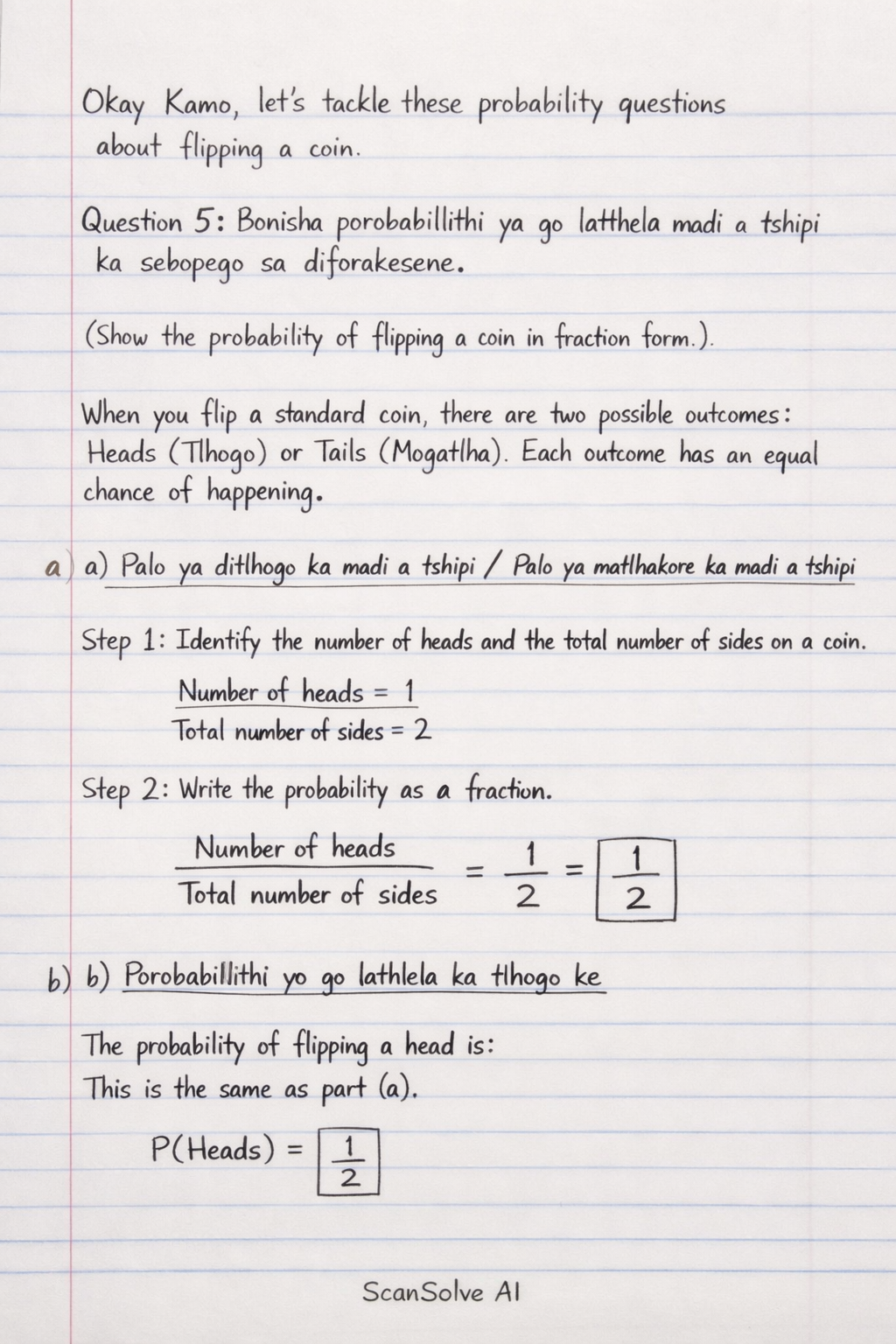
Okay Kamo, let's tackle these probability questions about flipping a coin. Question 5: Bonisha porobabillithi ya go latlhela madi a tshipi ka sebopego sa diforakesene. (Show the probability of flipping a coin in fraction form.) When you flip a standard coin, there are two possible outcomes: Heads (Tlhogo) or Tails (Mogatlha). Each outcome has an equal chance of happening. a) Palo ya ditlhogo ka madi a tshipi / Palo ya matlhakore ka madi a tshipi (Number of heads on a coin / Number of sides on a coin) Step 1: Identify the number of heads and the total number of sides on a coin. Number of heads = 1 Total number of sides = 2 Step 2: Write the probability as a fraction. Number of headsTotal number of sides = (1)/(2) b) Porobabillithi ya go latlhela ka tlhogo ke (The probability of flipping a head is) This is the same as part (a). P(Heads) = (1)/(2) c) Palo ya megatla ka madi a tshipi / Palo ya matlhakore ka madi a tshipi (Number of tails on a coin / Number of sides on a coin) Step 1: Identify the number of tails and the total number of sides on a coin. Number of tails = 1 Total number of sides = 2 Step 2: Write the probability as a fraction. Number of tailsTotal number of sides = (1)/(2) d) Porobabillithi ya go latlhela ka mogatla ke (The probability of flipping a tail is) This is the same as part (c). P(Tails) = (1)/(2) Question 4 (second instance on the page): Dirisa dipholo tsa rona go emela porobabillithi ya go latlhela madi a tshipi ka sebopego sa diforakesene. (Use our results to represent the probability of flipping a coin in fraction form.) This question asks for the general formula for probability based on observed outcomes. The formula given is: Palo ya makgetlo a o a fitlhelelangPalogotlhe ya go latlhela (Number of times you achieve the outcome / Total number of flips) For a single coin flip, the probability of getting a specific outcome (like heads or tails) is 1 out of 2. Probability = (1)/(2) Question 4 (first instance on the page): Thala pikithokerato go supa palo ya Ditlhogo kgotsa Megalla ya tekeletso ya gogo mo diphetolong tsa ntlha di le 10: (Draw a pictograph to show the number of Heads or Tails from the first 10 flips:) To fill in this pictograph, we would need the actual results of 10 coin flips. Since no specific results are provided, I cannot draw the pictograph. If you perform 10 coin flips, you would mark an 'X' or a symbol in the grid for each head or tail in the corresponding column (1 to 10). For example, if the first flip was Heads, you'd mark a square in column 1 for Heads. The statement at the end explains an important concept in probability: "Ditlamorago tsa gago tsa porobabillithi di ka tswa di farologane le ditlamorago tse di solofetsweng. Fa o dira latlhela tse dintsi, ke gone fa e le gaufi le ditlamorago tse di solofetsweng." (Your probability results might differ from the expected results. If you do many flips, then it will be closer to the expected results.) This is known as the Law of Large Numbers. It means that while a few coin flips might not give you exactly 50% heads and 50% tails, if you flip the coin many, many times, the proportion of heads and tails will get closer and closer to the theoretical probability of (1)/(2) for each. That's 2 down. 3 left today — send the next one.