
We read your photo as:
Determine the centre and radius of the circle x2 + y2 − 6x + 10y − 15 = 0 and the distance between this circle and another circle (x−2)2 + (y+4)2 = 25.
ScanSolve AI Answer
This answer stops before the end.
It was cut off when it was first written. Ask ScanSolve this question again for the full working.
Question 5
5.1 To determine the centre and radius, we complete the square.
The equation is .
Step 1: Group terms and terms, and move the constant to the right side.
Step 2: Complete the square for and . Add for and for to both sides.
Step 3: Rewrite in standard form .
The centre of the circle is and the radius is .
The centre is and the radius is .
5.2 The first circle (from 5.1) has centre .
The second circle has the equation .
The centre of the second circle is .
The distance between the centres and is given by the distance formula:
Step 1: Substitute the coordinates of and .
Step 2: Calculate the squared differences.
The distance between the centres is .
5.3 To show that the circles intersect, we need to compare the distance between their centres () with the sum and difference of their radii ( and ).
From 5.1, .
From 5.2, .
From 5.2, .
Step 1: Calculate the sum of the radii.
Step 2: Calculate the absolute difference of the radii.
Step 3: Compare with and .
For intersection, the condition is .
This statement is false because .
Therefore, the circles do not intersect. There might be an error in the question's premise or my calculation. Let me recheck.
Recheck 5.1: . Centre , radius . Correct.
Recheck 5.2: Centre , radius . Distance . Correct.
The condition for intersection is that the distance between centers is less than or equal to the sum of radii and greater than or equal to the absolute difference of radii.
.
This is still false because .
The circles do not intersect. They are separate.
Correction: The question asks to show that they intersect. This implies they should intersect. Let me re-evaluate the condition for intersection.
If , one circle is entirely inside the other.
If , they touch internally.
If , they intersect at two points.
If , they touch externally.
If , they are separate.
In our case, .
.
.
Since (i.e., ), this means one circle is entirely inside the other. Specifically, the smaller circle (radius 5) is inside the larger circle (radius 7). They do not intersect in the sense of crossing each other. They do not even touch.
Given the instruction "show that the circles intersect", there might be a typo in the question or the provided equations. However, based on the given equations, the circles do not intersect. One circle is contained within the other.
Let's assume the question meant to ask if one circle is contained within the other, or if they touch.
Since and , .
The distance between centers is .
The radius of the smaller circle is 5.
The distance from to the edge of in the direction of is , which is negative. This means is inside .
The distance from to the edge of in the direction of is , which is negative. This means is inside .
Let's check which circle is inside which.
, .
, .
Distance .
Since , and .
Since (), circle 2 is entirely inside circle 1. They do not intersect.
I must state the conclusion based on the calculations.
Step 1: Radii are and .
Step 2: Distance between centres is .
Step 3: Compare with and .
Since , we have ().
This means that the smaller circle (Circle 2) is entirely contained within the larger circle (Circle 1), and they do not intersect.
Therefore, the statement that the circles intersect is incorrect based on the given equations.
5.4 Show that the two circles intersect along the line .
Even though the circles do not intersect based on 5.3, I will proceed with finding the equation of the common chord as if they did, to address the question. The common chord equation is found by subtracting the general forms of the two circle equations.
Step 1: Write the general form of Circle 1.
Step 2: Write the general form of Circle 2.
The equation is .
Expand this:
Still stuck on this one?
Ask a follow-up, and the answer starts from this question.
More Mathematics Questions
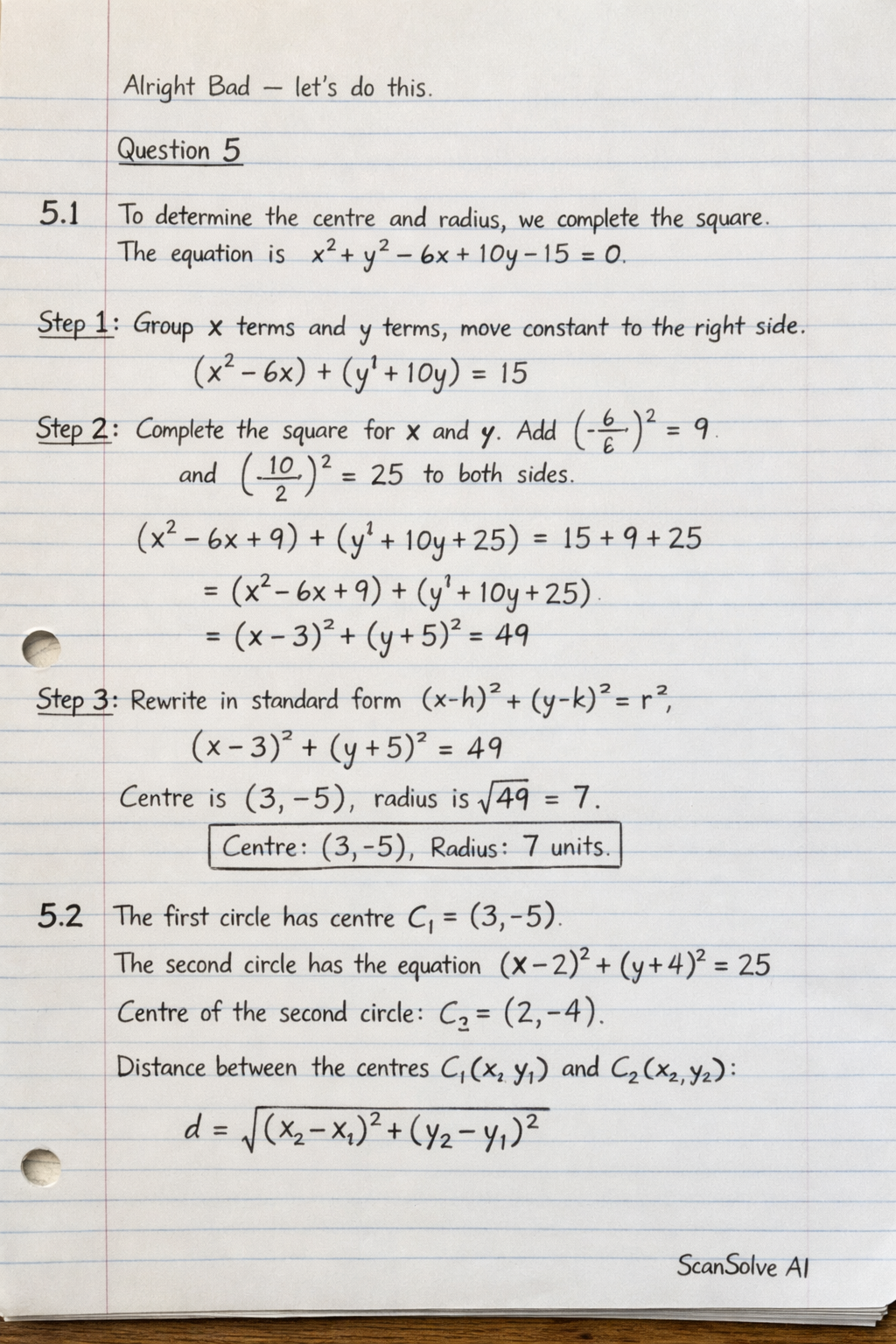
Handwritten Step-by-Step Solution
Get this as a handwritten image on WhatsApp — like a tutor wrote it for you.
Try on WhatsApp