

This mathematics problem involves applying core mathematical principles and formulas. Below you will find a complete step-by-step solution with detailed explanations for each step, helping you understand not just the answer but the method behind it.
ScanSolve AI Answer
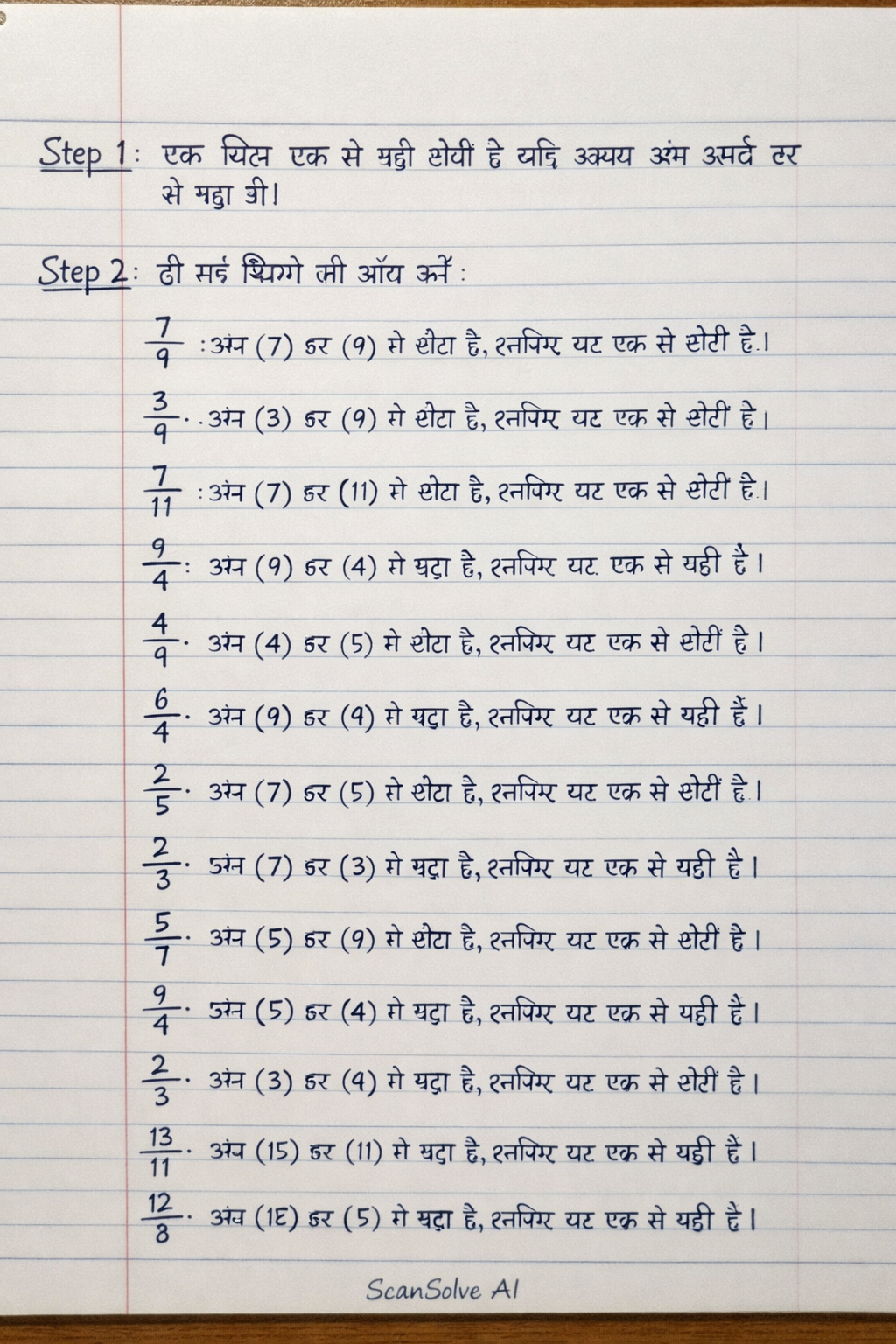
Step 1: एक भिन्न (fraction) एक से बड़ी होती है यदि उसका अंश (numerator) उसके हर (denominator) से बड़ा हो। Step 2: दी गई भिन्नों की जाँच करें: • (7)/(9): अंश (7) हर (9) से छोटा है, इसलिए यह एक से छोटी है। • (3)/(9): अंश (3) हर (9) से छोटा है, इसलिए यह एक से छोटी है। • (7)/(11): अंश (7) हर (11) से छोटा है, इसलिए यह एक से छोटी है। • (9)/(4): अंश (9) हर (4) से बड़ा है, इसलिए यह एक से बड़ी है। • (4)/(9): अंश (4) हर (9) से छोटा है, इसलिए यह एक से छोटी है। • (9)/(4): अंश (9) हर (4) से बड़ा है, इसलिए यह एक से बड़ी है। • (2)/(5): अंश (2) हर (5) से छोटा है, इसलिए यह एक से छोटी है। • (7)/(3): अंश (7) हर (3) से बड़ा है, इसलिए यह एक से बड़ी है। • (5)/(7): अंश (5) हर (7) से छोटा है, इसलिए यह एक से छोटी है। • (5)/(4): अंश (5) हर (4) से बड़ा है, इसलिए यह एक से बड़ी है। • (2)/(3): अंश (2) हर (3) से छोटा है, इसलिए यह एक से छोटी है। • (13)/(11): अंश (13) हर (11) से बड़ा है, इसलिए यह एक से बड़ी है। • (12)/(5): अंश (12) हर (5) से बड़ा है, इसलिए यह एक से बड़ी है। • (12)/(8): अंश (12) हर (8) से बड़ा है, इसलिए यह एक से बड़ी है। Step 3: एक से बड़ी भिन्नें हैं: (9)/(4), (9)/(4), (7)/(3), (5)/(4), (13)/(11), (12)/(5), (12)/(8) Send me the next one 📸