ScanSolve logoScanSolve
Toggle sidebar
  • Homework
  • Tutor
  • Humanizer
  • AI Detector
  • Questions
  • Blog
  • History
  • Mobile App

  • Homework
  • Tutor
  • Humanizer
  • AI Detector

  • Questions
  • Math homework helpMath
    Physics homework helpPhysics
    Chemistry homework helpChemistry
    Biology homework helpBiology
    Computer Science homework helpComputer Science
    History homework helpHistory
    More homework helpMore
  • Blog
  • History

  • Mobile App
ScanSolvePLUS
  • Unlimited answers
  • ScanSolve AI Pro
Start Free Trial →
Try on WhatsApp
Home > Mathematics Homework Help > Solution

Find a common denominator for the fractions.

Asked on March 28, 2026|Mathematics

This mathematics problem involves applying core mathematical principles and formulas. Below you will find a complete step-by-step solution with detailed explanations for each step, helping you understand not just the answer but the method behind it.

ScanSolve AI AnswerAnswered on March 28, 2026
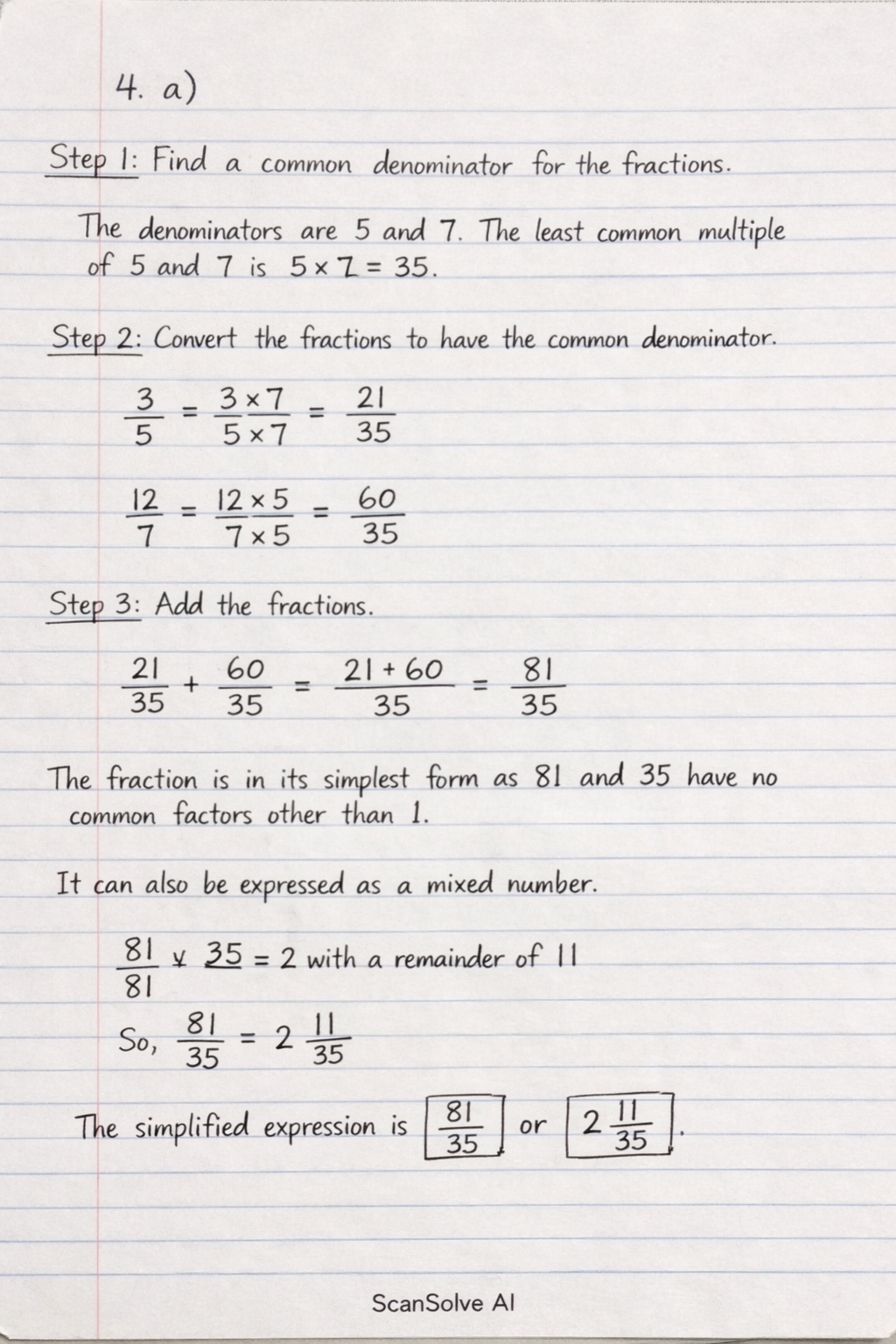
4. a) Step 1: Find a common denominator for the fractions. The denominators are 5 and 7. The least common multiple of 5 and 7 is $5 \times 7 = 35$. Step 2: Convert the fractions to have the common denominator. $$\frac{3}{5} = \frac{3 \times 7}{5 \times 7} = \frac{21}{35}$$ $$\frac{12}{7} = \frac{12 \times 5}{7 \times 5} = \frac{60}{35}$$ Step 3: Add the fractions. $$\frac{21}{35} + \frac{60}{35} = \frac{21 + 60}{35} = \frac{81}{35}$$ The fraction is in its simplest form as 81 and 35 have no common factors other than 1. It can also be expressed as a mixed number. $$81 \div 35 = 2 \text{ with a remainder of } 11$$ So, $\frac{81}{35} = 2\frac{11}{35}$. The simplified expression is $\boxed{\frac{81}{35}}$ or $\boxed{2\frac{11}{35}}$. 4. b) Step 1: Determine the cost per kg of meat. Given that 3 kg of meat costs Gh¢60. Cost per kg = $\frac{\text{Total Cost}}{\text{Weight}} = \frac{60 \text{ Gh¢}}{3 \text{ kg}} = 20 \text{ Gh¢/kg}$. Step 2: Calculate the cost for each weight in the table. For 2 kg: Cost = $2 \text{ kg} \times 20 \text{ Gh¢/kg} = 40 \text{ Gh¢}$. For 5 kg: Cost = $5 \text{ kg} \times 20 \text{ Gh¢/kg} = 100 \text{ Gh¢}$. For 12 kg: Cost = $12 \text{ kg} \times 20 \text{ Gh¢/kg} = 240 \text{ Gh¢}$. Step 3: Complete the table. | Meat (kg) | 2 | 3 | 5 | 12 | |---|---|---|---|---| | Cost Gh¢ | 40 | 60 | 100 | 240 | 4. c) Step 1: Substitute each given value of $x$ into the relation $y = 3x - 6$ to find the corresponding $y$ value. For $x = -2$: $$y = 3(-2) - 6 = -6 - 6 = -12$$ For $x = -1$: $$y = 3(-1) - 6 = -3 - 6 = -9$$ For $x = 0$: $$y = 3(0) - 6 = 0 - 6 = -6$$ For $x = 1$: $$y = 3(1) - 6 = 3 - 6 = -3$$ For $x = 2$: $$y = 3(2) - 6 = 6 - 6 = 0$$ Step 2: Complete the table. | x | -2 | -1 | 0 | 1 | 2 | |---|---|---|---|---|---| | y | -12 | -9 | -6 | -3 | 0 | 5. a) Step 1: Identify the length and width of the rectangle. Length $L = 12.8$ m Width $W = 7.5$ m Step 2: Use the formula for the perimeter of a rectangle, $P = 2(L + W)$. $$P = 2(12.8 \text{ m} + 7.5 \text{ m})$$ $$P = 2(20.3 \text{ m})$$ $$P = 40.6 \text{ m}$$ The perimeter of the rectangle is $\boxed{40.6 \text{ m}}$. 5. b) Step 1: Simplify the expression $-30abc \div 60b^3c^2$. $$\frac{-30abc}{60b^3c^2}$$ Divide the numerical coefficients: $$\frac{-30}{60} = -\frac{1}{2}$$ Divide the variable terms using the rule $x^m/x^n = x^{m-n}$: $$a^1/1 = a$$ $$b^1/b^3 = b^{1-3} = b^{-2} = \frac{1}{b^2}$$ $$c^1/c^2 = c^{1-2} = c^{-1} = \frac{1}{c}$$ Combine the simplified terms: $$-\frac{1}{2} \cdot a \cdot \frac{1}{b^2} \cdot \frac{1}{c} = -\frac{a}{2b^2c}$$ Step 2: Substitute the given values $a=1$, $b=-2$, and $c=3$ into the simplified expression. $$-\frac{1}{2(-2)^2(3)}$$ $$-\frac{1}{2(4)(3)}$$ $$-\frac{1}{8(3)}$$ $$-\frac{1}{24}$$ The simplified and evaluated expression is $\boxed{-\frac{1}{24}}$. 5. c) Step 1: Understand that supplementary angles add up to $180^\circ$. The two angles given are $(3y + 5)^\circ$ and $(2y + 15)^\circ$. Step 2: Set up the equation. $$(3y + 5) + (2y + 15) = 180$$ Step 3: Combine like terms. $$5y + 20 = 180$$ Step 4: Isolate the term with $y$. $$5y = 180 - 20$$ $$5y = 160$$ Step 5: Solve for $y$. $$y = \frac{160}{5}$$ $$y = 32$$ The value of $y$ is $\boxed{32}$.

Related Mathematics Questions

  • Set up the partial fraction decomposition.
  • Convert the percentage abundances to fractional abundances.
  • What is the Pythagorean theorem?
  • 1. Find the degree of each polynomial
  • Differentiate each term using the power rule (d)/(dx)(ax^n) = anx^n-1 and the rule for constants (d)/(dx)(c) = 0.
  • Solve number 5-7 na please
See all Mathematics questions

This step-by-step solution was generated by ScanSolve AI. Need help with more mathematics problems? Browse Mathematics solutions or ask your own question.

Home›Mathematics Homework Help›Find a common denominator for the fractions.
Q

Find a common denominator for the fractions.

March 28, 2026|Mathematics
Find a common denominator for the fractions.

Find a common denominator for the fractions.

ScanSolve AI

ScanSolve AI Answer

Answered on March 28, 2026

4. a) Step 1: Find a common denominator for the fractions. The denominators are 5 and 7. The least common multiple of 5 and 7 is 5×7=355 \times 7 = 355×7=35. Step 2: Convert the fractions to have the common denominator. 35=3×75×7=2135\frac{3}{5} = \frac{3 \times 7}{5 \times 7} = \frac{21}{35}53​=5×73×7​=3521​ 127=12×57×5=6035\frac{12}{7} = \frac{12 \times 5}{7 \times 5} = \frac{60}{35}712​=7×512×5​=3560​ Step 3: Add the fractions. 2135+6035=21+6035=8135\frac{21}{35} + \frac{60}{35} = \frac{21 + 60}{35} = \frac{81}{35}3521​+3560​=3521+60​=3581​ The fraction is in its simplest form as 81 and 35 have no common factors other than 1. It can also be expressed as a mixed number. 81÷35=2witharemainderof1181 \div 35 = 2 with a remainder of 1181÷35=2witharemainderof11 So, 8135=21135\frac{81}{35} = 2\frac{11}{35}3581​=23511​.

The simplified expression is 8135\boxed{\frac{81}{35}}3581​​ or 21135\boxed{2\frac{11}{35}}23511​​.

4. b) Step 1: Determine the cost per kg of meat. Given that 3 kg of meat costs Gh¢60. Cost per kg = TotalCostWeight=60Gh¢3kg=20 Gh¢/kg\frac{Total Cost}{Weight} = \frac{60 Gh¢}{3 kg} = 20 \text{ Gh¢/kg}WeightTotalCost​=3kg60Gh¢​=20 Gh¢/kg. Step 2: Calculate the cost for each weight in the table. For 2 kg: Cost = 2kg×20Gh¢/kg=40 Gh¢2 kg \times 20 Gh¢/kg = 40 \text{ Gh¢}2kg×20Gh¢/kg=40 Gh¢. For 5 kg: Cost = 5kg×20Gh¢/kg=100 Gh¢5 kg \times 20 Gh¢/kg = 100 \text{ Gh¢}5kg×20Gh¢/kg=100 Gh¢. For 12 kg: Cost = 12kg×20Gh¢/kg=240 Gh¢12 kg \times 20 Gh¢/kg = 240 \text{ Gh¢}12kg×20Gh¢/kg=240 Gh¢. Step 3: Complete the table.

| Meat (kg) | 2 | 3 | 5 | 12 | |---|---|---|---|---| | Cost Gh¢ | 40 | 60 | 100 | 240 |

4. c) Step 1: Substitute each given value of xxx into the relation y=3x−6y = 3x - 6y=3x−6 to find the corresponding yyy value. For x=−2x = -2x=−2: y=3(−2)−6=−6−6=−12y = 3(-2) - 6 = -6 - 6 = -12y=3(−2)−6=−6−6=−12 For x=−1x = -1x=−1: y=3(−1)−6=−3−6=−9y = 3(-1) - 6 = -3 - 6 = -9y=3(−1)−6=−3−6=−9 For x=0x = 0x=0: y=3(0)−6=0−6=−6y = 3(0) - 6 = 0 - 6 = -6y=3(0)−6=0−6=−6 For x=1x = 1x=1: y=3(1)−6=3−6=−3y = 3(1) - 6 = 3 - 6 = -3y=3(1)−6=3−6=−3 For x=2x = 2x=2: y=3(2)−6=6−6=0y = 3(2) - 6 = 6 - 6 = 0y=3(2)−6=6−6=0 Step 2: Complete the table.

| x | -2 | -1 | 0 | 1 | 2 | |---|---|---|---|---|---| | y | -12 | -9 | -6 | -3 | 0 |

5. a) Step 1: Identify the length and width of the rectangle. Length L=12.8L = 12.8L=12.8 m Width W=7.5W = 7.5W=7.5 m Step 2: Use the formula for the perimeter of a rectangle, P=2(L+W)P = 2(L + W)P=2(L+W). P=2(12.8m+7.5m)P = 2(12.8 m + 7.5 m)P=2(12.8m+7.5m) P=2(20.3m)P = 2(20.3 m)P=2(20.3m) P=40.6 mP = 40.6 \text{ m}P=40.6 m

The perimeter of the rectangle is 40.6m\boxed{40.6 m}40.6m​.

5. b) Step 1: Simplify the expression −30abc÷60b3c2-30abc \div 60b^3c^2−30abc÷60b3c2. −30abc60b3c2\frac{-30abc}{60b^3c^2}60b3c2−30abc​ Divide the numerical coefficients: −3060=−12\frac{-30}{60} = -\frac{1}{2}60−30​=−21​ Divide the variable terms using the rule xm/xn=xm−nx^m/x^n = x^{m-n}xm/xn=xm−n: a1/1=aa^1/1 = aa1/1=a b1/b3=b1−3=b−2=1b2b^1/b^3 = b^{1-3} = b^{-2} = \frac{1}{b^2}b1/b3=b1−3=b−2=b21​ c1/c2=c1−2=c−1=1cc^1/c^2 = c^{1-2} = c^{-1} = \frac{1}{c}c1/c2=c1−2=c−1=c1​ Combine the simplified terms: −12⋅a⋅1b2⋅1c=−a2b2c-\frac{1}{2} \cdot a \cdot \frac{1}{b^2} \cdot \frac{1}{c} = -\frac{a}{2b^2c}−21​⋅a⋅b21​⋅c1​=−2b2ca​ Step 2: Substitute the given values a=1a=1a=1, b=−2b=-2b=−2, and c=3c=3c=3 into the simplified expression. −12(−2)2(3)-\frac{1}{2(-2)^2(3)}−2(−2)2(3)1​ −12(4)(3)-\frac{1}{2(4)(3)}−2(4)(3)1​ −18(3)-\frac{1}{8(3)}−8(3)1​ −124-\frac{1}{24}−241​

The simplified and evaluated expression is −124\boxed{-\frac{1}{24}}−241​​.

5. c) Step 1: Understand that supplementary angles add up to 180∘180^\circ180∘. The two angles given are (3y+5)∘(3y + 5)^\circ(3y+5)∘ and (2y+15)∘(2y + 15)^\circ(2y+15)∘. Step 2: Set up the equation. (3y+5)+(2y+15)=180(3y + 5) + (2y + 15) = 180(3y+5)+(2y+15)=180 Step 3: Combine like terms. 5y+20=1805y + 20 = 1805y+20=180 Step 4: Isolate the term with yyy. 5y=180−205y = 180 - 205y=180−20 5y=1605y = 1605y=160 Step 5: Solve for yyy. y=1605y = \frac{160}{5}y=5160​ y=32y = 32y=32

The value of yyy is 32\boxed{32}32​.

Need help with your own homework?

Get instant step-by-step solutions to any question. Free to start.

Ask Your Question
Handwritten step-by-step solution

Handwritten Step-by-Step Solution

Get this solution as a handwritten image on WhatsApp — just like a tutor wrote it for you.

Try on WhatsApp

More Mathematics Questions

Set up the partial fraction decomposition.Convert the percentage abundances to fractional abundances.What is the Pythagorean theorem?1. Find the degree of each polynomialDifferentiate each term using the power rule (d)/(dx)(ax^n) = anx^n-1 and the rule for constants (d)…Solve number 5-7 na please
See all Mathematicsquestions →