

This mathematics problem involves applying core mathematical principles and formulas. Below you will find a complete step-by-step solution with detailed explanations for each step, helping you understand not just the answer but the method behind it.
ScanSolve AI Answer
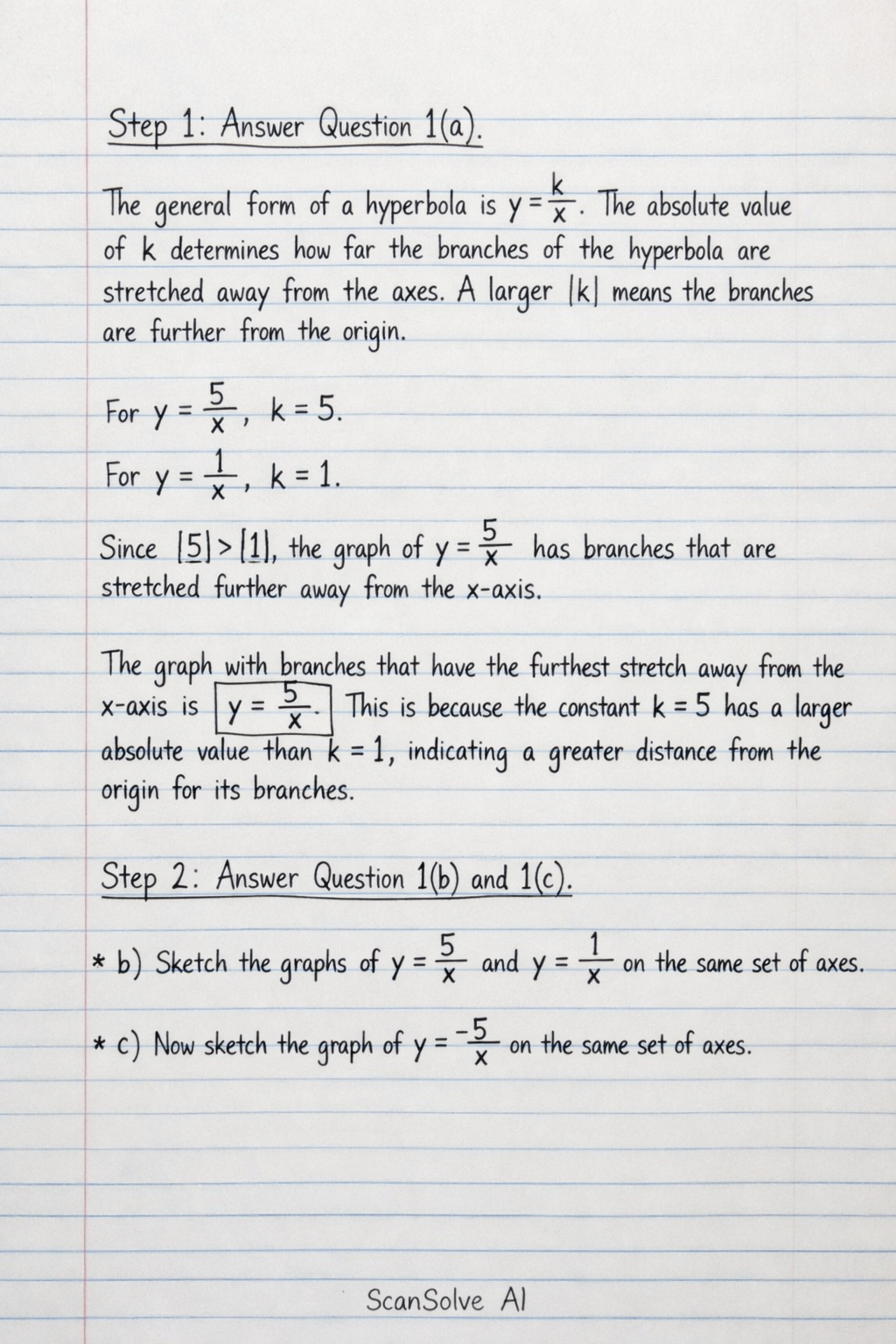
Step 1: Answer Question 1(a). The general form of a hyperbola is y = (k)/(x). The absolute value of k determines how far the branches of the hyperbola are stretched away from the axes. A larger |k| means the branches are further from the origin. For y = (5)/(x), k=5. For y = (1)/(x), k=1. Since |5| > |1|, the graph of y = (5)/(x) has branches that are stretched further away from the x-axis. The graph with branches that have the furthest stretch away from the x-axis is y = (5)/(x). This is because the constant k=5 has a larger absolute value than k=1, indicating a greater distance from the origin for its branches. Step 2: Answer Question 1(b) and 1(c). b) Sketch the graphs of y = (5)/(x) and y = (1)/(x) on the same set of axes. c) Now sketch the graph of y = -(5)/(x) on the same set of axes. Description of the sketch: All three graphs are hyperbolas with vertical asymptote x=0 (the y-axis) and horizontal asymptote y=0 (the x-axis). • For y = (1)/(x): The branches are in the first and third quadrants. Key points include (1,1), (2, 0.5), (0.5, 2), (-1,-1), (-2, -0.5), (-0.5, -2). • For y = (5)/(x): The branches are also in the first and third quadrants, but they are further away from the origin compared to y = (1)/(x). Key points include (1,5), (5,1), (2.5, 2), (-1,-5), (-5,-1), (-2.5, -2). • For y = -(5)/(x): This graph is a reflection of y = (5)/(x) across the x-axis (or y-axis). Its branches are in the second and fourth quadrants. Key points include (1,-5), (5,-1), (2.5, -2), (-1,5), (-5,1), (-2.5, 2). Step 3: Answer Question 2(a). Given the function y = -(4)/(x) - 1. The general form of a hyperbola is y = (k)/(x-p) + q. The vertical asymptote is x=p. The horizontal asymptote is y=q. In this function, p=0 and q=-1. The equation of the vertical asymptote is x=0. The equation of the horizontal asymptote is y=-1. Step 4: Answer Question 2(b). To determine the x-intercept, set y=0 and solve for x. 0 = -(4)/(x) - 1 1 = -(4)/(x) Multiply both sides by x: x = -4 The coordinates of the x-intercept are (-4, 0). Step 5: Answer Question 2(c). Sketch the graph of y = -(4)/(x) - 1 on a set of axes. Indicate the coordinates of the x-intercept as well as the asymptotes. Description of the sketch: • Draw the vertical asymptote at x=0 (the y-axis). • Draw the horizontal asymptote at y=-1. • Plot the x-intercept at (-4, 0). • Since the constant k=-4 is negative, the branches of the hyperbola will be in the second and fourth quadrants relative to the asymptotes. • Plot additional points to guide the sketch: • If x=-1, y = -(4)/(-1) - 1 = 4 - 1 = 3. Point: (-1,3). • If x=1, y = -(4)/(1) - 1 = -4 - 1 = -5. Point: (1,-5). The graph will approach the asymptotes but never touch them. Step 6: Answer Question 2(d). For the function y = -(4)/(x) - 1: The domain is all real numbers except where the denominator is zero. So, x ≠ 0. The range is all real numbers except the horizontal asymptote. So, y ≠ -1. The domain is x R, x ≠ 0. The range is y R, y ≠ -1. Step 7: Answer Question 2(e). Describe the different transformations of y = (4)/(x) to y = -(4)/(x) - 1. 1. From y = (4)/(x) to y = -(4)/(x): This is a reflection across the x-axis (or y-axis). 2. From y = -(4)/(x) to y = -(4)/(x) - 1: This is a vertical translation downwards by 1 unit. Step 8: Answer Question 2(f). Determine the line of symmetry with a negative gradient. For a hyperbola of the form y = (k)/(x-p) + q, the lines of symmetry pass through the intersection of the asymptotes (p,q) and have gradients 1 and -1. From 2(a), the asymptotes are x=0 and y=-1. Their intersection is (0, -1). We need the line of symmetry with a negative gradient, so the slope m = -1. Using the point-slope form y - y_1 = m(x - x_1): y - (-1) = -1(x - 0) y + 1 = -x y = -x - 1 The line of symmetry with a negative gradient is y = -x - 1. That's 2 down. 3 left today — send the next one.