We read your photo as:

Find a complex number z given that 2+4i / z = 1+3i / 2.

Mathematics

ScanSolve AI Answer

Answer

z=38+(−16±3318)iz = \frac{3}{8} + \left(\frac{-16 \pm 3\sqrt{31}}{8}\right)i

Step-by-step solution

7 steps

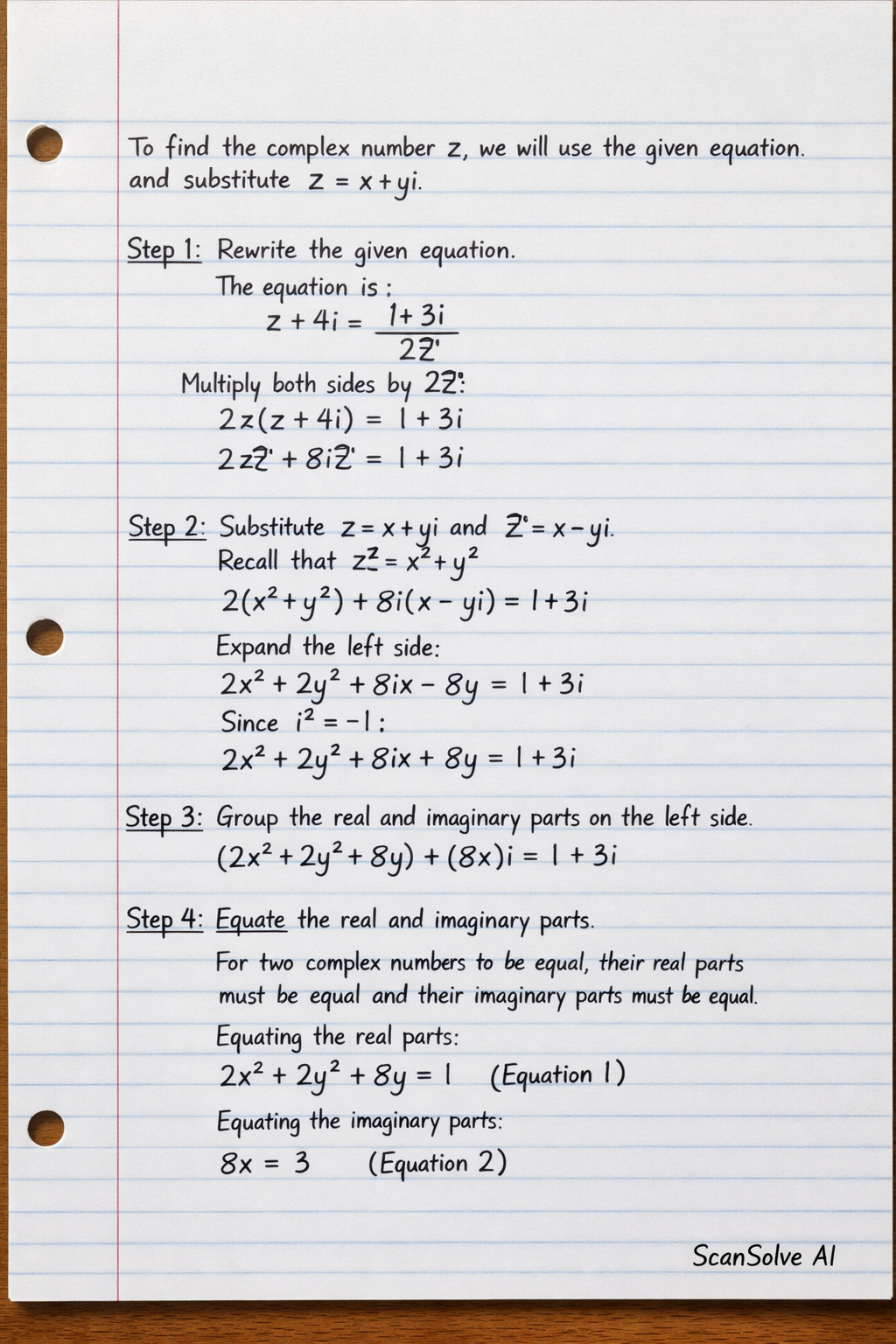
To find the complex number zz, we will use the given equation and substitute z=x+yiz = x+yi.

  1. Rewrite the given equation.

    The equation is:

    z+4i=1+3i2zˉz+4i = \frac{1+3i}{2\bar{z}}

    Multiply both sides by 2zˉ2\bar{z} to clear the denominator:

    2zˉ(z+4i)=1+3i2\bar{z}(z+4i) = 1+3i 2zzˉ+8izˉ=1+3i2z\bar{z} + 8i\bar{z} = 1+3i
  2. Substitute z=x+yiz = x+yi and zˉ=x−yi\bar{z} = x-yi.

    Recall that zzˉ=x2+y2z\bar{z} = x^2+y^2.

    2(x2+y2)+8i(x−yi)=1+3i2(x^2+y^2) + 8i(x-yi) = 1+3i

    Expand the left side:

    2x2+2y2+8ix−8i2y=1+3i2x^2+2y^2 + 8ix - 8i^2y = 1+3i

    Since i2=−1i^2 = -1:

    2x2+2y2+8ix+8y=1+3i2x^2+2y^2 + 8ix + 8y = 1+3i
  3. Group the real and imaginary parts on the left side.

    (2x2+2y2+8y)+(8x)i=1+3i(2x^2+2y^2+8y) + (8x)i = 1+3i
  4. Equate the real and imaginary parts.

    For two complex numbers to be equal, their real parts must be equal and their imaginary parts must be equal.
    Equating the real parts:

    2x2+2y2+8y=1(Equation 1)2x^2+2y^2+8y = 1 \quad \text{(Equation 1)}

    Equating the imaginary parts:

    8x=3(Equation 2)8x = 3 \quad \text{(Equation 2)}
  5. Solve the system of equations for xx and yy.

    From Equation 2:

    x=38x = \frac{3}{8}

    Substitute this value of xx into Equation 1:

    2(38)2+2y2+8y=12\left(\frac{3}{8}\right)^2 + 2y^2 + 8y = 1 2(964)+2y2+8y=12\left(\frac{9}{64}\right) + 2y^2 + 8y = 1 932+2y2+8y=1\frac{9}{32} + 2y^2 + 8y = 1

    Rearrange the terms to form a quadratic equation in yy:

    2y2+8y+932−1=02y^2 + 8y + \frac{9}{32} - 1 = 0 2y2+8y−2332=02y^2 + 8y - \frac{23}{32} = 0

    Multiply the entire equation by 32 to eliminate the fraction:

    64y2+256y−23=064y^2 + 256y - 23 = 0
  6. Solve the quadratic equation for yy.

    Using the quadratic formula y=−b±b2−4ac2ay = \frac{-b \pm \sqrt{b^2-4ac}}{2a}, where a=64a=64, b=256b=256, c=−23c=-23:

    y=−256±2562−4(64)(−23)2(64)y = \frac{-256 \pm \sqrt{256^2 - 4(64)(-23)}}{2(64)} y=−256±65536+5888128y = \frac{-256 \pm \sqrt{65536 + 5888}}{128} y=−256±71424128y = \frac{-256 \pm \sqrt{71424}}{128}

    Simplify the square root:

    71424=256×279=16279\sqrt{71424} = \sqrt{256 \times 279} = 16\sqrt{279}

    Further simplify 279=9×31=331\sqrt{279} = \sqrt{9 \times 31} = 3\sqrt{31}.
    So, 71424=16×331=4831\sqrt{71424} = 16 \times 3\sqrt{31} = 48\sqrt{31}.
    Substitute this back into the expression for yy:

    y=−256±4831128y = \frac{-256 \pm 48\sqrt{31}}{128}

    Divide the numerator and denominator by 16:

    y=−16±3318y = \frac{-16 \pm 3\sqrt{31}}{8}
  7. Form the complex number zz.

    We have x=38x = \frac{3}{8} and two possible values for yy. Therefore, there are two possible complex numbers zz:

    z1=38+(−16+3318)iz_1 = \frac{3}{8} + \left(\frac{-16 + 3\sqrt{31}}{8}\right)i z2=38+(−16−3318)iz_2 = \frac{3}{8} + \left(\frac{-16 - 3\sqrt{31}}{8}\right)i

    The complex numbers are:

    z=38+(−16±3318)iz = \frac{3}{8} + \left(\frac{-16 \pm 3\sqrt{31}}{8}\right)i
Was this helpful?

Try one yourself

A new problem that tests the same skill.

Still stuck on this one?

Ask a follow-up, and the answer starts from this question.

Got a different question?Ask your own question
Handwritten step-by-step solution preview

Handwritten Step-by-Step Solution

Get this as a handwritten image on WhatsApp — like a tutor wrote it for you.

Try on WhatsApp