We read your photo as:

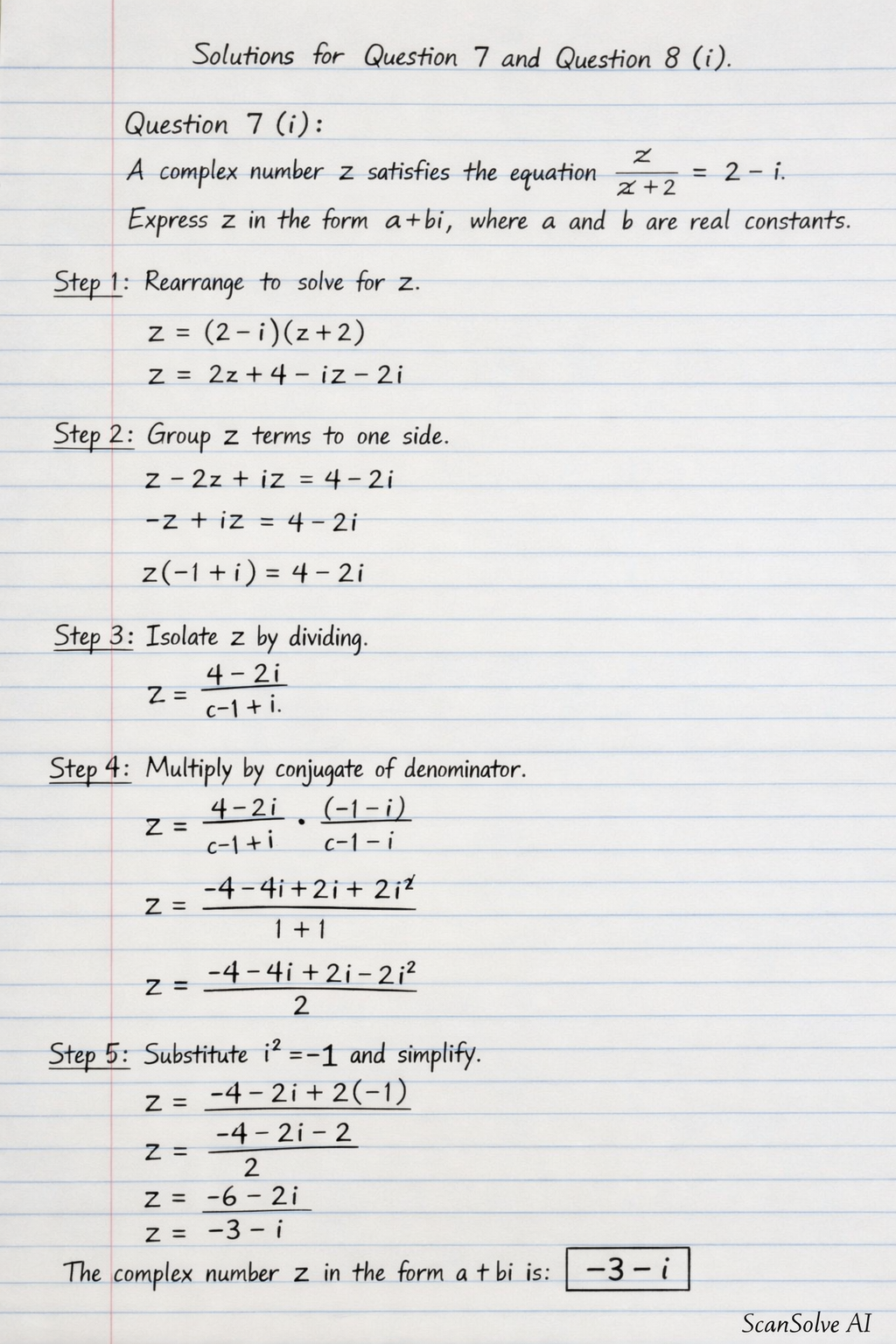
A complex number z satisfies the equation (z)/(z+2) = 2 − i. Express z in the form a+bi, where a and b are real constants.

Mathematics

ScanSolve AI Answer

Step-by-step solution

14 steps

Here are the solutions for Question 7 and Question 8 (i).

Question 7 (i):
A complex number zz satisfies the equation zz+2=2−i\frac{z}{z+2} = 2 - i.
Express zz in the form a+bia+bi, where aa and bb are real constants.

  1. Rearrange the equation to solve for zz.

    z=(2−i)(z+2)z = (2 - i)(z + 2) z=2z+4−iz−2iz = 2z + 4 - iz - 2i
  2. Group terms containing zz on one side and constant terms on the other.

    z−2z+iz=4−2iz - 2z + iz = 4 - 2i −z+iz=4−2i-z + iz = 4 - 2i z(−1+i)=4−2iz(-1 + i) = 4 - 2i
  3. Isolate zz by dividing.

    z=4−2i−1+iz = \frac{4 - 2i}{-1 + i}
  4. Multiply the numerator and denominator by the conjugate of the denominator.

    The conjugate of −1+i-1+i is −1−i-1-i.

    z=4−2i−1+i×−1−i−1−iz = \frac{4 - 2i}{-1 + i} \times \frac{-1 - i}{-1 - i} z=(4)(−1)+(4)(−i)+(−2i)(−1)+(−2i)(−i)(−1)2+(1)2z = \frac{(4)(-1) + (4)(-i) + (-2i)(-1) + (-2i)(-i)}{(-1)^2 + (1)^2} z=−4−4i+2i+2i21+1z = \frac{-4 - 4i + 2i + 2i^2}{1 + 1}
  5. Substitute i2=−1i^2 = -1 and simplify.

    z=−4−2i+2(−1)2z = \frac{-4 - 2i + 2(-1)}{2} z=−4−2i−22z = \frac{-4 - 2i - 2}{2} z=−6−2i2z = \frac{-6 - 2i}{2} z=−3−iz = -3 - i

    The complex number zz in the form a+bia+bi is −3−i\boxed{-3 - i}.


    Question 7 (ii):
    The vector equations of two lines are given by r=3i+6j+k+λ(2i−3j−k)\mathbf{r} = 3\mathbf{i} + 6\mathbf{j} + \mathbf{k} + \lambda(2\mathbf{i} - 3\mathbf{j} - \mathbf{k}) and r=3i−j+4k+μ(i−2j+k)\mathbf{r} = 3\mathbf{i} - \mathbf{j} + 4\mathbf{k} + \mu(\mathbf{i} - 2\mathbf{j} + \mathbf{k}).

    Part (a): Find the vector normal to the plane containing both lines.

  6. Identify the direction vectors of the two lines.

    The direction vector of the first line is d1=(2−3−1)\mathbf{d_1} = \begin{pmatrix} 2 \\ -3 \\ -1 \end{pmatrix}.
    The direction vector of the second line is d2=(1−21)\mathbf{d_2} = \begin{pmatrix} 1 \\ -2 \\ 1 \end{pmatrix}.

  7. The normal vector to the plane containing both lines is perpendicular to both direction vectors.

    This can be found by taking the cross product of d1\mathbf{d_1} and d2\mathbf{d_2}.

    n=d1×d2=(2−3−1)×(1−21)\mathbf{n} = \mathbf{d_1} \times \mathbf{d_2} = \begin{pmatrix} 2 \\ -3 \\ -1 \end{pmatrix} \times \begin{pmatrix} 1 \\ -2 \\ 1 \end{pmatrix} n=((−3)(1)−(−1)(−2)(−1)(1)−(2)(1)(2)(−2)−(−3)(1))\mathbf{n} = \begin{pmatrix} (-3)(1) - (-1)(-2) \\ (-1)(1) - (2)(1) \\ (2)(-2) - (-3)(1) \end{pmatrix} n=(−3−2−1−2−4+3)\mathbf{n} = \begin{pmatrix} -3 - 2 \\ -1 - 2 \\ -4 + 3 \end{pmatrix} n=(−5−3−1)\mathbf{n} = \begin{pmatrix} -5 \\ -3 \\ -1 \end{pmatrix}

    The vector normal to the plane containing both lines is −5i−3j−k\boxed{-5\mathbf{i} - 3\mathbf{j} - \mathbf{k}}.

    Part (b): Obtain the Cartesian equation of the plane containing both lines.

  8. Use the normal vector n=(−5−3−1)\mathbf{n} = \begin{pmatrix} -5 \\ -3 \\ -1 \end{pmatrix} from Part (a).

  9. Choose a point on the plane.

    We can use the position vector of a point from either line. From the first line, a point on the plane is a=(361)\mathbf{a} = \begin{pmatrix} 3 \\ 6 \\ 1 \end{pmatrix}.

  10. The Cartesian equation of a plane is given by r⋅n=a⋅n\mathbf{r} \cdot \mathbf{n} = \mathbf{a} \cdot \mathbf{n}.

    Let r=(xyz)\mathbf{r} = \begin{pmatrix} x \\ y \\ z \end{pmatrix}.

    (xyz)⋅(−5−3−1)=(361)⋅(−5−3−1)\begin{pmatrix} x \\ y \\ z \end{pmatrix} \cdot \begin{pmatrix} -5 \\ -3 \\ -1 \end{pmatrix} = \begin{pmatrix} 3 \\ 6 \\ 1 \end{pmatrix} \cdot \begin{pmatrix} -5 \\ -3 \\ -1 \end{pmatrix} −5x−3y−z=(3)(−5)+(6)(−3)+(1)(−1)-5x - 3y - z = (3)(-5) + (6)(-3) + (1)(-1) −5x−3y−z=−15−18−1-5x - 3y - z = -15 - 18 - 1 −5x−3y−z=−34-5x - 3y - z = -34
  11. Multiply the entire equation by -1 to express it with positive leading coefficients (optional, but standard practice).

    5x+3y+z=345x + 3y + z = 34

    The Cartesian equation of the plane containing both lines is 5x+3y+z=34\boxed{5x + 3y + z = 34}.


    Question 8 (i):
    The equation of a line is 3y=x+53y = x + 5 and the equation of a circle is x2+y2−6x−2y−15=0x^2 + y^2 - 6x - 2y - 15 = 0. Show that the line is a chord to the circle.

  12. Express xx in terms of yy from the line equation.

    x=3y−5x = 3y - 5
  13. Substitute this expression for xx into the circle equation.

    (3y−5)2+y2−6(3y−5)−2y−15=0(3y - 5)^2 + y^2 - 6(3y - 5) - 2y - 15 = 0
  14. Expand and simplify the equation.

    (9y2−30y+25)+y2−(18y−30)−2y−15=0(9y^2 - 30y + 25) + y^2 - (18y - 30) - 2y - 15 = 0 9y2−30y+25+y2−18y+30−2y−15=09y^2 - 30y + 25 + y^2 - 18y + 30 - 2y - 15 = 0

    Combine like terms:

    (9y2+y2)+(−30y−18y−2y)+(25+30−15)=0(9y^2 + y^2) + (-30y - 18y - 2y) + (25 + 30 - 15) = 0
Was this helpful?

Still stuck on this one?

Ask a follow-up, and the answer starts from this question.

Got a different question?Ask your own question
Handwritten step-by-step solution preview

Handwritten Step-by-Step Solution

Get this as a handwritten image on WhatsApp — like a tutor wrote it for you.

Try on WhatsApp