
We read your photo as:
Consider the following linear number patterns: 23; 17; 11; p; -1; ext and 2x+1, 18, 4x+5. Find the value of p and x.
ScanSolve AI Answer
Step-by-step solution
7 stepshere's the solution for Question 3.
Part 3.1: Consider the following linear number pattern:
3.1.1: Write down the value of
Determine the common difference ().
For a linear number pattern, the common difference between consecutive terms is constant.
The common difference is .
Calculate .
The term is the term after 11.
3.1.2: Determine the term of the number pattern
Use the formula for the term of a linear pattern.
The formula is , where is the first term and is the common difference.
Here, and .3.1.3: Determine the term of the sequence
Substitute into the term formula.
3.1.4: Which term will be equal to -121?
Set and solve for .
The term will be equal to .
Part 3.2: are the first 3 terms of a linear number pattern
3.2.1: Determine the value of
Use the property of a linear number pattern.
In a linear pattern, the common difference between consecutive terms is constant.
So, .Solve the equation for .
Still stuck on this one?
Ask a follow-up, and the answer starts from this question.
More Mathematics Questions
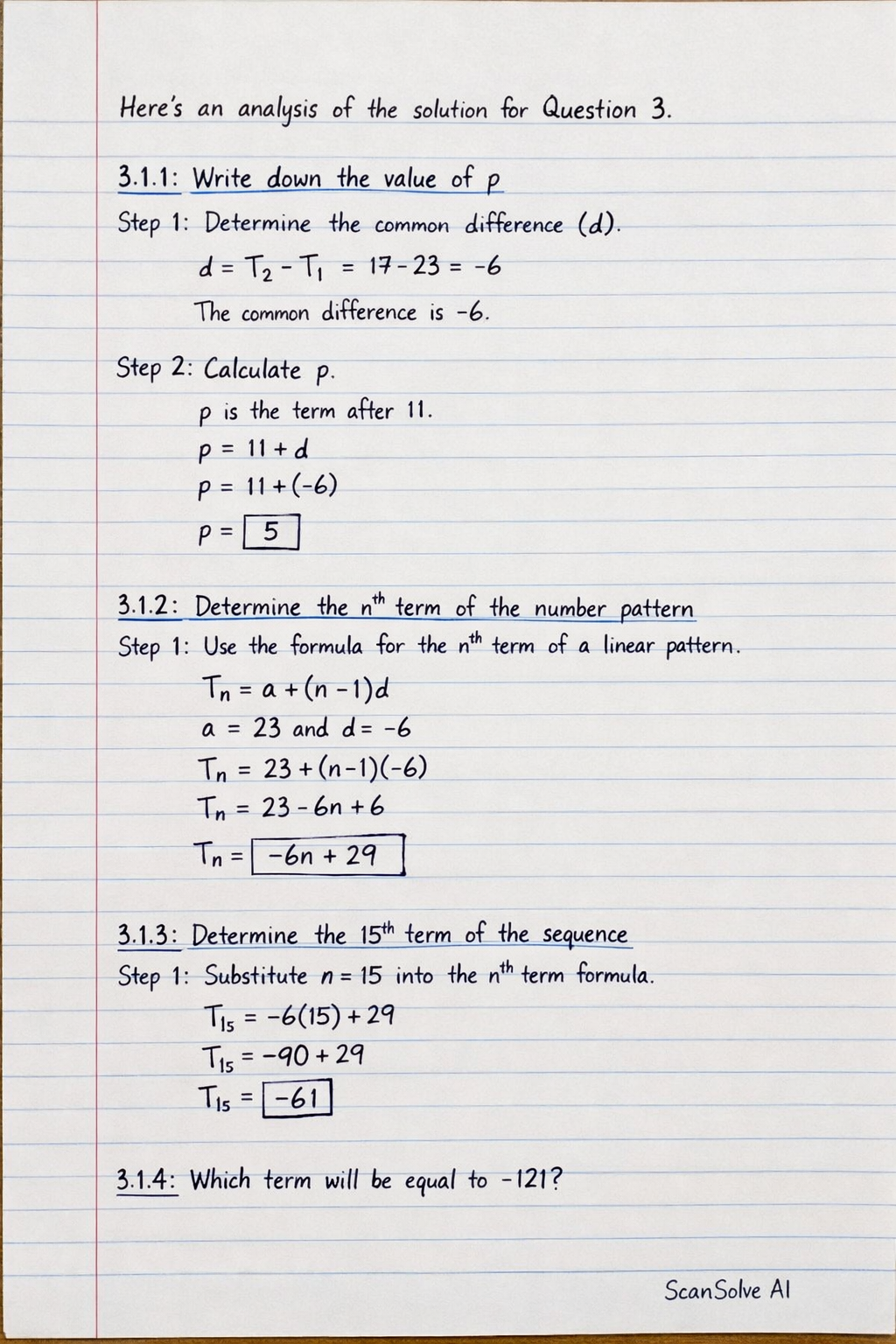
Handwritten Step-by-Step Solution
Get this as a handwritten image on WhatsApp — like a tutor wrote it for you.
Try on WhatsApp