
We read your photo as:
Consider the four letters A, B and C. Find the number of ordered arrangement when considered 2 letters at a time if (i) replacement is allowed (ii) replacement is not allowed
ScanSolve AI Answer
Answers
2 partsStep-by-step solution
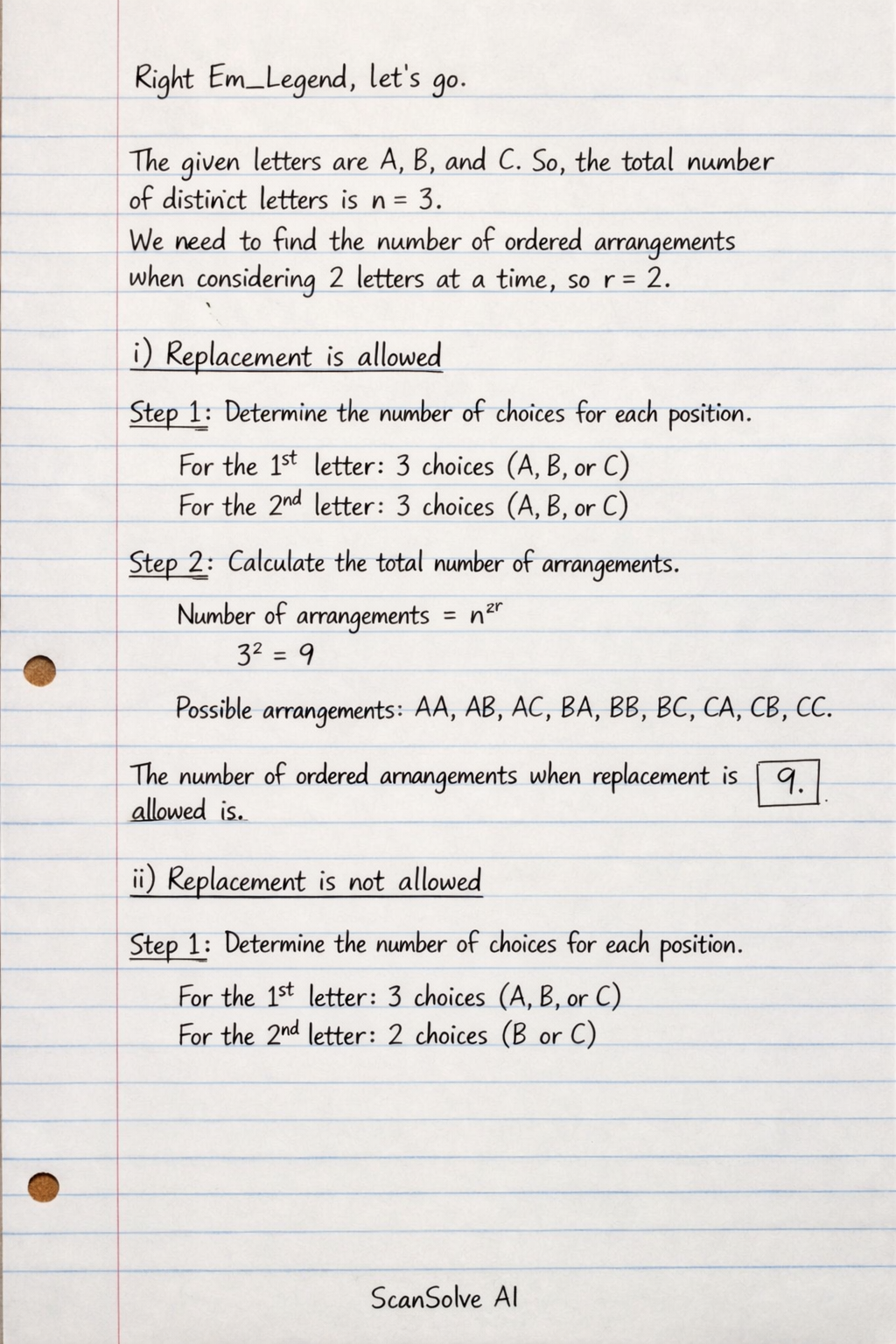
4 stepsThe given letters are A, B, and C. So, the total number of distinct letters is .
We need to find the number of ordered arrangements when considering 2 letters at a time, so .
Part i· 2 steps
Replacement is allowed
Determine the number of choices for each position.
Since replacement is allowed, for the first letter, there are 3 choices (A, B, or C). For the second letter, there are also 3 choices (A, B, or C), as the first letter can be repeated.
Calculate the total number of ordered arrangements.
The number of ordered arrangements with replacement is given by .
The possible arrangements are: AA, AB, AC, BA, BB, BC, CA, CB, CC.
The number of ordered arrangements when replacement is allowed is .
Part ii
Replacement is not allowed
Determine the number of choices for each position.
Since replacement is not allowed, for the first letter, there are 3 choices (A, B, or C). For the second letter, there are only 2 remaining choices, as the first letter cannot be repeated.
Calculate the total number of ordered arrangements.
The number of ordered arrangements without replacement is given by the permutation formula .
The possible arrangements are: AB, AC, BA, BC, CA, CB.
The number of ordered arrangements when replacement is not allowed is .
Try one yourself
A new problem that tests the same skill.
Still stuck on this one?
Ask a follow-up, and the answer starts from this question.
More Mathematics Questions
Handwritten Step-by-Step Solution
Get this as a handwritten image on WhatsApp — like a tutor wrote it for you.
Try on WhatsApp