
This mathematics problem involves applying core mathematical principles and formulas. Below you will find a complete step-by-step solution with detailed explanations for each step, helping you understand not just the answer but the method behind it.
ScanSolve AI Answer
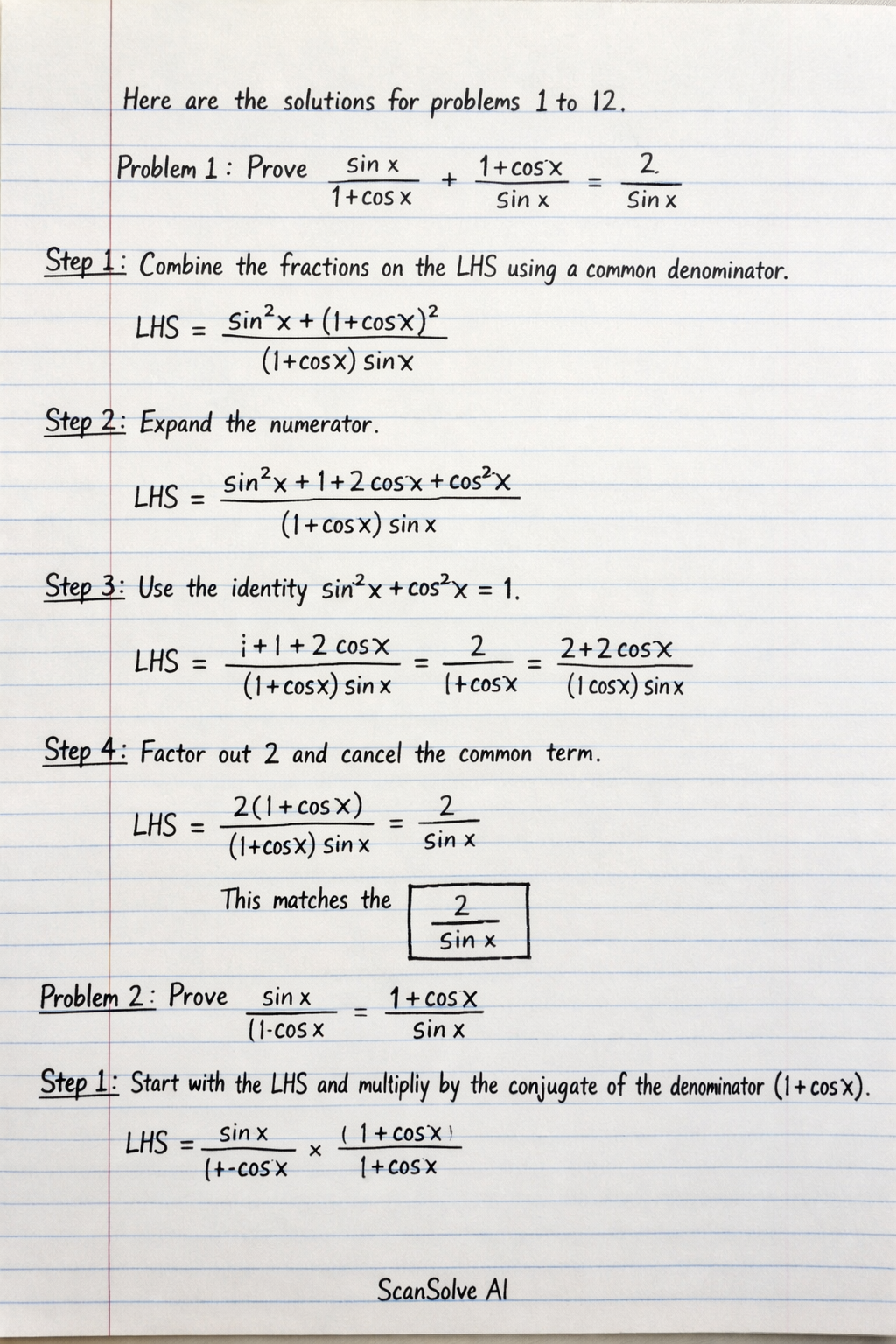
Here are the solutions for problems 1 to 12. Problem 1: Prove ( x)/(1+ x) + (1+ x)/( x) = (2)/( x) Step 1: Combine the fractions on the left-hand side (LHS) using a common denominator. LHS = (^2 x + (1+ x)^2)/((1+ x) x) Step 2: Expand the numerator. LHS = (^2 x + 1 + 2 x + ^2 x)/((1+ x) x) Step 3: Use the identity ^2 x + ^2 x = 1. LHS = (1 + 1 + 2 x)/((1+ x) x) = (2 + 2 x)/((1+ x) x) Step 4: Factor out 2 from the numerator and cancel the common term. LHS = (2(1+ x))/((1+ x) x) = (2)/( x) This matches the right-hand side (RHS). (2)/( x) Problem 2: Prove ( x)/(1- x) = (1+ x)/( x) Step 1: Start with the left-hand side (LHS) and multiply the numerator and denominator by the conjugate of the denominator, (1+ x). LHS = ( x)/(1- x) × (1+ x)/(1+ x) Step 2: Multiply the terms in the numerator and denominator. LHS = ( x (1+ x))/(1^2 - ^2 x) Step 3: Use the identity 1 - ^2 x = ^2 x. LHS = ( x (1+ x))/(^2 x) Step 4: Cancel out x from the numerator and denominator. LHS = (1+ x)/( x) This matches the right-hand side (RHS). (1+ x)/( x) Problem 3: Prove ( x)/(1- x) - (1- x)/( x) = 2 x Step 1: Combine the fractions on the left-hand side (LHS) using a common denominator. LHS = (^2 x - (1- x)^2)/((1- x) x) Step 2: Expand the numerator. LHS = (^2 x - (1 - 2 x + ^2 x))/((1- x) x) = (^2 x - 1 + 2 x - ^2 x)/((1- x) x) Step 3: Use the identity ^2 x - 1 = -^2 x. LHS = (-^2 x + 2 x - ^2 x)/((1- x) x) = (2 x - 2^2 x)/((1- x) x) Step 4: Factor out 2 x from the numerator. LHS = (2 x (1- x))/((1- x) x) Step 5: Cancel out the common term (1- x). LHS = (2 x)/( x) = 2 x This matches the right-hand side (RHS). 2 x Problem 4: Prove (1+ x)/( x) + ( x)/(1+ x) = (2)/( x) Step 1: Combine the fractions on the left-hand side (LHS) using a common denominator. LHS = ((1+ x)^2 + ^2 x)/( x (1+ x)) Step 2: Expand the numerator. LHS = (1 + 2 x + ^2 x + ^2 x)/( x (1+ x)) Step 3: Use the identity ^2 x + ^2 x = 1. LHS = (1 + 2 x + 1)/( x (1+ x)) = (2 + 2 x)/( x (1+ x)) Step 4: Factor out 2 from the numerator and cancel the common term. LHS = (2(1+ x))/( x (1+ x)) = (2)/( x) This matches the right-hand side (RHS). (2)/( x) Problem 5: Prove (1+ x)/( x) - ( x)/(1+ x) = 2 x Step 1: Combine the fractions on the left-hand side (LHS) using a common denominator. LHS = ((1+ x)^2 - ^2 x)/( x (1+ x)) Step 2: Expand the numerator. LHS = (1 + 2 x + ^2 x - ^2 x)/( x (1+ x)) Step 3: Use the identity ^2 x = 1 - ^2 x. LHS = (1 + 2 x + ^2 x - (1 - ^2 x))/( x (1+ x)) = (1 + 2 x + ^2 x - 1 + ^2 x)/( x (1+ x)) Step 4: Simplify the numerator. LHS = (2 x + 2^2 x)/( x (1+ x)) Step 5: Factor out 2 x from the numerator and cancel the common term. LHS = (2 x (1+ x))/( x (1+ x)) = (2 x)/( x) Step 6: Express the result in terms of x. LHS = 2 x This matches the right-hand side (RHS). 2 x Problem 6: Prove ( x)/(1+ x) + x = x Step 1: Start with the left-hand side (LHS) and express x as ( x)/( x). LHS = ( x)/(1+ x) + ( x)/( x) Step 2: Combine the fractions using a common denominator. LHS = (^2 x + x (1+ x))/((1+ x) x) Step 3: Expand the numerator. LHS = (^2 x + x + ^2 x)/((1+ x) x) Step 4: Use the identity ^2 x + ^2 x = 1. LHS = (1 + x)/((1+ x) x) Step 5: Cancel out the common term (1+ x). LHS = (1)/( x) = x This matches the right-hand side (RHS). x Problem 7: Prove ( x)/(1- x) - x = x Step 1: Start with the left-hand side (LHS) and express x as ( x)/( x). LHS = ( x)/(1- x) - ( x)/( x) Step 2: Combine the fractions using a common denominator. LHS = (^2 x - x (1- x))/((1- x) x) Step 3: Expand the numerator. LHS = (^2 x - x + ^2 x)/((1- x) x) Step 4: Use the identity ^2 x + ^2 x = 1. LHS = (1 - x)/((1- x) x) Step 5: Cancel out the common term (1- x). LHS = (1)/( x) = x This matches the right-hand side (RHS). x Problem 8: Prove ( x)/(1+ x) + x = x Step 1: Start with the left-hand side (LHS) and express x as ( x)/( x). LHS = ( x)/(1+ x) + ( x)/( x) Step 2: Combine the fractions using a common denominator. LHS = (^2 x + x (1+ x))/((1+ x) x) Step 3: Expand the numerator. LHS = (^2 x + x + ^2 x)/((1+ x) x) Step 4: Use the identity ^2 x + ^2 x = 1. LHS = (1 + x)/((1+ x) x) Step 5: Cancel out the common term (1+ x). LHS = (1)/( x) = x This matches the right-hand side (RHS). x Problem 9: Prove ( x)/(1- x) - x = x Step 1: Start with the left-hand side (LHS) and express x as ( x)/( x). LHS = ( x)/(1- x) - ( x)/( x) Step 2: Combine the fractions using a common denominator. LHS = (^2 x - x (1- x))/((1- x) x) Step 3: Expand the numerator. LHS = (^2 x - x + ^2 x)/((1- x) x) Step 4: Use the identity ^2 x + ^2 x = 1. LHS = (1 - x)/((1- x) x) Step 5: Cancel out the common term (1- x). LHS = (1)/( x) = x This matches the right-hand side (RHS). x Problem 10: Prove (1+ x)/(1- x) = ( x + x)^2 Step 1: Start with the right-hand side (RHS) and express x and x in terms of x and x. RHS = ((1)/( x) + ( x)/( x))^2 Step 2: Combine the terms inside the parenthesis. RHS = ((1+ x)/( x))^2 Step 3: Square the numerator and the denominator. RHS = ((1+ x)^2)/(^2 x) Step 4: Use the identity ^2 x = 1 - ^2 x. RHS = ((1+ x)^2)/(1 - ^2 x) Step 5: Factor the denominator using the difference of squares formula, a^2 - b^2 = (a-b)(a+b). RHS = ((1+ x)^2)/((1- x)(1+ x)) Step 6: Cancel out one term of (1+ x) from the numerator and denominator. RHS = (1+ x)/(1- x) This matches the left-hand side (LHS). (1+ x)/(1- x) Problem 11: Prove (1- x)/(1+ x) = ( x - x)^2 Step 1: Start with the right-hand side (RHS) and express x and x in terms of x and x. RHS = ((1)/( x) - ( x)/( x))^2 Step 2: Combine the terms inside the parenthesis. RHS = ((1- x)/( x))^2 Step 3: Square the numerator and the denominator. RHS = ((1- x)^2)/(^2 x) Step 4: Use the identity ^2 x = 1 - ^2 x. RHS = ((1- x)^2)/(1 - ^2 x) Step 5: Factor the denominator using the difference of squares formula, a^2 - b^2 = (a-b)(a+b). RHS = ((1- x)^2)/((1- x)(1+ x)) Step 6: Cancel out one term of (1- x) from the numerator and denominator. RHS = (1- x)/(1+ x) This matches the left-hand side (LHS). (1- x)/(1+ x) Problem 12: Prove ( x)/(1+ x) = (1- x)/( x) Step 1: Start with the left-hand side (LHS) and multiply the numerator and denominator by the conjugate of the denominator, (1- x). LHS = ( x)/(1+ x) × (1- x)/(1- x) Step 2: Multiply the terms in the numerator and denominator. LHS = ( x (1- x))/(1^2 - ^2 x) Step 3: Use the identity 1 - ^2 x = ^2 x. LHS = ( x (1- x))/(^2 x) Step 4: Cancel out x from the numerator and denominator. LHS = (1- x)/( x) This matches the right-hand side (RHS). (1- x)/( x) Send me the next one 📸