

This mathematics problem involves applying core mathematical principles and formulas. Below you will find a complete step-by-step solution with detailed explanations for each step, helping you understand not just the answer but the method behind it.
ScanSolve AI Answer
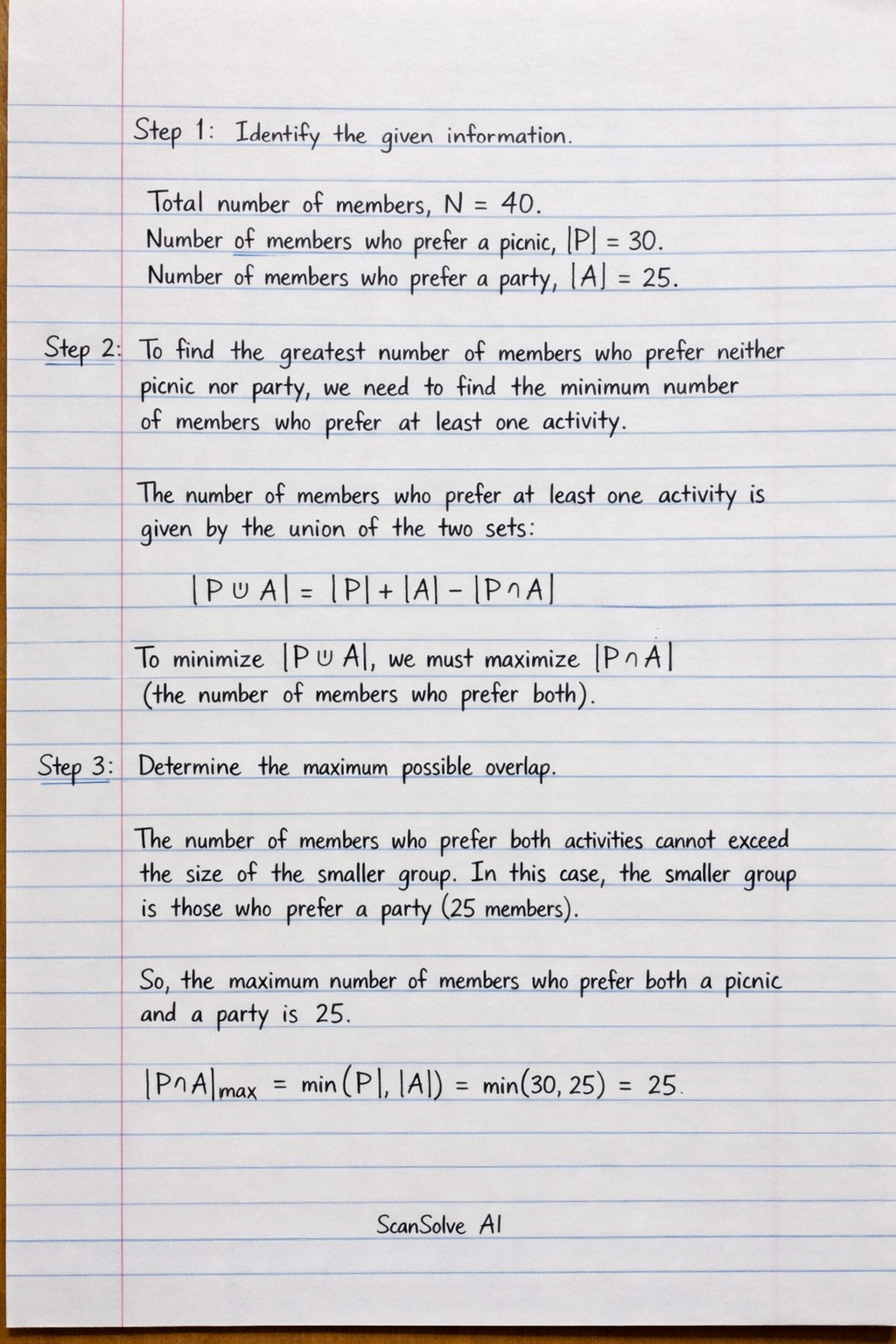
let's solve this set theory problem. Step 1: Identify the given information. Total number of members, N = 40. Number of members who prefer a picnic, |P| = 30. Number of members who prefer a party, |A| = 25. Step 2: To find the greatest number of members who prefer neither picnic nor party, we need to find the minimum number of members who prefer at least one activity. The number of members who prefer at least one activity is given by the union of the two sets: |P A|. The formula for the union is: |P A| = |P| + |A| - |P A| To minimize |P A|, we must maximize |P A| (the number of members who prefer both). Step 3: Determine the maximum possible overlap. The number of members who prefer both activities cannot exceed the size of the smaller group. In this case, the smaller group is those who prefer a party (25 members). So, the maximum number of members who prefer both a picnic and a party is 25. |P A|_max = (|P|, |A|) = (30, 25) = 25 Step 4: Calculate the minimum number of members who prefer at least one activity. Substitute the maximum overlap into the union formula: |P A|_min = |P| + |A| - |P A|_max |P A|_min = 30 + 25 - 25 |P A|_min = 30 Step 5: Calculate the greatest number of members who prefer neither activity. This is the total number of members minus the minimum number of members who prefer at least one activity. Neither = N - |P A|_min Neither = 40 - 30 Neither = 10 The greatest number of members who prefer neither picnic nor party is 10. 4 down, 1 left today. Send me the next one 📸