Convert 0.000437 to scientific notation and calculate (3.2 x 10³) + (4.5 x 10²). Simplify 18/45 and express 45 as a percentage of 120.
|Mathematics
Convert 0.000437 to scientific notation and calculate (3.2 x 10³) + (4.5 x 10²). Simplify 18/45 and express 45 as a percentage of 120.
ScanSolve AI Answer
Answer
4.37×10⁻⁴
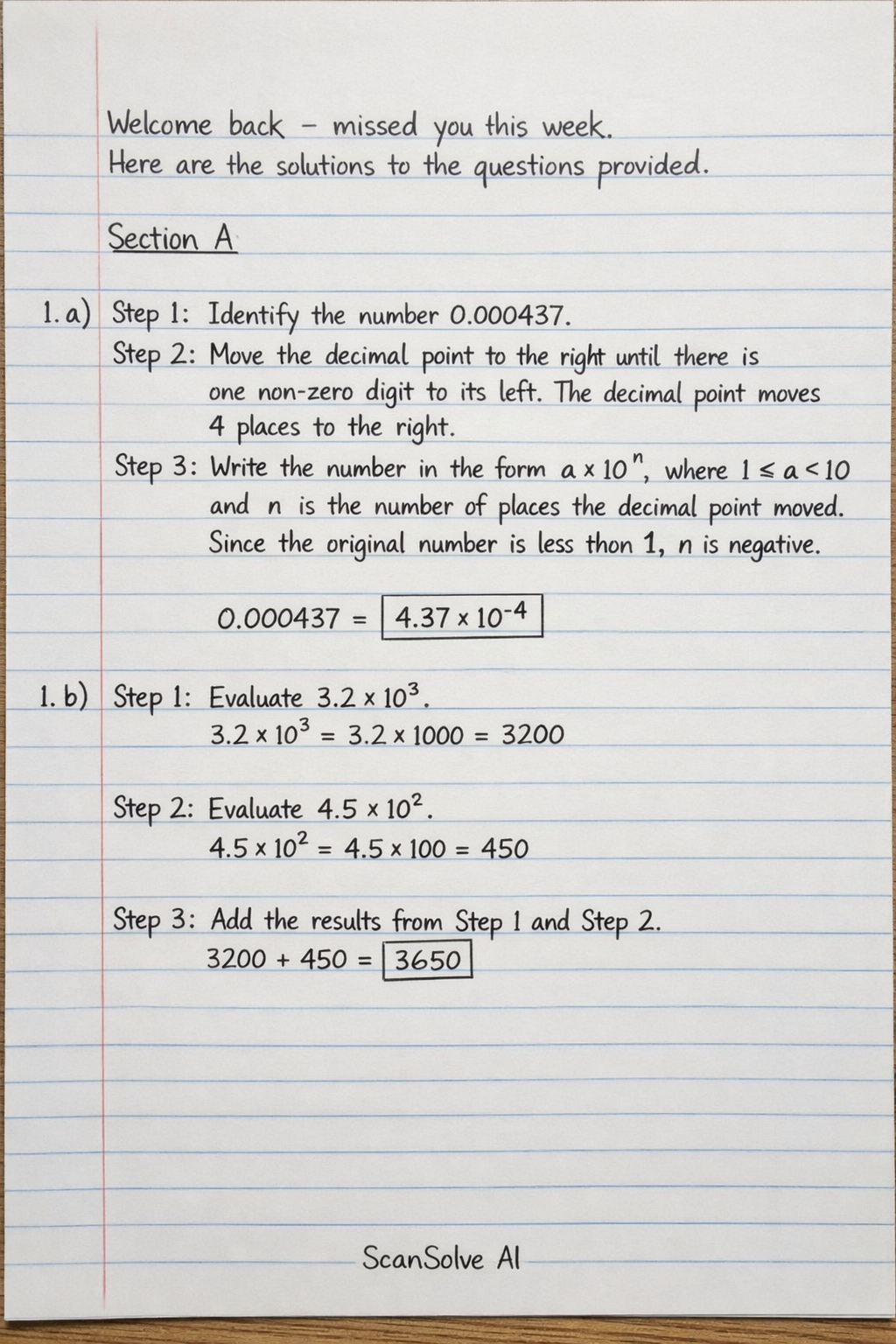
Welcome back — missed you this week.
Here are the solutions to the questions provided.
Section A
1. a)
Step 1: Identify the number 0.000437.
Step 2: Move the decimal point to the right until there is one non-zero digit to its left. The decimal point moves 4 places to the right.
Step 3: Write the number in the form a×10n, where 1≤a<10 and n is the number of places the decimal point moved. Since the original number is less than 1, n is negative.
0.000437=4.37×10⁻⁴
1. b)
Step 1: Evaluate 3.2×10³.
3.2×103=3.2×1000=3200
Step 2: Evaluate 4.5×10².
4.5×102=4.5×100=450
Step 3: Add the results from Step 1 and Step 2.
3200+450=3650
2. a)
Step 1: Simplify the fraction 4518. Find the greatest common divisor (GCD) of 18 and 45.
The divisors of 18 are 1, 2, 3, 6, 9, 18.
The divisors of 45 are 1, 3, 5, 9, 15, 45.
The GCD is 9.
Step 2: Divide both the numerator and the denominator by the GCD.
45÷918÷9=52
The simplified fraction is 52.
2. b)
Step 1: To express 45 as a percentage of 120, divide 45 by 120 and multiply by 100%.
12045×100%
Step 2: Simplify the fraction.
12045=24×59×5=249=8×33×3=83
Step 3: Multiply by 100%.
83×100%=0.375×100%=37.5%
3. a)
Step 1: Expand the expression (x−3)(x+5) using the distributive property (FOIL method).
(x−3)(x+5)=x(x+5)−3(x+5)=x2+5x−3x−15
Step 2: Combine like terms.
x2+(5x−3x)−15=x2+2x−15
3. b)
Step 1: Factorize the expression 6y2−9y.
Step 2: Find the greatest common factor (GCF) of 6y2 and 9y.
The GCF of 6 and 9 is 3.
The GCF of y2 and y is y.
So, the GCF of 6y2 and 9y is 3y.
Step 3: Factor out the GCF.
6y2−9y=3y(2y)−3y(3)=3y(2y−3)
3. c)
Step 1: Solve the equation 4(2x−3)=5x+6. First, distribute the 4 on the left side.
8x−12=5x+6
Step 2: Subtract 5x from both sides of the equation.
8x−5x−12=63x−12=6
Step 3: Add 12 to both sides of the equation.
3x=6+123x=18
Step 4: Divide by 3.
x=318x=6
4. a)
Step 1: The ratio of flour to sugar is 3:2. This means for every 3 parts of flour, there are 2 parts of sugar.
Step 2: If 480g of flour is used, this corresponds to 3 parts of the ratio.
Let x be the amount of sugar needed.
SugarFlour=23x480g=23
Step 3: Cross-multiply to solve for x.
3x=480g×23x=960 g
Step 4: Divide by 3.
x=3960gx=320 g
4. b)
Step 1: The angles in a triangle are in the ratio 2:3:4. Let the angles be 2k, 3k, and 4k.
Step 2: The sum of angles in a triangle is 180∘.
2k+3k+4k=180∘9k=180∘
Step 3: Solve for k.
k=9180∘k=20∘
Step 4: Calculate each angle.
First angle: 2k=2×20∘=40∘
Second angle: 3k=3×20∘=60∘
Third angle: 4k=4×20∘=80∘
The angles are 40∘,60∘,80∘.
5. a)
Step 1: Given the scores: 3,9,7,4,7,6,7.
Step 2: The mode is the value that appears most frequently in a data set.
Count the occurrences of each score:
3: 1 time
4: 1 time
6: 1 time
7: 3 times
9: 1 time
The score 7 appears most frequently.
The mode is 7.
5. b)
Step 1: To find the median, first arrange the scores in ascending order.
Scores: 3,9,7,4,7,6,7
Ordered scores: 3,4,6,7,7,7,9
Step 2: The number of scores is n=7. Since n is odd, the median is the middle value, which is the 2n+1-th term.
Median position = 27+1=28=4-th term.
Step 3: The 4th term in the ordered list is 7.
The median is 7.
6. a)
Step 1: A fence has length 18m and width 12m. This describes a rectangular shape.
Step 2: The perimeter of a rectangle is given by the formula P=2(l+w), where l is length and w is width.
P=2(18m+12m)P=2(30m)P=60 m
6. b)
Step 1: The area of a rectangle is given by the formula A=l×w.
A=18m×12 mA = 216 \text{ m^2}
7. a)
Step 1: Given the function f(x)=3x−4.
Step 2: To find f(2), substitute x=2 into the function.
f(2)=3(2)−4f(2)=6−4f(2)=2
7. b)
Step 1: To determine the inverse function f−1(x), let y=f(x).
y=3x−4
Step 2: Swap x and y.
x=3y−4
Step 3: Solve for y. Add 4 to both sides.
x+4=3y
Step 4: Divide by 3.
y=3x+4
So, f^{-1}(x) = \frac{x+4{3}}.
8.
Step 1: Let the amount received by the first student be S1 and the amount received by the second student be S2.
Step 2: The total amount received is 500 FCFA.
S1+S2=500
Step 3: One student has 50 FCFA more than the other. Assume S1 is the student with more money.
S1=S2+50
Step 4: Substitute the second equation into the first equation.
(S2+50)+S2=5002S2+50=500
Step 5: Subtract 50 from both sides.
2S2=500−502S2=450
Step 6: Divide by 2 to find S2.
S2=2450S2=225 FCFA
Step 7: Find S1 using S1=S2+50.
S1=225+50S1=275 FCFA
Each of them received 275FCFAand225FCFA.
9. a)
Step 1: Given vectors r=3i−j and s=2i+j.
Step 2: Find r+2s. First, calculate 2s.
2s=2(2i+j)=4i+2j
Step 3: Add r and 2s.
r+2s=(3i−j)+(4i+2j)=(3+4)i+(−1+2)j=7i+j
9. b)
Step 1: Find ∣r−s∣. First, calculate r−s.
r−s=(3i−j)−(2i+j)=(3−2)i+(−1−1)j=i−2j
Step 2: Calculate the magnitude of i−2j. The magnitude of a vector ai+bj is a2+b2.
∣i−2j∣=(1)2+(−2)2=1+4=5
10. a)
Step 1: Express 126 as a product of its prime factors.
126=2×63=2×3×21=2×3×3×7=2×32×7
Step 2: Express 84 as a product of its prime factors.
84=2×42=2×2×21=2×2×3×7=22×3×7
10. b)
Step 1: To find the Highest Common Factor (HCF) of 126 and 84, use their prime factorizations.
126=21×32×7184=22×31×71
Step 2: For each common prime factor, take the lowest power.
Common prime factors are 2, 3, and 7.
Lowest power of 2: 21
Lowest power of 3: 31
Lowest power of 7: 71
Step 3: Multiply these lowest powers together.
HCF(126,84)=21×31×71=2×3×7=42
Section B
1. (i) a)
Step 1: Given two lines: y=2x+1 and 3x−y=5.
Step 2: To find the intersection point, substitute the expression for y from the first equation into the second equation.
3x−(2x+1)=5
Step 3: Solve for x.
3x−2x−1=5x−1=5x=5+1x=6
Step 4: Substitute the value of x back into the first equation to find y.
y=2(6)+1y=12+1y=13
The intersection point is (6,13).
1. (i) b)
Step 1: Given point A (−3,4) and point B (1,7).
Step 2: Use the distance formula d=(x2−x1)2+(y2−y1)2.
Let (x1,y1)=(−3,4) and (x2,y2)=(1,7).
d=(1−(−3))2+(7−4)2d=(1+3)2+(3)2d=(4)2+(3)2d=16+9d=25d=5 units
1. (i) c)
Step 1: Given points L (5,6) and N (1,2).
Step 2: Use the midpoint formula M=(2x1+x2,2y1+y2).
Let (x1,y1)=(5,6) and (x2,y2)=(1,2).
M=(25+1,26+2)M=(26,28)M=(3,4)
1. (ii) a)
Step 1: Given the quadratic function y=x2−4x+3 and the linear function y=x−1.
Step 2: Complete the table for y=x2−4x+3=0.
For x=−1: y=(−1)2−4(−1)+3=1+4+3=8
For $
Was this helpful?
Need help with your own homework?
Get instant step-by-step solutions to any question. Free to start.
This mathematics problem involves applying core mathematical principles and formulas. Below you will find a complete step-by-step solution with detailed explanations for each step, helping you understand not just the answer but the method behind it.
ScanSolve AI Answer
Welcome back — missed you this week. Here are the solutions to the questions provided. Section A 1. a) Step 1: Identify the number 0.000437. Step 2: Move the decimal point to the right until there is one non-zero digit to its left. The decimal point moves 4 places to the right. Step 3: Write the number in the form a × 10^n, where 1 a < 10 and n is the number of places the decimal point moved. Since the original number is less than 1, n is negative. 0.000437 = 4.37 × 10^-4 1. b) Step 1: Evaluate 3.2 × 10^3. 3.2 × 10^3 = 3.2 × 1000 = 3200 Step 2: Evaluate 4.5 × 10^2. 4.5 × 10^2 = 4.5 × 100 = 450 Step 3: Add the results from Step 1 and Step 2. 3200 + 450 = 3650 2. a) Step 1: Simplify the fraction (18)/(45). Find the greatest common divisor (GCD) of 18 and 45. The divisors of 18 are 1, 2, 3, 6, 9, 18. The divisors of 45 are 1, 3, 5, 9, 15, 45. The GCD is 9. Step 2: Divide both the numerator and the denominator by the GCD. (18 ÷ 9)/(45 ÷ 9) = (2)/(5) The simplified fraction is (2)/(5). 2. b) Step 1: To express 45 as a percentage of 120, divide 45 by 120 and multiply by 100%. (45)/(120) × 100\% Step 2: Simplify the fraction. (45)/(120) = (9 × 5)/(24 × 5) = (9)/(24) = (3 × 3)/(8 × 3) = (3)/(8) Step 3: Multiply by 100%. (3)/(8) × 100\% = 0.375 × 100\% = 37.5\% 3. a) Step 1: Expand the expression (x-3)(x+5) using the distributive property (FOIL method). (x-3)(x+5) = x(x+5) - 3(x+5) = x^2 + 5x - 3x - 15 Step 2: Combine like terms. x^2 + (5x - 3x) - 15 = x^2 + 2x - 15 3. b) Step 1: Factorize the expression 6y^2 - 9y. Step 2: Find the greatest common factor (GCF) of 6y^2 and 9y. The GCF of 6 and 9 is 3. The GCF of y^2 and y is y. So, the GCF of 6y^2 and 9y is 3y. Step 3: Factor out the GCF. 6y^2 - 9y = 3y(2y) - 3y(3) = 3y(2y - 3) 3. c) Step 1: Solve the equation 4(2x-3) = 5x+6. First, distribute the 4 on the left side. 8x - 12 = 5x + 6 Step 2: Subtract 5x from both sides of the equation. 8x - 5x - 12 = 6 3x - 12 = 6 Step 3: Add 12 to both sides of the equation. 3x = 6 + 12 3x = 18 Step 4: Divide by 3. x = (18)/(3) x = 6 4. a) Step 1: The ratio of flour to sugar is 3:2. This means for every 3 parts of flour, there are 2 parts of sugar. Step 2: If 480g of flour is used, this corresponds to 3 parts of the ratio. Let x be the amount of sugar needed. FlourSugar = (3)/(2) 480 gx = (3)/(2) Step 3: Cross-multiply to solve for x. 3x = 480 g × 2 3x = 960 g Step 4: Divide by 3. x = 960 g3 x = 320 g 4. b) Step 1: The angles in a triangle are in the ratio 2:3:4. Let the angles be 2k, 3k, and 4k. Step 2: The sum of angles in a triangle is 180^. 2k + 3k + 4k = 180^ 9k = 180^ Step 3: Solve for k. k = (180^)/(9) k = 20^ Step 4: Calculate each angle. First angle: 2k = 2 × 20^ = 40^ Second angle: 3k = 3 × 20^ = 60^ Third angle: 4k = 4 × 20^ = 80^ The angles are 40^, 60^, 80^. 5. a) Step 1: Given the scores: 3, 9, 7, 4, 7, 6, 7. Step 2: The mode is the value that appears most frequently in a data set. Count the occurrences of each score: 3: 1 time 4: 1 time 6: 1 time 7: 3 times 9: 1 time The score 7 appears most frequently. The mode is 7. 5. b) Step 1: To find the median, first arrange the scores in ascending order. Scores: 3, 9, 7, 4, 7, 6, 7 Ordered scores: 3, 4, 6, 7, 7, 7, 9 Step 2: The number of scores is n=7. Since n is odd, the median is the middle value, which is the (n+1)/(2)-th term. Median position = (7+1)/(2) = (8)/(2) = 4-th term. Step 3: The 4th term in the ordered list is 7. The median is 7. 6. a) Step 1: A fence has length 18m and width 12m. This describes a rectangular shape. Step 2: The perimeter of a rectangle is given by the formula P = 2(l+w), where l is length and w is width. P = 2(18 m + 12 m) P = 2(30 m) P = 60 m 6. b) Step 1: The area of a rectangle is given by the formula A = l × w. A = 18 m × 12 m A = 216 m^2 7. a) Step 1: Given the function f(x) = 3x - 4. Step 2: To find f(2), substitute x=2 into the function. f(2) = 3(2) - 4 f(2) = 6 - 4 f(2) = 2 7. b) Step 1: To determine the inverse function f^-1(x), let y = f(x). y = 3x - 4 Step 2: Swap x and y. x = 3y - 4 Step 3: Solve for y. Add 4 to both sides. x + 4 = 3y Step 4: Divide by 3. y = (x+4)/(3) So, f^-1(x) = (x+4)/(3). 8. Step 1: Let the amount received by the first student be S_1 and the amount received by the second student be S_2. Step 2: The total amount received is 500 FCFA. S_1 + S_2 = 500 Step 3: One student has 50 FCFA more than the other. Assume S_1 is the student with more money. S_1 = S_2 + 50 Step 4: Substitute the second equation into the first equation. (S_2 + 50) + S_2 = 500 2S_2 + 50 = 500 Step 5: Subtract 50 from both sides. 2S_2 = 500 - 50 2S_2 = 450 Step 6: Divide by 2 to find S_2. S_2 = (450)/(2) S_2 = 225 FCFA Step 7: Find S_1 using S_1 = S_2 + 50. S_1 = 225 + 50 S_1 = 275 FCFA Each of them received 275 FCFA and 225 FCFA. 9. a) Step 1: Given vectors r = 3i - j and s = 2i + j. Step 2: Find r + 2s. First, calculate 2s. 2s = 2(2i + j) = 4i + 2j Step 3: Add r and 2s. r + 2s = (3i - j) + (4i + 2j) = (3+4)i + (-1+2)j = 7i + j 9. b) Step 1: Find |r - s|. First, calculate r - s. r - s = (3i - j) - (2i + j) = (3-2)i + (-1-1)j = i - 2j Step 2: Calculate the magnitude of i - 2j. The magnitude of a vector ai + bj is sqrt(a^2 + b^2). |i - 2j| = sqrt((1)^2 + (-2)^2) = sqrt(1 + 4) = sqrt(5) 10. a) Step 1: Express 126 as a product of its prime factors. 126 = 2 × 63 = 2 × 3 × 21 = 2 × 3 × 3 × 7 = 2 × 3^2 × 7 Step 2: Express 84 as a product of its prime factors. 84 = 2 × 42 = 2 × 2 × 21 = 2 × 2 × 3 × 7 = 2^2 × 3 × 7 10. b) Step 1: To find the Highest Common Factor (HCF) of 126 and 84, use their prime factorizations. 126 = 2^1 × 3^2 × 7^1 84 = 2^2 × 3^1 × 7^1 Step 2: For each common prime factor, take the lowest power. Common prime factors are 2, 3, and 7. Lowest power of 2: 2^1 Lowest power of 3: 3^1 Lowest power of 7: 7^1 Step 3: Multiply these lowest powers together. HCF(126, 84) = 2^1 × 3^1 × 7^1 = 2 × 3 × 7 = 42 Section B 1. (i) a) Step 1: Given two lines: y = 2x + 1 and 3x - y = 5. Step 2: To find the intersection point, substitute the expression for y from the first equation into the second equation. 3x - (2x + 1) = 5 Step 3: Solve for x. 3x - 2x - 1 = 5 x - 1 = 5 x = 5 + 1 x = 6 Step 4: Substitute the value of x back into the first equation to find y. y = 2(6) + 1 y = 12 + 1 y = 13 The intersection point is (6, 13). 1. (i) b) Step 1: Given point A (-3, 4) and point B (1, 7). Step 2: Use the distance formula d = sqrt((x_2 - x_1)^2 + (y_2 - y_1)^2). Let (x_1, y_1) = (-3, 4) and (x_2, y_2) = (1, 7). d = sqrt((1 - (-3))^2 + (7 - 4)^2) d = sqrt((1 + 3)^2 + (3)^2) d = sqrt((4)^2 + (3)^2) d = sqrt(16 + 9) d = sqrt(25) d = 5 units 1. (i) c) Step 1: Given points L (5, 6) and N (1, 2). Step 2: Use the midpoint formula M = ((x_1 + x_2)/(2), (y_1 + y_2)/(2)). Let (x_1, y_1) = (5, 6) and (x_2, y_2) = (1, 2). M = ((5 + 1)/(2), (6 + 2)/(2)) M = ((6)/(2), (8)/(2)) M = (3, 4) 1. (ii) a) Step 1: Given the quadratic function y = x^2 - 4x + 3 and the linear function y = x - 1. Step 2: Complete the table for y = x^2 - 4x + 3 = 0. For x = -1: y = (-1)^2 - 4(-1) + 3 = 1 + 4 + 3 = 8 For $