
We read your photo as:
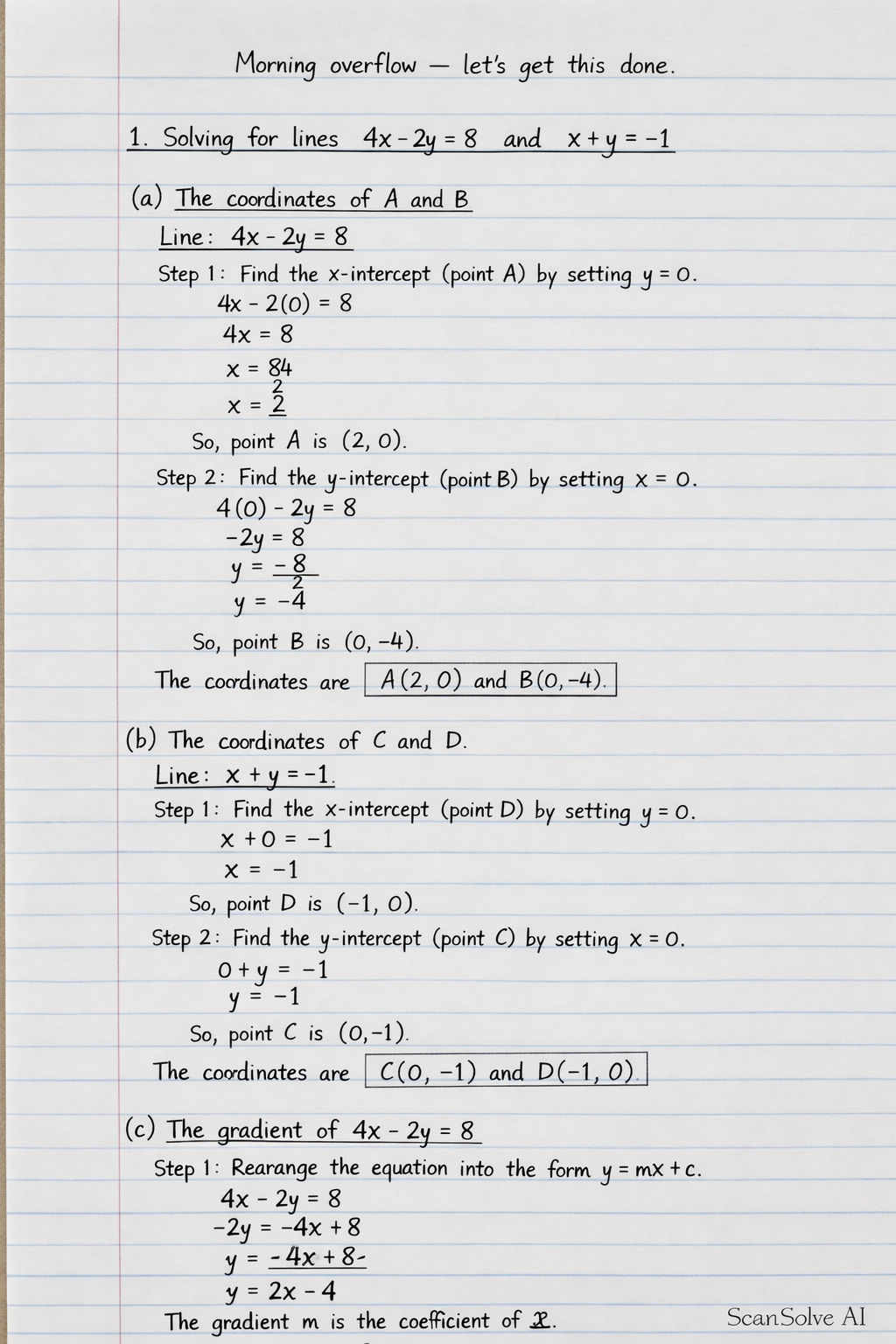
Find the coordinates of the intercepts and the gradients of the lines 4x − 2y = 8 and x + y = -1, and their intersection point E.
ScanSolve AI Answer
Step-by-step solution
14 steps1. Solving for lines and
a) The coordinates of A and B
Line:
Find the x-intercept (point A) by setting .
So, point A is .
Find the y-intercept (point B) by setting .
So, point B is .
The coordinates are .b) The coordinates of C and D
Line:Find the x-intercept (point D) by setting .
So, point D is .
Find the y-intercept (point C) by setting .
So, point C is .
The coordinates are .c) The gradient of
Rearrange the equation into the form .
The gradient is the coefficient of .
The gradient is .d) The gradient of
Rearrange the equation into the form .
The gradient is the coefficient of .
The gradient is .e) The coordinates of E
Point E is the intersection of and .Use substitution or elimination.
From the second equation, .
Substitute this into the first equation:Substitute back into .
The coordinates of E are .
f) The values of x for which the lines are increasing or decreasing
Determine if the gradient of each line is positive or negative.
For , the gradient is 2 (from part c). Since , this line is increasing.
For , the gradient is (from part d). Since , this line is decreasing.
The line is increasing for all values of .
The line is decreasing for all values of .
2. Given: and
a) On the same set of axes, draw neat sketch graphs of the two functions.
To sketch the graphs, we find two points for each line, typically the intercepts.
For :
If , then . Point: .
If , then . Point: .
For :
If , then . Point: .
If , then . Point: .
To draw the sketch, plot these points for each line and connect them. The lines will intersect at the point found in part (b).b) Determine the coordinates of the point of intersection.
We have the system of equations:Subtract equation (2) from equation (1) to eliminate .
Substitute into either equation.
Using equation (1):
The coordinates of the point of intersection are .
3. Determine the equations of the following lines in the form .
The image shows a line passing through and .
The form is equivalent to , where is the gradient and is the y-intercept.Find the gradient using the two points and .
Identify the y-intercept .
The line crosses the y-axis at , so .
Write the equation in the form .
The equation of the line is .
Still stuck on this one?
Ask a follow-up, and the answer starts from this question.
More Mathematics Questions
Handwritten Step-by-Step Solution
Get this as a handwritten image on WhatsApp — like a tutor wrote it for you.
Try on WhatsApp