
We read your photo as:
Create six 3-digit numbers using only the digits 5 and 8. Then, form 3-digit numbers using the digits 9, 5, and 6 exactly once. Finally, use the digits 1, 3, 7, and 9 to form six 4-digit numbers witho
ScanSolve AI Answer
Here are the solutions to the questions:
Q1: Make six 3-digit numbers using 5 and 8.
To form 3-digit numbers using only the digits 5 and 8, one of the digits must be repeated.
-
Step 1: Consider numbers with two 5s and one 8, or two 8s and one 5.
- Numbers with two 5s and one 8: 558, 585, 855
- Numbers with two 8s and one 5: 885, 858, 588
-
Step 2: List six unique 3-digit numbers.
- The six 3-digit numbers are:
Q2: Form 3-digit numbers by using the digits 9, 5, and 6.
To form 3-digit numbers using each of the digits 9, 5, and 6 exactly once, we find all possible permutations.
-
Step 1: Arrange the digits in all possible orders.
- Starting with 9: 956, 965
- Starting with 5: 596, 569
- Starting with 6: 695, 659
-
Step 2: List all the 3-digit numbers formed.
- The 3-digit numbers are:
Q3: Use 1, 3, 7, and 9 to form six 4-digit numbers without repeating any digit.
To form 4-digit numbers using each of the digits 1, 3, 7, and 9 exactly once, we find permutations. We only need to list six of them.
-
Step 1: Arrange the digits in different orders to form unique 4-digit numbers.
- Start with 1: 1379, 1397
- Start with 3: 3179, 3197
- Start with 7: 7139, 7193
-
Step 2: List six unique 4-digit numbers.
- Six 4-digit numbers are:
Still stuck on this one?
Ask a follow-up, and the answer starts from this question.
More Mathematics Questions
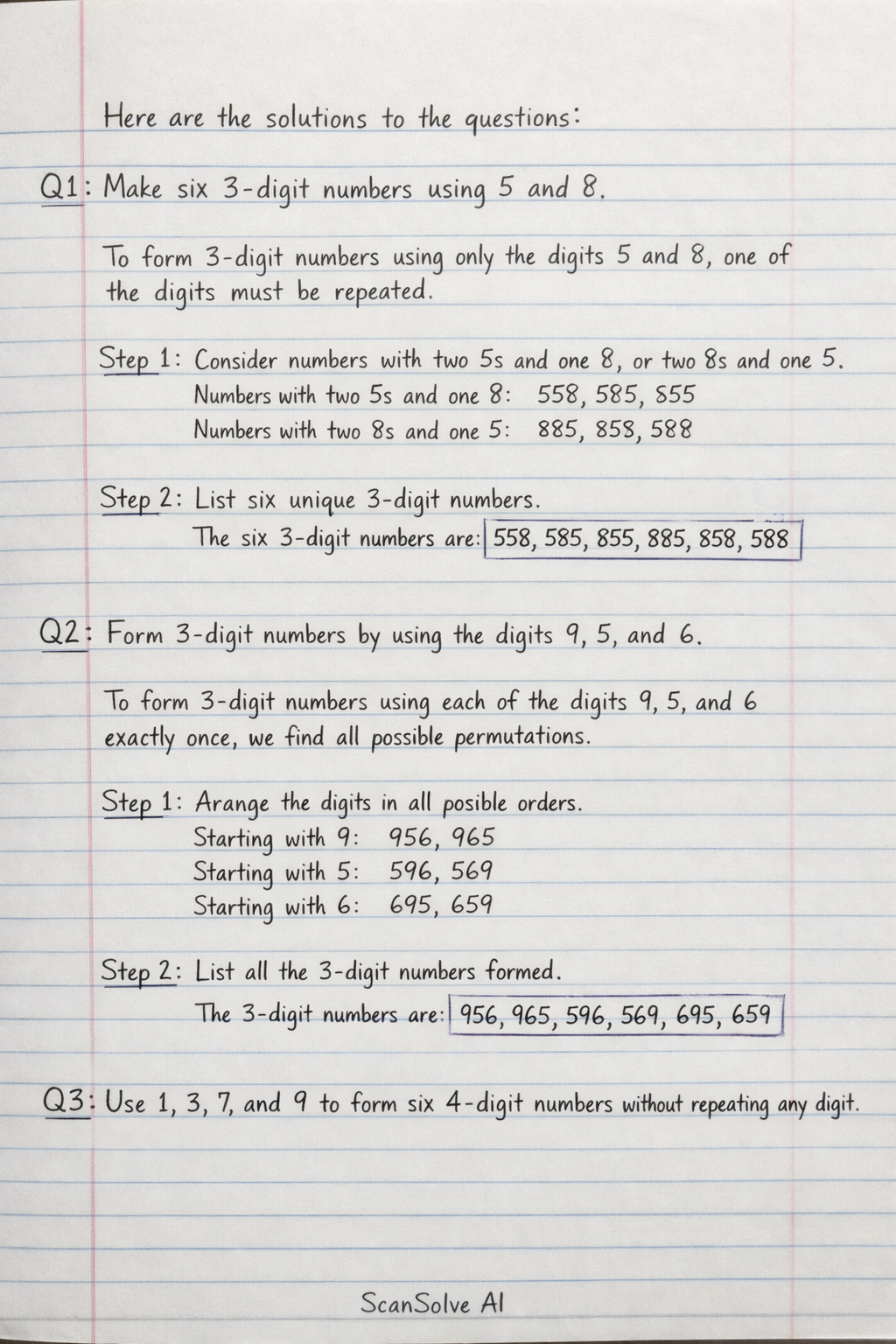
Handwritten Step-by-Step Solution
Get this as a handwritten image on WhatsApp — like a tutor wrote it for you.
Try on WhatsApp