
We read your photo as:
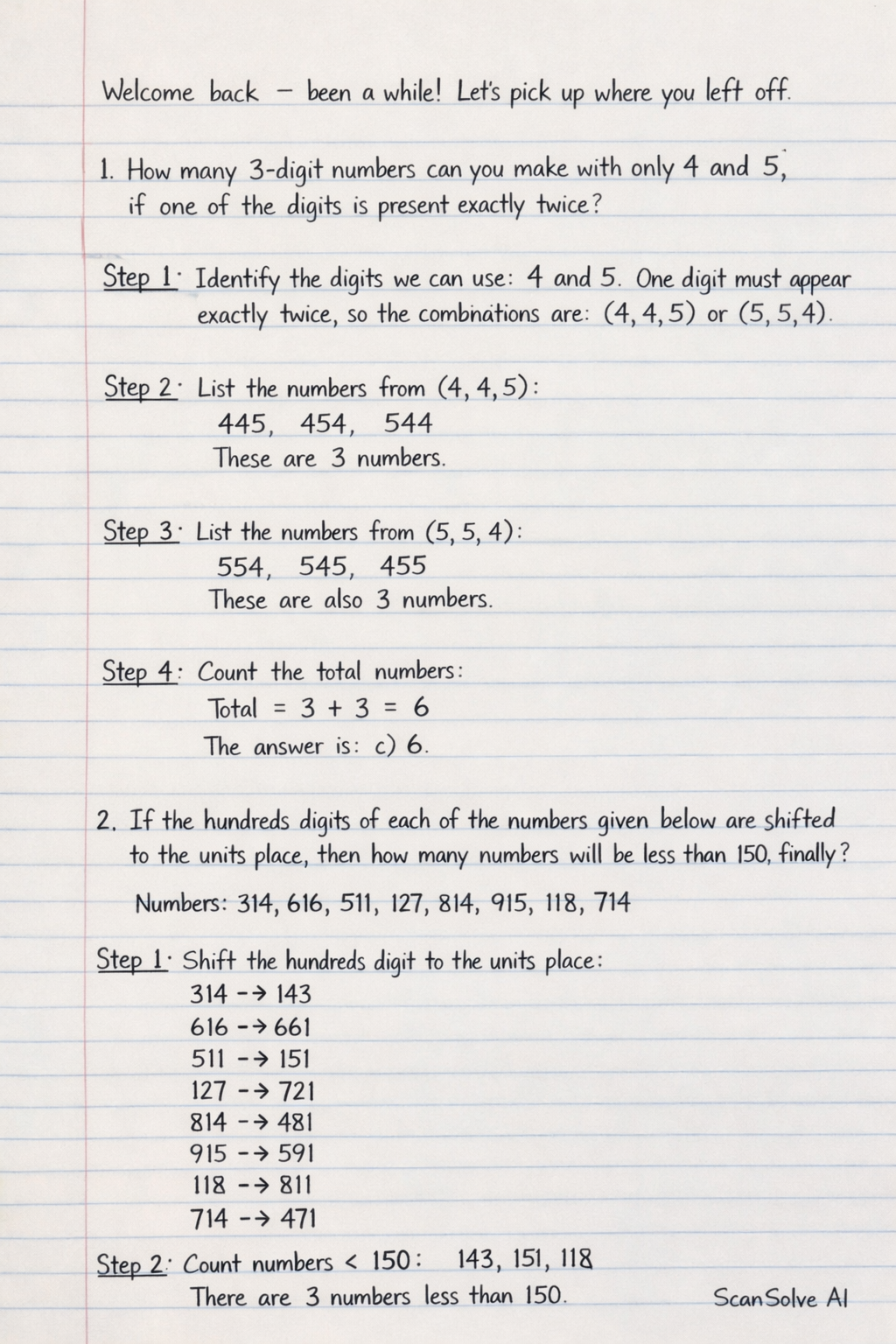
How many 3-digit numbers can you make with only 4 and 5, if one of the digits is present exactly twice?
ScanSolve AI Answer
Step-by-step solution
25 steps1. How many 3-digit numbers can you make with only 4 and 5, if one of the digits is present exactly twice?
उन अंकों की पहचान करें जिनका उपयोग किया जा सकता है। अंक 4 और 5 हैं। एक अंक ठीक दो बार आना चाहिए, जिसका अर्थ है कि दूसरा अंक एक बार आएगा।
संभावित अंक संयोजन हैं: $(4, 4, 5)$ या $(5, 5, 4)$।
संयोजन $(4, 4, 5)$ से बनने वाली संख्याओं को सूचीबद्ध करें।
- 445
- 454
- 544 ये 3 संख्याएँ हैं।
संयोजन $(5, 5, 4)$ से बनने वाली संख्याओं को सूचीबद्ध करें।
- 554
- 545
- 455 ये भी 3 संख्याएँ हैं।
कुल संख्याओं की गणना करें।
कुल संख्याएँ
सही विकल्प है: c) 6
2. If the hundreds digits of each of the numbers given below are shifted to the units place, then how many numbers will be less than 150, finally?
संख्याएँ: 314, 616, 511, 127, 814, 915, 118, 714प्रत्येक संख्या के सैकड़ों अंक को इकाई के स्थान पर स्थानांतरित करें। यदि मूल संख्या है, तो नई संख्या होगी।
- 314 143 (150 से कम)
- 616 166 (150 से कम नहीं)
- 511 115 (150 से कम)
- 127 271 (150 से कम नहीं)
- 814 148 (150 से कम)
- 915 159 (150 से कम नहीं)
- 118 181 (150 से कम नहीं)
- 714 147 (150 से कम)
उन नई संख्याओं की गणना करें जो 150 से कम हैं।
143, 115, 148, 147
कुल 4 संख्याएँ हैं।सही विकल्प है: b) 4
3. What is the difference between the largest and the second largest three-digit numbers formed using the digits 0, 3, and 1 such that no digit is repeated within a number?
दिए गए अंकों (0, 3, 1) का उपयोग करके सबसे बड़ी 3-अंकीय संख्या बनाएँ, जिसमें कोई अंक दोहराया न जाए।
सबसे बड़ी संख्या बनाने के लिए, सबसे बड़े अंक को सैकड़ों के स्थान पर, अगले सबसे बड़े को दहाई के स्थान पर और सबसे छोटे को इकाई के स्थान पर रखें।
अंक 3, 1, 0 हैं।
सबसे बड़ी संख्या: 310दिए गए अंकों (0, 3, 1) का उपयोग करके दूसरी सबसे बड़ी 3-अंकीय संख्या बनाएँ, जिसमें कोई अंक दोहराया न जाए।
सबसे बड़ी संख्याएँ अवरोही क्रम में:
- 310
- 301
- 130
- 103 दूसरी सबसे बड़ी संख्या: 301
सबसे बड़ी और दूसरी सबसे बड़ी संख्या के बीच का अंतर ज्ञात करें।
अंतर
सही विकल्प है: d) 9
4. Find the odd one out.
a) Thirty-Two tens and two ones
b) Three hundreds and Twelve ones
c) Three hundred and twenty-two
d) Three hundreds, two tens and two ones
प्रत्येक विकल्प को संख्यात्मक मान में परिवर्तित करें।
a) Thirty-Two tens and two ones
b) Three hundreds and Twelve ones
c) Three hundred and twenty-two
d) Three hundreds, two tens and two ones
विषम विकल्प की पहचान करें।
विकल्प a, c, और d सभी 322 का प्रतिनिधित्व करते हैं। विकल्प b 312 का प्रतिनिधित्व करता है।
इसलिए, विकल्प b विषम है।सही विकल्प है: b) Three hundreds and Twelve ones
5. In a 3-digit number, the digit in the units place is twice the digit in the hundreds place. What could be the lowest possible value of the sum of the digits?
3-अंकीय संख्या के अंकों को (सैकड़ों), (दहाई), और (इकाई) मान लें।
दी गई शर्त है कि इकाई का अंक सैकड़ों के अंक का दोगुना है: ।
और के संभावित मान निर्धारित करें।
चूंकि एक 3-अंकीय संख्या का सैकड़ों का अंक है, ।
चूंकि एक अंक है, ।
इसलिए, ।
के संभावित मान हैं।
तदनुसार के मान होंगे।अंकों के योग () का न्यूनतम संभव मान ज्ञात करें।
योग को न्यूनतम करने के लिए, हमें , , और को न्यूनतम करना होगा।
का सबसे छोटा संभव मान 1 है, जिससे मिलता है।
का सबसे छोटा संभव मान 0 है।
तो, अंकों का निरपेक्ष न्यूनतम योग है।दिए गए विकल्पों में से सबसे छोटा संभव मान चुनें।
विकल्प हैं a) 0, b) 2, c) 4, d) 5।
- 0 संभव नहीं है क्योंकि ।
- 2 संभव नहीं है क्योंकि के साथ, , जो असंभव है।
- 4 संभव है। यदि , तो । संख्या 112 होगी, और अंकों का योग है।
- 5 संभव है। यदि , तो । संख्या 122 होगी, और अंकों का योग है। दिए गए विकल्पों में से, सबसे छोटा संभव योग 4 है।
सही विकल्प है: c) 4
6. I am given a number 435. If the first (hundreds) and third (units) digits of this number are interchanged, then the new number will be ______ the original number.
मूल संख्या की पहचान करें।
मूल संख्या
सैकड़ों और इकाई के अंकों को आपस में बदलें।
सैकड़ों का अंक 4 है और इकाई का अंक 5 है।
अंकों को बदलने पर नई संख्या 534 होगी।नई संख्या की मूल संख्या से तुलना करें।
नई संख्या मूल संख्या से बड़ी है।सही विकल्प है: c) greater than
7. Nishit remembers that his friend Shreya's score is more than 160 but less than 190, whereas their friend Nitigya remembers that Shreya's score is more than 170 but less than 200. If Nishit and Nitigya both remember correctly, and the units place of Shreya's score is 0, what is her score?
निशित की याददाश्त से स्कोर की सीमा निर्धारित करें।
नितिग्या की याददाश्त से स्कोर की सीमा निर्धारित करें।
दोनों की याददाश्त को मिलाकर स्कोर की संयुक्त सीमा ज्ञात करें।
स्कोर 170 से अधिक होना चाहिए (क्योंकि यह 160 से अधिक और 170 से अधिक दोनों है)।
स्कोर 190 से कम होना चाहिए (क्योंकि यह 190 से कम और 200 से कम दोनों है)।
तो, संयुक्त सीमा है:इकाई के स्थान पर 0 वाले स्कोर को पहचानें।
170 और 190 के बीच, इकाई के स्थान पर 0 वाला एकमात्र अंक 180 है।
इसलिए, श्रेया का स्कोर 180 है।सही विकल्प है: d) 180
8. Lalit has 3 marbles and 3 boxes, where each box represents a place value, as labelled. He places the marbles into the boxes to form a number. For example, in the image shown below, the number 120 is formed. How many different numbers can Lalit form if he uses all 3 marbles every time to make a number?
समस्या को समझें। ललित के पास 3 कंचे हैं और 3 बक्से (सैकड़ों, दहाई, इकाई) हैं। उसे सभी 3 कंचों का उपयोग करके संख्याएँ बनानी हैं।
यह 3 समान वस्तुओं को 3 अलग-अलग बक्सों में वितरित करने की समस्या है।
सभी संभावित वितरणों को सूचीबद्ध करें।
मान लें कि सैकड़ों के बक्से में कंचे हैं, दहाई के बक्से में कंचे हैं, और इकाई के बक्से में कंचे हैं।
शर्त है: , जहाँ पूर्णांक हैं।
संभावित संयोजन (सैकड़ों, दहाई, इकाई) और उनसे बनने वाली संख्याएँ:- (उदाहरण में दिया गया)
विभिन्न संख्याओं की कुल संख्या की गणना करें।
कुल 10 अलग-अलग संख्याएँ बनाई जा सकती हैं।
सही विकल्प है: c) 10
Still stuck on this one?
Ask a follow-up, and the answer starts from this question.
More Mathematics Questions
Handwritten Step-by-Step Solution
Get this as a handwritten image on WhatsApp — like a tutor wrote it for you.
Try on WhatsApp